GEV -0.57% CAT -0.66% NVDA -1.43% Explore stocks on Coinbase Trading disclosure Trading disclosure The above button links to Coinbase. Yahoo Finance is not a broker-dealer or investment adviser and does not offer securities or cryptocurrencies for sale or facilitate trading. Coinbase pays us for certain activity generated through this link. Prices displayed are informational.
Technology companies are investing massively in artificial intelligence (AI) infrastructure, and analysts expect AI capital expenditures to reach $800 billion this year. This is driving huge sales for computing, power, cooling, and other related infrastructure needs for these next-generation data centers.
Those investments don't seem likely to slow down anytime soon. According to Goldman Sachs, hyperscaler capital investments could reach $1.7 trillion by 2027 and $2.1 trillion by 2029. Demand for industrial companies offering power solutions has surged. As a result, GE Vernova (NYSE: GEV) and Caterpillar (NYSE: CAT) have been two standout stocks in recent years.
Missed Nvidia in 2009? This Rare Signal Is Flashing Again. In 2009, a "Double Down" signal flashed for a little-known chipmaker called Nvidia. For the first time in years, that same "Total Conviction" signal is flashing for a company 1/100th the size of Nvidia. Continue »
Both companies benefit from surging demand for power from hyperscalers. But in the AI power building boom, GE Vernova has greater exposure. This can be good or bad, depending on investors' expectations for future AI spending. Here are the key differences between the two businesses.
GE Vernova supplies power infrastructure, and its equipment helps provide roughly 25% of the world's electricity. The company's equipment and services can be found across the electricity and power value chain, including generation, transmission, conversion, and storage. Its business is split into three distinct segments: power, electrification, and wind.
Specifically, it's seeing robust demand for its power-generation equipment, including heavy-duty gas turbines and aeroderivative gas turbines. The latter appeal to data center operators because they can be delivered in as little as six months and provide bridge power while operators wait for grid hookups or larger power-generating equipment.
The company is also seeing demand from utilities for its large-scale HA gas turbines, which can provide multiple gigawatts of power. Strong orders for its substation and transmission infrastructure have been driving earnings as well. In the first half of 2026, data center orders in its electrification segment doubled to $5 billion.
In total, GE Vernova's backlog has surged to $176 billion, measured in remaining performance obligations. Its equipment backlog is nearly $112 billion in its power segment and $44 billion in electrification, split evenly between equipment and services. Roughly 20% of the company's 116 gigawatts in contracted gas equipment is for data center customers, with the remainder going to traditional utility customers.
Caterpillar's business is split between construction and mining equipment on one side, and power and energy on the other.
Data centers need large, redundant backup power equipment to keep AI training and inference workloads running; otherwise, downtime can cost hyperscalers huge amounts of dollars and lost time. Data center operators are driving strong demand for Caterpillar's standby and backup power systems. Diesel generator order backlogs stretch into 2028.
The company's backlog stands at $72 billion, with power-generation sales surging 72% from last year. Order backlogs for its gas turbine equipment stretch to 2030. Demand is so robust that management has also restarted production of its 10-megawatt medium-speed gas reciprocating engine platform, which it discontinued in 2022. Caterpillar is bringing 1.5 gigawatts of capacity online and will begin delivering equipment in the fourth quarter.
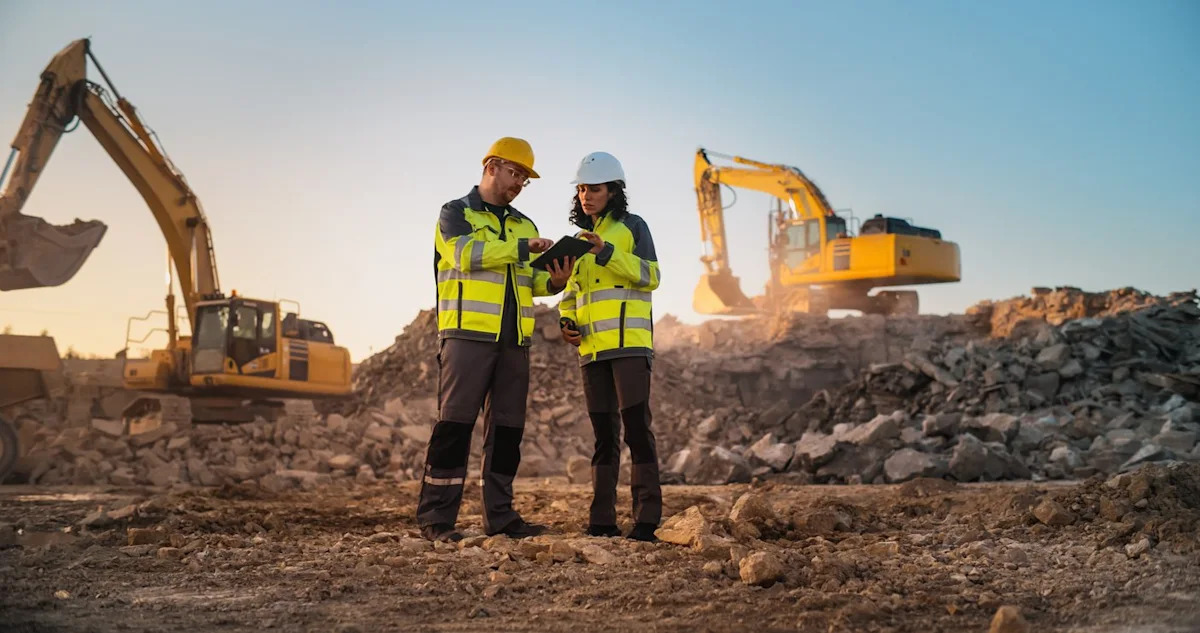
The company also benefits from the actual construction and site development for data centers. It provides the equipment needed to prepare construction sites, including excavation, grading, and foundation work.
Both companies are becoming closely tied to the AI-themed trade, and their stocks have become significantly more volatile as a result. Since the start of 2024, GE Vernova is up 596% while Caterpillar is up 149%. That volatility has cut both ways, as each stock is down 23% and 32%, respectively, from its 52-week high.
These are two pick-and-shovel stocks benefiting from huge hyperscaler spending. For those seeking more exposure to data center orders, GE Vernova's growth is driven largely by this, whereas Caterpillar's business is more diversified, with exposure to construction, mining, and other equipment.
Before you buy stock in GE Vernova, consider this:
The Motley Fool Stock Advisor analyst team just identified what they believe are the 10 best stocks for investors to buy now… and GE Vernova wasn't one of them. The 10 stocks that made the cut could produce monster returns in the coming years.
Consider when Netflix made this list on December 17, 2004... if you invested $1,000 at the time of our recommendation, you'd have $380,363!* Or when Nvidia made this list on April 15, 2005... if you invested $1,000 at the time of our recommendation, you'd have $1,315,732!*
Now, it's worth noting Stock Advisor's total average return is 919% — a market-crushing outperformance compared to 211% for the S&P 500. Don't miss the latest top 10 list, available with Stock Advisor, and join an investing community built by individual investors for individual investors.
*Stock Advisor returns as of October 18, 2026.
Courtney Carlsen has positions in GE Vernova and Goldman Sachs Group. The Motley Fool has positions in and recommends Caterpillar, GE Vernova, and Goldman Sachs Group. The Motley Fool has a disclosure policy.
GE Vernova vs. Caterpillar: Which Has More Exposure to the AI Power Build-Out? was originally published by The Motley Fool