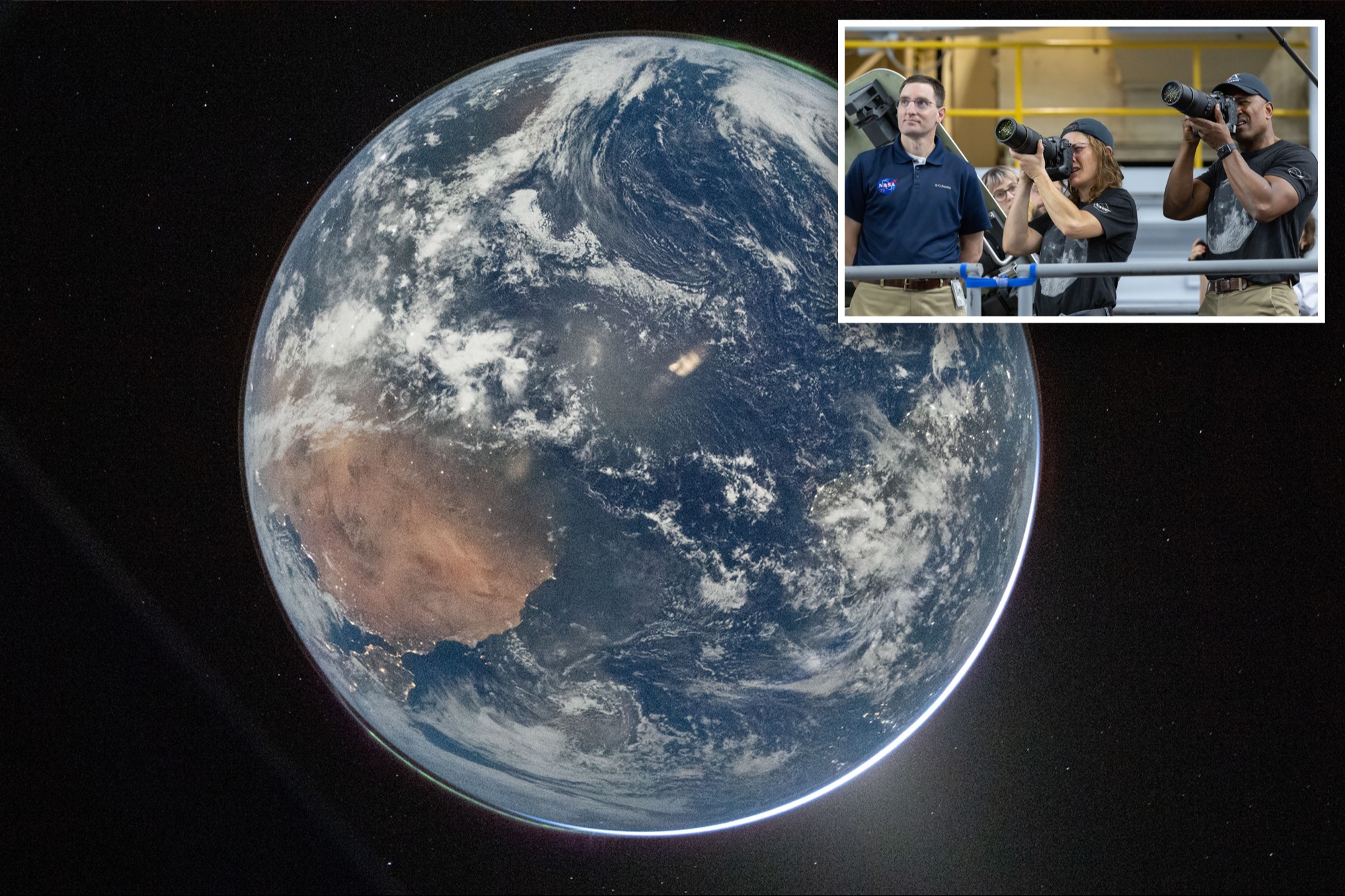
The Artemis II astronauts were filmed struggling to walk after experiencing Earth’s gravity again following their historic mission to the moon.
The intrepid quartet — comprised of astronauts comprised of Reid Wiseman, Victor Glover and Christina Koch and Canadian astronaut Jeremy Hansen — had reentered Earth’s atmosphere at a peak velocity of nearly 25,000 miles per hour.
The capsule then splashed down at a gentle 19mph in the Pacific Ocean off San Diego precisely at 8:07 p.m. ET.
NASA dubbed the Artemis II mission a resounding success, adding that the crew had hit a “perfect bullseye” during their landing.
The crew were then retrieved from the Orion crew module and flown via helicopter to the USS John P Murtha — and amphibious Navy dock ship — where the history-making space voyagers were met by cheering crowds.
However, as the courageous explorers exited the chopper and made their way across the deck, it was apparent that they were experiencing some locomotive difficulties due to their 9-day stint in microgravity.
As the footage showed, all four team members had to be supported by an aid on each side. All the while, a third assistant pushed a wheelchair behind them in case any of the crewmembers suddenly became weak in the knees.
Thankfully, the astronauts were able to make their post space-walk sans wheelchair assistance. One even strode across the platform unaided, waving triumphantly at employees aboard the vessel — not too shoddy given they literally went to the moon and back. NASA said they were in “excellent shape” following their arrival back on Earth.
Meanwhile, commander Reid Wiseman reported that all four crewmembers were “stable” and “green,” indicating they were in good shape, CNN reported.
Extended stints in microgravity can cause a host of issues during and following the return.
These include inner-ear balance problems, nausea, immune system issues, sleep disturbances and vision problems because microgravity causes blood to pool in the head, affecting the optic nerve.
Weightlessness in space can also induce major mass loss. After just two weeks, muscle mass can plummet by 20% while astronauts lose up to 2% of their bone density per month because their body no longer requires skeletal support in the microgravity environment.
In general, the longer astronauts spend in space the more susceptible they are to gravity-related ailments.
Thankfully, the Artemis II crew shouldn’t experience too many issues as they were only in space for ten days.
The crew is currently slated to undergo an “obstacle course” — involving climbing and ladder and other tests — to gauge well they adjust to Earth’s gravity and also gather data for future space forays.
This latest celestial saga marked the first time humans had seen the moon up close since Apollo 17 left it in 1972.
During the historic jaunt, the spacecraft soared 252,756 miles from Earth on Monday, shattering the 248,655-mile record set by Apollo 13 nearly 56 years ago to the date in 1970.
“I’m still at a loss for words,” said NASA Administrator Jared Isaacman while perched on Murtha. “I mean, you know, like the childhood Jared right now, can’t believe what I just saw.”
He added, “I mean, almost been waiting my whole lifetime to see this, and then as NASA administrator, I just couldn’t be more proud of the entire workforce, the years, the effort, the late nights, all that contributed to this incredible moment.”
NASA will now focus on reviewing data from the Artemis II mission, before concocting plans for Artemis III, which, much like the recent mission, will entail a lunar fly-by but no landing.
The potential moon landing will occur in 2028 with the Artemis IV, per their plans.
During that mission, astronauts will also help lay the foundation for a permanent moon base, which will act as a jumping off point for future space missions, including one to Mars.