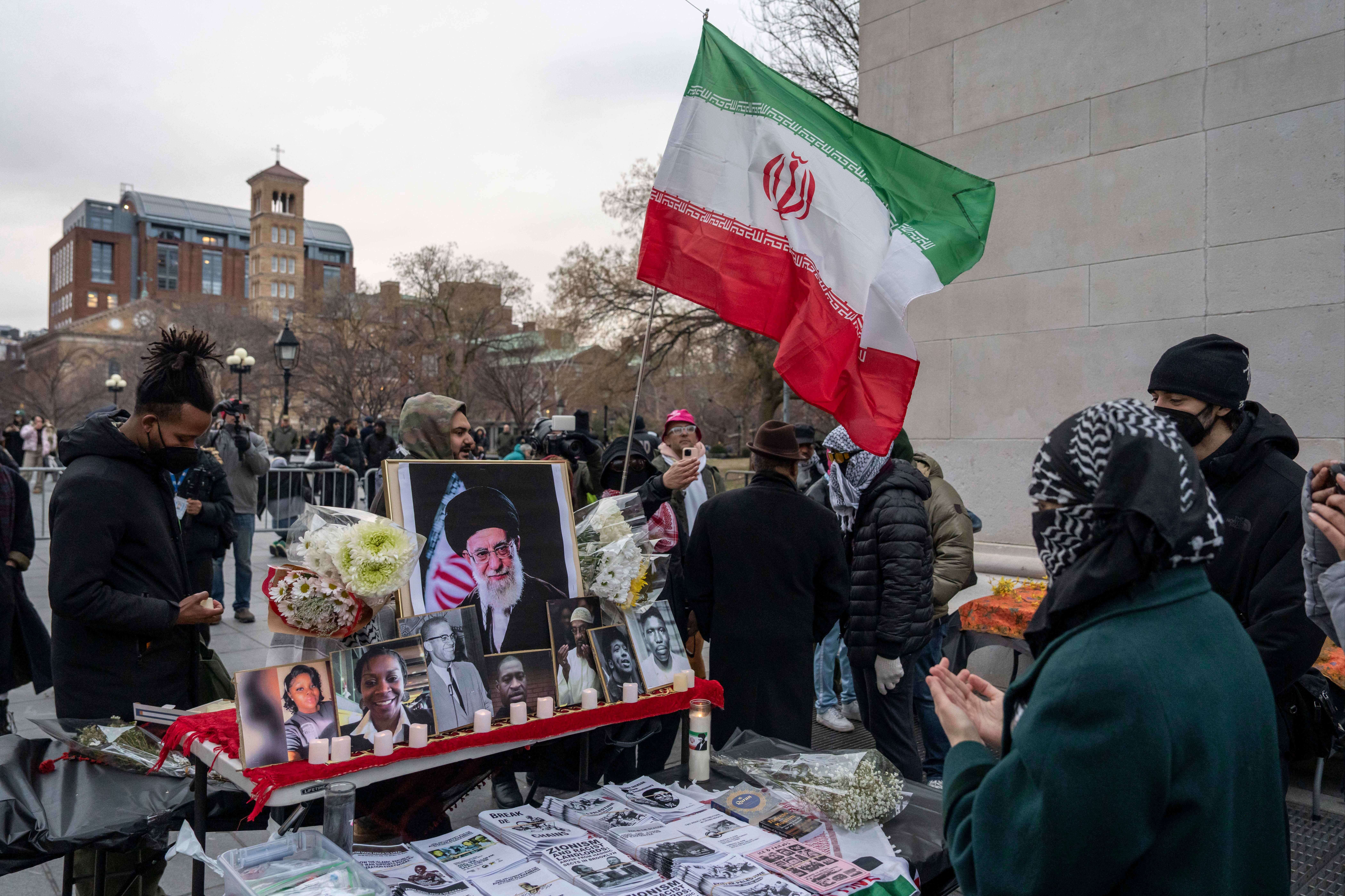
A demonstrator prays during a vigil for the late Iran's Supreme Leader Ayatollah Ali Khamenei in New York, Friday, March 6, 2026. AP When Iran’s Ayatollah Ali Khamenei was killed under American and Israeli bombardment last month, a few dozen activists gathered in New York to mourn him.
Cameras outnumbered candles — yet the moment generated nearly 19 million views on X and led broadcasts on CBS, ABC and Fox News.
The gap between who showed up and who was watching is the whole story.
The Network Contagion Research Institute spent months mapping the pipeline behind moments like this.
At its center is Press TV, an Iranian state broadcaster under US Treasury sanctions.
Records show Press TV contacted two American activist groups — the United National Antiwar Coalition and the Workers World Party — more than 260 times over three years, with messages spiking reliably before major protests.
The Khamenei vigil was not a spontaneous expression of American sentiment, but a manufactured media event.
This network doesn’t operate like traditional propaganda — it functions more like a switchboard.
Small, fringe events are routed through aligned activists, picked up by state-linked media, then amplified across Western platforms, making them appear far larger and more representative than they are.
In practice, it operates as a kind of “BS factory,” taking minor demonstrations and mass-producing the illusion of widespread American support.
The goal is not persuasion in the traditional sense.
It is distortion, meant to make Americans question their own judgment.
Survey research conducted with Rutgers University finds that roughly one in five Americans now rate the human-rights records of countries like Iran, China and North Korea as equal to or better than those of Western democracies.
That doesn’t reflect skepticism, but something deeper — a breakdown in moral calibration.
Researchers call this phenomenon moral inversion, and Americans have seen it before.
During the Cold War, Soviet intelligence services ran active-measures campaigns designed to do exactly this.
They amplified America’s failures and stripped away context to collapse the distinction between democratic societies and authoritarian regimes in Western minds.
One widely circulated narrative falsely claimed that the United States invented the AIDS virus as a tool of oppression.
Others portrayed the Soviet system as a moral counterweight to Western imperialism.
The objective was not to convince Americans that the Soviet Union was good, but to convince them that all systems were equally corrupt.
Today’s adversaries, including Iran, China and Russia, have refined that strategy for the social-media era.
Instead of broadcasting a single narrative, they seed dozens.
Claims that Western institutions are inherently oppressive.
Claims that authoritarian states are misunderstood or unfairly maligned.
Their power comes from selective framing, presenting real flaws without context until the entire system appears illegitimate.
Activist groups, influencers and online communities pick them up, often sincerely, and carry them further.
This network does not operate in isolation: It overlaps with a broader activist ecosystem that extends beyond Iran.
Individuals inside this same protest infrastructure are connected to groups like Code Pink.
Its co-founder, Medea Benjamin, appears in Press TV call records as one of a small cluster of American activists receiving repeated direct contacts, part of a network that collectively received hundreds of outreach calls over a multi-year period.
Benjamin has traveled to Tehran, appeared in Iranian state-linked settings, and published a recent book portraying China in sharply favorable terms.
This is not fringe activity, but a case study in how foreign narratives move through American networks.
The result is a population that struggles to distinguish between imperfect democracies and repressive regimes.
The people caught in these pipelines do not see themselves as foreign assets.
The same narratives promoted by state media outlets in Tehran, Moscow and Beijing reliably surface inside American discourse, often amplified by individuals who would reject any direct association with those regimes.
Foreign adversaries no longer need to convince Americans to adopt their worldview.
They only need to erode Americans’ confidence in their own.
A country that cannot distinguish its own record from North Korea’s has lost more than perspective — it’s lost the ability to defend itself at all.
Shawn Chenoweth is the director of cognitive advantage at the National Security Council. Joel Finkelstein is co-founder and chief science officer of the Network Contagion Research Institute.