Hungary's election on April 12 is the most important for the state since 1989, and also of historic significance for the EU. DW takes a more detailed look.
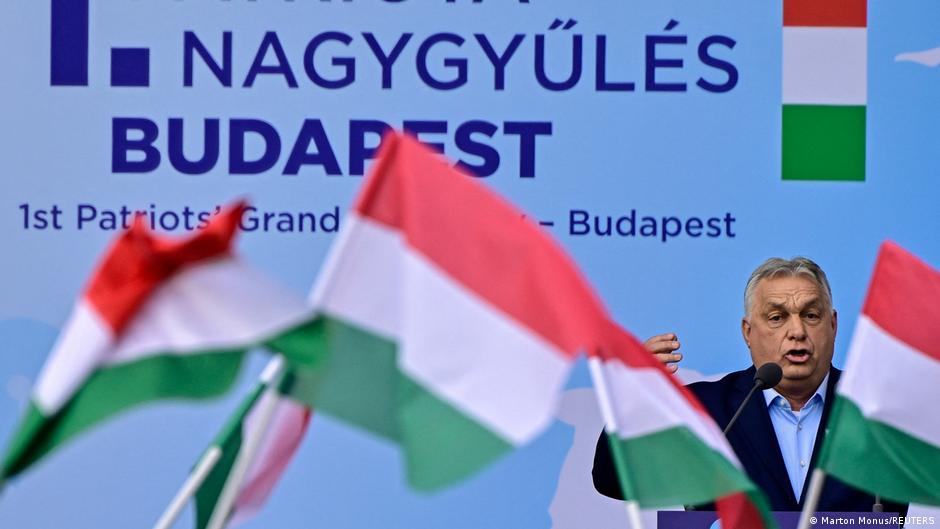
https://p.dw.com/p/5BvHpOrban's regime is a model for nationalists around the world Image: Marton Monus/REUTERSAdvertisementOn April 12, Hungary faces its most decisive parliamentary election since Hungary's communist regime stepped down voluntarily in 1989/90. The question is whether Hungarian Prime Minister Viktor Orban and his government can be voted out of office or not. For the first time since 2010, there is a real possibility that an opposition party — the conservative Tisza party led by Orban's main challenger, Peter Magyar – could win.
In Hungary, the election is being viewed as a significant moment in the country's modern history. It could also determine both the future of the European Union and play a role in how much Russia can influence the bloc in future.
After his first election win with a two-thirds majority in the spring of 2010, Orban announced a System of National Cooperation (NER) and orchestrated a shake-up of the elite in the state, administrative and judicial apparatus, as well as the civil service, filling key positions with his loyalists. Hungary has since been transformed into an ultra-centralized state.
Orban has also weakened the system of checks and balances and thus the possibilities of countering power. Most of the print and audiovisual media outlets have been brought under government control, either directly or indirectly through companies and foundations affiliated with Orban's party Fidesz; the autonomy of universities has been dismantled; and a significant portion of state and public assets has been placed under the control of foundations affiliated with Orban. Experts describe Hungary today as a "hybrid system” located between democracy and dictatorship.
Orban's economic and tax policies have favored his upper-middle-class base but the financial situation of many other Hungarians has deteriorated in recent years, as has public infrastructure, healthcare and education. There is widespread dissatisfaction with state corruption and blatant cases of illegal self-enrichment. Many Hungarians are also tired of the atmosphere of verbal civil war that Orban has created, such as with his portrayal of Ukraine as the "villain" in the war with Russia, or the constant vilification of his critics as enemies and "traitors to the fatherland."
Orban's stated goal is to "conquer Brussels" and to transform the EU into a confederation of politically sovereign nation states that share common economic interests. Hungary's prime minister has railed against the bloc for years and, through his vetoes and refusal to support key decisions regarding the EU and foreign policy, has at times rendered it effectively incapable of acting. Another win for Orban would further weaken the EU, while a change of power in the Hungarian capital Budapest would contribute to strengthening the bloc again.
No other EU member state has such close ties to Russia as Orban's Hungary. Though he has approved most of the bloc's sanctions against Russia following its annexation of Crimea in 2014, since its full-scale invasion of Ukraine in 2022 he has repeatedly called for them to be lifted while pushing through exemptions and blocking support for Ukraine as much as possible. In doing so, he has weakened the EU — a stated common goal of both Orban and Russian President Vladimir Putin. Orban's defeat at the polls would constitute a serious blow to Russia.
After the 2010 election, Fidesz started pushing through major electoral reforms that placed greater emphasis on the first-past-the-post system, which gave the party a significant head start that persists to this day. Of 199 lawmakers, 106 are elected in single-member districts by a simple majority. Constituencies loyal to Fidesz tend to be smaller, meaning fewer votes are needed to elect a representative there. In the last election in 2022, Orban's party received about 53% of the vote but won a larger percentage of constituencies, thereby securing just under 68% of the seats in parliament — an absolute majority.
Ethnic Hungarians who live in Hungary's neighboring countries and hold Hungarian citizenship are permitted to vote for party lists and participate via absentee ballot. However, Hungarians in western European countries who tend to be critical of Orban can only vote at embassies and consulates in those states, but not via absentee ballot.
Hungarian election experts argue that the voting system is unfair, but few believe that there will be any vote rigging in the upcoming election. Some have said that there is some potential for fraud in the postal voting system and that the votes of ethnic Hungarians in neighboring countries could secure Orban one or two extra seats. All this means it will be hard to bring about a change of government but not impossible.
Hungarian election analysts are certain that an absolute majority of voters in Hungary want a change in government. For over a year, independent polling firms have predicted a lead — in some cases a significant one — for the Tisza party over Fidesz. However, these figures only partially reflect the electoral prospects of the individual candidates in each constituency. These polls do not wholly take into account Fidesz's voter base, which comprises primarily older adults and retirees in small towns and villages. Therefore, the poll predictions could be inaccurate. Most election analysts, however, expect Orban to be voted out of office.
Vance targets EU while campaigning for Orban in HungaryTo view this video please enable JavaScript, and consider upgrading to a web browser that supports HTML5 video
The main goals and objectives of Peter Magyar and his Tisza party are for Hungary to distance itself from Russia and become a reliable ally of the EU and NATO again. However, with regard to migration and Ukraine, Magyar intends to continue Hungary's current approach, at least partly, but without entering into total confrontation within the EU.
On the domestic front, Magyar has announced a crackdown on corruption and a "systemic overhaul," which would entail a introducing a fairer electoral system, limiting the prime minister's term to two electoral cycles, and writing up a new constitution. Orban and other high-ranking politicians in his inner circle could face charges of corruption and high treason.
Orban has not yet answered this question directly. He has merely said that he has sometimes won elections and sometimes lost them, and that Hungary is a democracy.
If Orban claims victory, mass demonstrations are likely, and violent clashes are also conceivable, as anger and hatred toward the Orban regime are now widespread. If Orban does lose, whether his supporters take to the streets end masse or not will likely depend on his attitude.
Orban has taken numerous precautions to avoid losing power. Many changes to his system require a two-thirds parliamentary majority, and many key positions have been filled for years to come. Thus, his own "deep state" could easily sabotage a government that only enjoys a simple majority. And even with a two-thirds majority, it could take years for Tisza to completely overhaul the Orban system.
Hungary: Europe or an authoritarian path?To view this video please enable JavaScript, and consider upgrading to a web browser that supports HTML5 video
This article was translated from German.