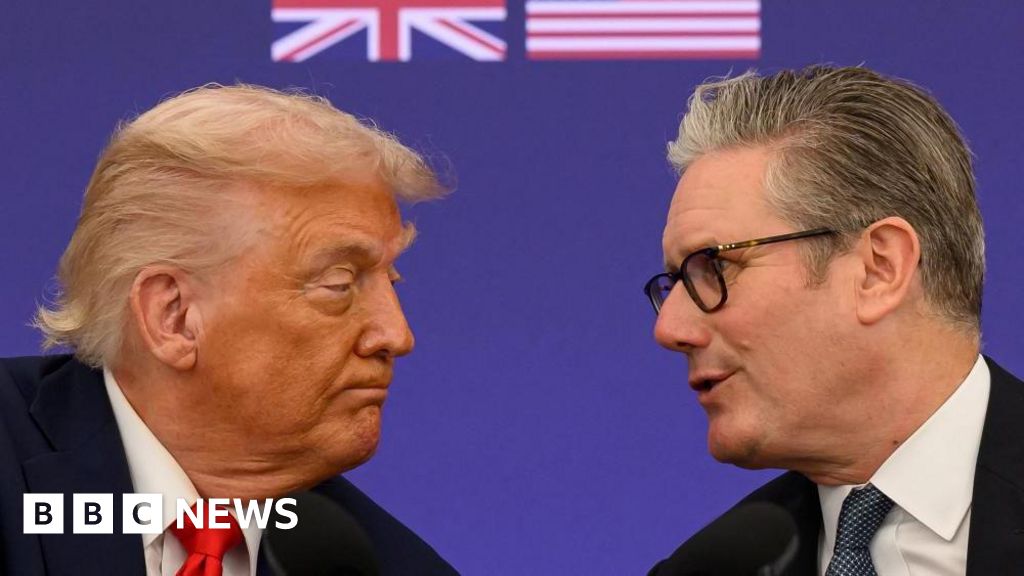
ShareSaveAdd as preferred on GoogleJoe PikePolitics correspondentReutersIt was always an unlikely political bromance: the camera-loving, right-wing businessman hitting it off with a restrained, left-wing London lawyer.
Cupid's arrow struck during a two-hour dinner at Trump Tower in September 2024. Five months later in the Oval Office, Starmer whipped out an invitation from the King. The president almost purred.
The strength of that initial Trump-Starmer relationship was both a surprise, and a rare example of a clear success for the PM amid a domestically difficult first year in office.
Starmer's team regularly declared that their carefully-planned charm offensive had worked. And their proof was the UK's superior trading relationship with Washington.
Yet the disintegration of that same friendship in recent weeks also has benefits. And the prime minister is getting steadily more comfortable at taking advantage.
The old Downing Street tactic whenever jaws dropped at a headline-grabbing declaration from the White House was to say: "We're not getting involved" or "what's there to gain?".
The UK government carefully voiced policy differences with the US on trade wars, recognition of Palestine or the future of Greenland. But in those interventions, they normally played the policy, not the president.
Everything changed when Trump and Starmer disagreed over the use of UK military bases in the Iran War.
Ever since we have witnessed a flurry of invective from the president: declaring Starmer was "no Winston Churchill", retweeting a mocking TV sketch about him and even impersonating the PM's voice at a news conference.
If that's what Donald Trump is doing in public, we can only wonder about the tone of their regular phone calls in private.
Downing Street's anodyne summaries ("readouts" in the government slang) give nothing away and Whitehall officials remain largely tight-lipped. Perhaps we will have to wait for Sir Keir's inevitable post-premiership autobiography for the unvarnished truth.
The PM believes these insults are part of an effort to apply pressure and get him to change his mind. He has insisted it will not succeed.
Those who have left the government are more honest - and sometimes damning - about transatlantic relations. Ben Judah, who advised David Lammy as foreign secretary and accompanied him to the White House wrote this week that the US "no longer only cooperates with us as allies but coerces us as vassals".
He wrote of experiencing "the realisation that our closest ally, the superpower we had built our entire security around, had become erratic, emotional and unpredictable."
Richard Shirreff, a British former Nato commander, described the US as "an ally that is behaving more as a predator".
Few still working in the UK government would be as honest but the prime minister is changing his approach, albeit relatively subtly.
This week he admitted to ITV News that he was "fed up with the fact that families across the country see their bills go up and down... because of the actions of Putin or Trump".
But the next day he avoided repeating those comments when questioned by a journalist.
"We still understand the relationship is still very important", explained an ally of the PM. "That's why he's not deliberately going out of his way to blow it up. He's been measured and calm, not creating drama and throwing out insults."
Sir Keir's comments followed Rachel Reeves saying she was angry at Trump's decision to launch military action. The chancellor said the war is "causing real hardship for people now",
Government officials admit the uniting theme here is their central campaign issue: the cost of living. Ministers understand voters' frustrations at rising petrol and diesel prices and the government needs to distance itself from the causes of those economic shocks.
With difficult elections looming on 7 May, the Iran crisis offers a political opportunity. Sir Keir has largely avoided the campaign trail, instead using the advantage of his position to try and look like a leader: convening a meeting of business leaders, chairing an emergency Cobra, hosting a news conference and touring the Gulf.
His team sees his record on Iran as strong, and they want him to keep talking about it. "He might not have got [the decision] quite right on farmers' inheritance tax", admits one in government. "But the Iran decision really mattered. And he called it absolutely right."
This ongoing international crisis also makes any mooted Labour leadership challenge far trickier for the PM's internal enemies.
Some former British diplomats believe the Trump-Starmer relationship is irreparable, even if Trump famously changes his mind. In JD Vance he appointed a vice-president who once said he was a "Never Trump guy" and with Marco Rubio a secretary of state who once called him a "con artist".
Starmer's advisers remain reasonably optimistic about the leaders' ability to work together: "They still have a relationship. It's in both countries' interests to work together", a source said. But none deny the strains.
UK-US military and intelligence cooperation will continue, but government sources point to increased British defence spending, a closer relationship with the EU and a push towards energy independence as evidence their wider approach is changing.
King Charles is likely to attempt a delicate repair job during his trip to Washington later this month, but for now Whitehall officials admit the president's unpredictability will continue. One admitted, with a sigh: "We all sit there every night to see what the next tweet is".