play Live Sign upShow navigation menuplay Live Click here to searchsearchSign upFeatures|Israel-Palestine conflictIsraeli settlers turn Passover into celebration of ethnic cleansingPalestinians displaced by settler violence confront loss of community as settlers celebrate their forced expulsions.
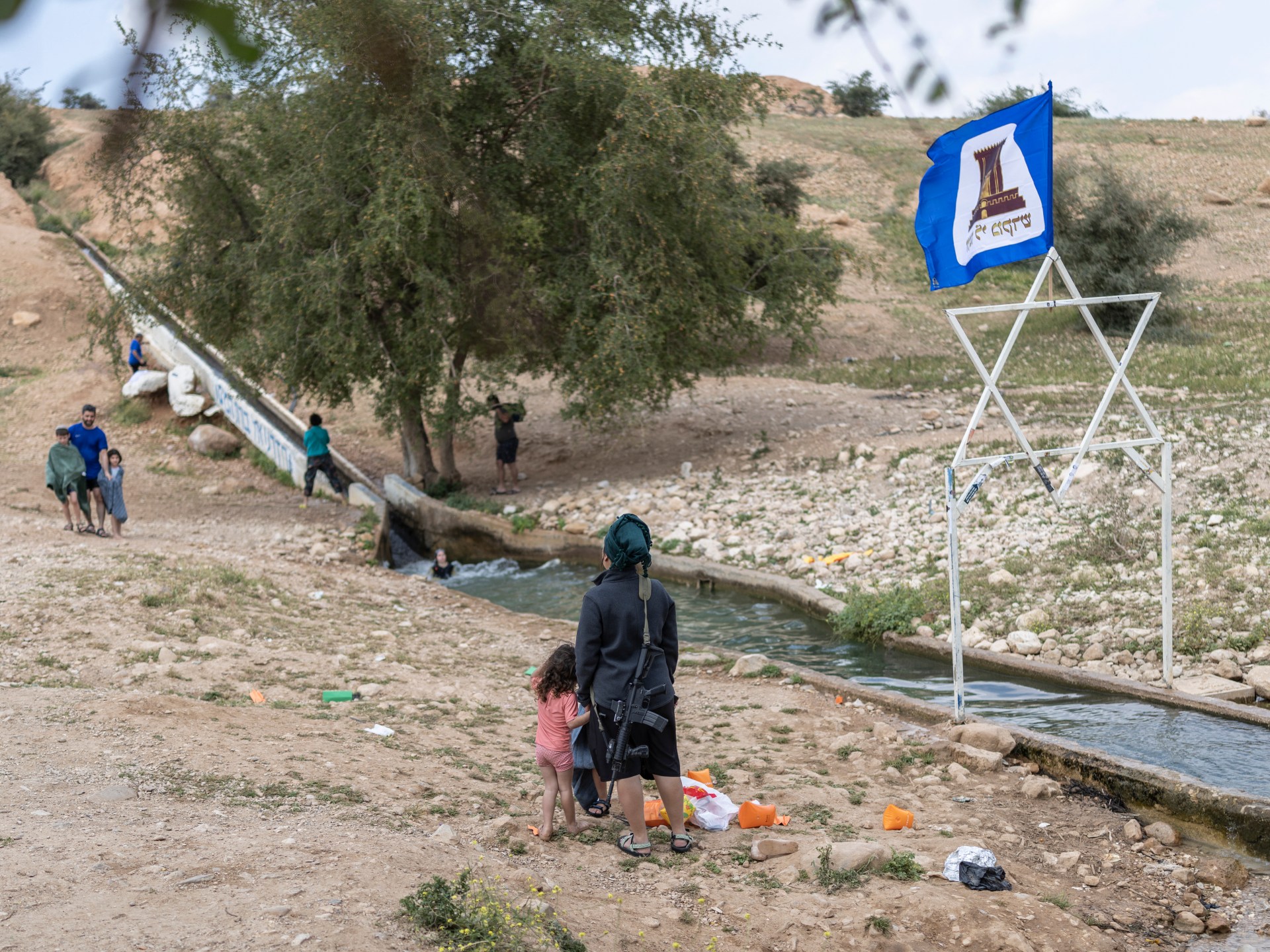
xwhatsapp-strokecopylinkgoogleAdd Al Jazeera on GoogleinfoAn armed Israeli settler gathers with others at a water slide in the Israeli-occupied West Bank village of Ras Ein al-Auja on April 9, 2026 [AFP]By Al Jazeera StaffPublished On 10 Apr 202610 Apr 2026Jordan Valley, Occupied West Bank – Haitham al-Zayed, 24, says his fondest memories as a child were spent swimming in al-Auja’s lush pools. “You’d always find someone there during hot days. Everyone went there to cool down,” he said.
Three months after he and his family were forcibly displaced by Jewish settlers from Shallal al-Auja – located beside the stream coming down from al-Auja spring in the southern occupied West Bank – he was horrified, but unsurprised, when thousands of settlers converged on the spring during the Jewish festival of Passover at the start of this month.
In one video circulating on settler chat groups, settler children waded and splashed in the same natural pools where Haitham had once swam. Their parents barbecued nearby, speaking to the camera with elation. “Happy holiday! Look at this wonder,” one man announced. “After years that Jews could not come here, the people of Israel returned to their land.”
The video then focused on who made this possible: The so-called hilltop youth, the networks of young settlers carrying out systematic violence against Palestinians, driving out dozens of communities across the West Bank since 2023. “Do you know thanks to whom this wonderful thing happened?” one man said. “Thanks to a few youth – 16 years old! That are going around this area with their flocks. I saw them stubbornly redeeming the land for us.”
For Haitham, watching the video from the area his family has been displaced to – a patch of desert, mountainous terrain in an area called Jabal al-Birka, roughly 5km (3 miles) from Shallal al-Auja and within direct sightline of it – the footage was “very hard to see”, if unsurprising. In the background of the celebrations, he could make out the remains of structures damaged or burned in the months of escalating violence that preceded their displacement. “It’s not just one incident,” he said. “It’s all systematic. It’s tied to the expansion of annexation in the West Bank.”
According to the United Nations’ Office for the Coordination of Humanitarian Affairs (OCHA), 1,727 Palestinians from 36 communities in the West Bank were displaced in the first three months of 2026 alone, due to settler violence and access restrictions – already exceeding the highest annual figure recorded in any of the previous three years.
Allegra Pacheco, chief of party of the West Bank Protection Consortium – a strategic partnership of several international organisations and nearly a dozen European Union donor countries working to prevent the forcible displacement of Palestinians from Area C – said the video was more than provocation. It was potentially evidence of the celebration of the intentional use of violence by Israeli settlers to forcibly displace Palestinians – a serious violation of international law. “The praising of ethnic cleansing carried out by these settler youth,” said Pacheco, “it’s really showing both the impunity and the lack of accountability we are seeing right now.”
The displacement Haitham described did not happen overnight. For years, settlers had conducted what he called “provocative tours” around his community.
Then, after Israel’s genocidal war on Gaza and the accompanying intensification of raids on the West Bank started in October 2023, access to al-Auja spring and its canals was cut off by settlers, severing the Palestinian community’s main water source and summer gathering spots.
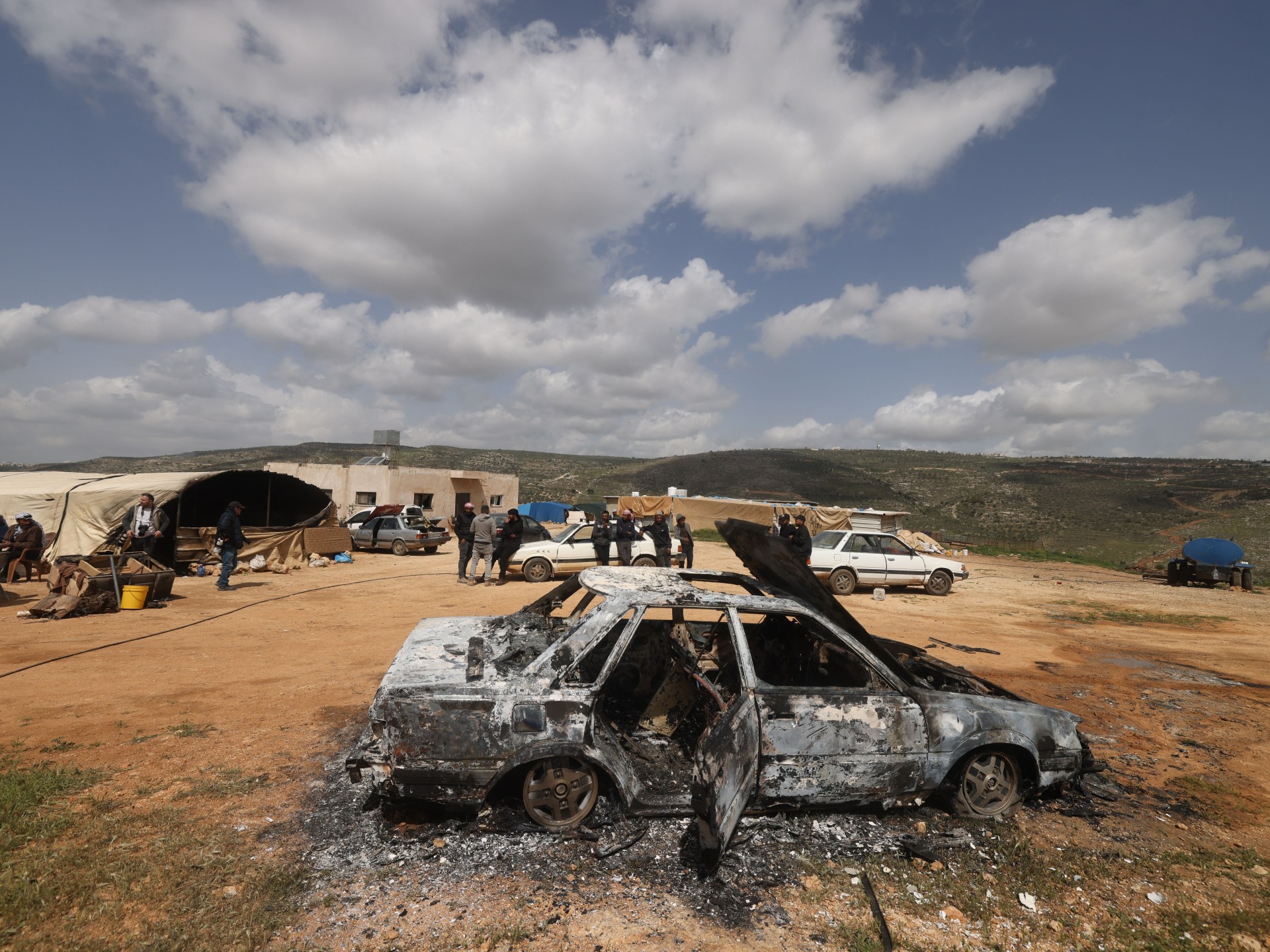
Armed settlers on all-terrain vehicles (ATVs) – funded by the Israeli government and provided to settler outposts, which are unauthorised and technically illegal under both Israeli and international law – chased livestock and children. Israeli soldiers – and often settlers in military fatigues – raided homes to interrogate or detain residents on the basis of settler claims. “Just from my family – me and my father – about 400 sheep were stolen,” Haitham said.
By January of this year, the families of Shallal al-Auja and the adjacent community of Ras Ein al-Auja – primary targets of settler violence for months – concluded they had no choice but to leave. Haitham’s family was among them.
These days, he thinks a lot about the friends he grew up with, longing for the football pitch where they played every evening, and the funerals and weddings that bound their Bedouin community together.
The former community now finds itself dispersed across the West Bank, with aid from international organisations likely to end soon, and a lack of electricity and other infrastructure.
“We’re just fighting for survival, and all that joy of being all together has now dissipated into just us trying to live to the next day,” Haitham says.
Passover brought a rash of videos from across the West Bank of settlers picnicking, hiking and praying in areas Palestinians had recently been driven from.
It was, Pacheco explained, an organised effort. “For the vacation, they’ve set up these ‘get to know the Holy Land’ hikes,” she said, adding that settlers had “intentionally picked” areas in the West Bank under partial or total Palestinian administrative control (referred to as Areas B and A, respectively), a deliberate push beyond Area C, which is under the full control of Israel.
It reflected, Pacheco said, a hardening of settler ideology. “The settlers have said it – the plan is to empty out C, push [Palestinians] into B, push them into A. Now, they have a new one: It’s all ours.”
In settler chat groups, one slogan has gained currency: “Marching towards the expulsion of the enemy.”
That march pushed forward in recent months in Hammam al-Maleh, a once-touristic area in the northern Jordan Valley featuring hot springs and Mamluk-era remains. With settler shepherds employing the same violent playbook as elsewhere, the Palestinian shepherding community was driven to a near-wholesale evacuation in the past month.
In videos spread during Passover, what appeared to be hundreds of settlers gathered for music and prayers just outside Hammam al-Maleh’s abandoned school, which had not long ago served more than 100 students from the surrounding area.
Muhammad – who asked that his full name not be used, fearing retribution from Israeli authorities – is the last permanent resident of Hammam al-Maleh, refusing to leave. The displaced families watching the Passover video from wherever they had scattered, he said, “were extremely hurt – not only the children, but also their parents, because they saw their homes in the background. They saw the land they were kicked out of.”
The pattern of violence that Muhammad describes in Hammam al-Maleh mirrors closely what Haitham describes happened in the al-Auja area: Livestock invasions around people’s homes, attacks on property, intimidation of women and children, with the Israeli military often coming to aid settlers rather than Palestinian residents under attack, and often the detention and arrest of the Palestinians.
But the northern Jordan Valley has been the location of some of the most brutal settler attacks lately, including the reported sexual assault of a father in front of his tied-up children in Khirbet Hamsa al-Fawqa, and the brutal beating of an elderly man in Tayasir. “The settlers have no mercy,” explained Muhammad. “[These settlers] don’t want to only attack able-bodied men. They specifically go after the ones they know can’t defend themselves. So they target the children and the elderly.
“They don’t want the land. It’s just: How do we kick Palestinians out?”
On March 8, Gilad Shriki, commander of the Israeli forces’ Jordan Valley Brigade, came and warned Hammam al-Maleh and several other communities in the area to leave, declaring that “Area C will soon be cleared of Palestinians,” according to Palestinian activists in the Jordan Valley.
Haitham’s new home in the southern Jordan Valley now houses about 120 families from several communities that came there after fleeing settler violence. Located in Area A and on land owned by the Islamic Waqf, they had hoped they would be safe. But “the same people that used to harass us have just appeared in the same area again,” he said. “They’re doing the same provocations [land invasions]. They are chasing the children with the ATVs.”
Fearing for their safety, Muhammad moved his wife and four small children – including a nine-year-old daughter who is disabled and unable to speak – from Hammam al-Maleh to Tayasir, which is in Area B. But “the same settlers that attacked us in Hammam al-Maleh are now chasing them there,” he said.
“There’s a continuous pattern of chasing Palestinians, even if they leave – to displace them again,” said Muhammad. “That’s part of why I’m not willing to move – I know it’s not going to end here.”
With more than 5,600 people displaced since 2023, according to OCHA’s latest figures, the crisis has stretched far beyond the West Bank Protection Consortium’s original Area C mandate. “And now, we’re witnessing the most worrisome escalation in their violence – armed settlers repeatedly shooting and killing Palestinians,” said Pacheco.
On April 8, settlers shot and killed Alaa Sobeih inside his greenhouse in Tayasir – where Muhammad’s family and many others from Hammam al-Maleh had fled.
Pacheco referred to the UN’s early warning indicators for mass atrocities. “This kind of incitement, this tolerance of violence against a distinct ethnic group by non-state actors with no accountability, and now public celebrations of the act – it’s extremely disturbing,” she said. “It’s not just worrisome by what they’re saying, but what this could potentially lead to very soon.”
Though his neighbours’ homes in Hammam al-Maleh have been dismantled, Muhammad is refusing to leave. “If I’m not around, then they potentially won,” he said. “If they go to my house and I’m not there, they would post celebration photos.” Despite the isolation and the violence, Muhammad remains in Hammam al-Maleh in part for “that satisfaction of proving [to them] that this land is ours”.
When he left for three days during Eid to visit his family, settlers stripped the community of generators, electrical cables and solar panels, leaving them without reliable electricity.
Without any sheep to graze, he patrols the community each day. The settlers know he is there, and he makes sure of it.
Muhammad, refusing to leave at all, put it simply: “I was born here. I was raised here. I am not willing to leave. Even if I die here – I will die happy, because I stayed on my land.”