As the US and Iran gear up for high-stakes talks, the bigger question is whether Tehran can hold the line amid signs of fractures within the regime.
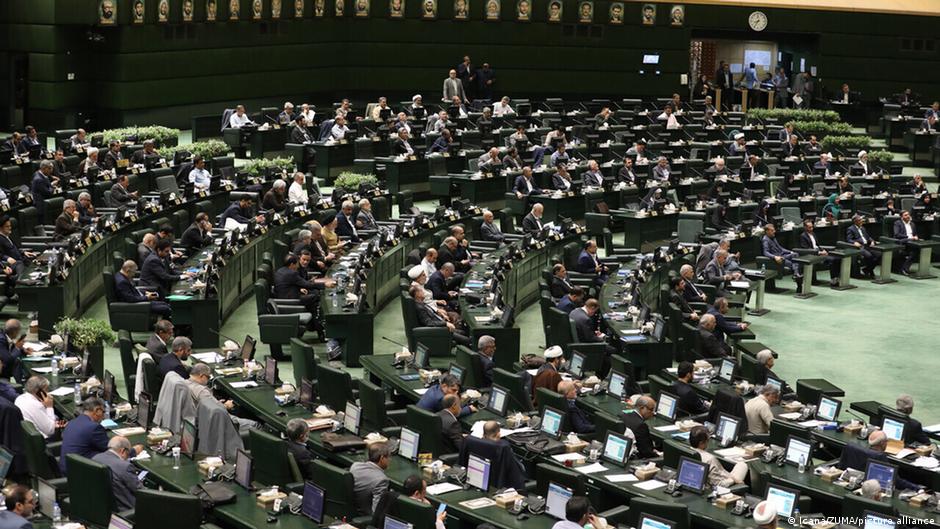
https://p.dw.com/p/5BzXwSome hard-line voices appear to believe that Iran now has the upper hand and should press on rather than compromiseImage: Icana/ZUMA/picture allianceAdvertisementIranian and US negotiators are set to meet for talks in Pakistan's capital Islamabad this weekend to try to cement the two-week ceasefire both sides agreed to after nearly six weeks of war.
The high-stakes negotiations were still hanging in the balance on Friday as Israel and Hezbollah — the Iran-backed Shiite militant group in Lebanon — continued to trade fire.
Tehran has also not fully reopened the Strait of Hormuz, a key artery of global trade through which a fifth of global oil and about a quarter of natural gas shipments passed before the war broke out.
Publicly, Iran has approached the talks with caution, but inside the country, the picture is more complicated.
On the surface, wartime conditions have created the impression of a unified regime, but in reality, there are signs of tension beneath that facade.
Some hard-line voices appear to believe that Iran now has the upper hand and should press on rather than compromise. Those who favor a truce and lasting peace agreement, meanwhile, risk being branded as appeasers.
Is the Iran truce already unraveling?To view this video please enable JavaScript, and consider upgrading to a web browser that supports HTML5 video
The tension was visible in the statement issued by Iran's Supreme National Security Council after the temporary ceasefire was announced.
Without naming anyone, it called on all sides to avoid sowing division, a sign the leadership is worried about fractures inside the regime.
In the past, the office of the supreme leader could usually settle such disputes, but the picture today is murkier.
Mojtaba Khamenei, who succeeded his father as supreme leader after he was killed in an airstrike on the first day of the war, has remained absent from public view, fueling speculation about his status.
The absence of a clear arbiter capable of bringing together the regime's myriad factions risks turning tactical disagreements into something more destabilizing, say observers.
The most obvious risk to the ceasefire comes from those inside the regime who may see continued confrontation as more useful than compromise.
One political activist in Iran, previously associated with the reformist camp but who now describes himself as independent, told DW that the government fears hard-liners could take an increasingly rigid stance and challenge an already weakened state that lacks strong organizational capacity.
He said that in recent days, the authorities had distributed weapons among loyalist forces out of fear of public unrest. "They are afraid of a popular uprising," he said, adding that even "12- and 13-year-old children" could be seen among those mobilized on the streets.
The large mobilization also makes compromise harder to sell domestically, where it risks being seen as surrender rather than necessity.
Iran's own history offers a warning. After the Iran-Iraq war in the 1980s, people who supported ending the conflict were attacked for years as those who had prevented victory, even though then Supreme Leader Ayatollah Ruhollah Khomeini himself accepted the ceasefire and described it as drinking from a "poisoned chalice."
Analyst: Trump 'undermined America's standing in the world' To view this video please enable JavaScript, and consider upgrading to a web browser that supports HTML5 video
The regime's ideological reflexes remain another major obstacle.
In recent days, voices from within the establishment have tried to tie Israel's persistent attacks on Lebanon to any future Tehran-Washington understanding.
It's not clear whether those statements are deliberate attempts to weaken the chances of Iran and the US reaching an agreement during the upcoming talks.
Yet, there are also forces inside the system that appear to have strong reasons to hold the ceasefire.
Reza Alijani, a political activist, told DW that both Pakistan publicly and China behind the scenes played a role in pushing Tehran toward the deal.
But in his view, the real pressure came from Iran's own limitations. "The Islamic Republic still has military capacity," he said, "but it is unlikely to have the economic capacity for a long war."
That gap, Alijani argued, has widened the divide between the military side of the system and its political-executive wing. "This split is affecting decision-making and will help shape the future."
What is Israel's endgame with Hezbollah and Lebanon?To view this video please enable JavaScript, and consider upgrading to a web browser that supports HTML5 video
Babak Dorbeiki, a former deputy for social and cultural affairs at Iran's Strategic Research Center, said a durable ceasefire is possible only if the talks move beyond short-term crisis management.
"It can happen only if the Islamabad negotiations move from 'crisis management' to 'changing the structure of the relationship,'" he said.
He also believes that for lasting peace, Tehran will need to give up its ideological confrontation, build a regional security framework and redefine its internal interests so that "the survival of the regime no longer depends on external tension."
But it won't prove easy as some sections of the Iranian leadership view external confrontation as useful to strengthen their domestic position, Dorbeiki underlined.
Against this backdrop, for a tenuous truce to become a durable peace, it will require not only an Iran-US deal but also a buy-in from all the powerful players in the Islamic Republic's regime.