Amusement parks around the world are locked in a race to build the fastest, tallest and most terrifying roller coasters imaginable. Engineers are pushing the limits of speed, height and G-forces, designing rides that twist, drop and launch like never before.
But as coasters reach new extremes, the thrill comes with genuine risk, raising the question: how far can human tolerance — and physics itself — allow the quest for ultimate adrenaline to go?
Recently, at the Six Flags Over Texas park in Arlington, owners installed the world’s tallest vertical loop on its new Tormenta Rampaging Run ride. At 179 feet — as high as Niagara Falls’ American Falls — the loop is just one of six world records the new coaster will set when it opens soon, including being the tallest (309 feet), fastest (87 mph) and longest (4,199 feet) dive coaster.
The ride, designed by Swiss-based firm Bolliger & Mabillard, represents a daring leap into a new future for roller coasters, but also highlights the extent of the coaster arms race that parks are always fighting.
Currently, the world’s fastest roller coaster is Falcons Flight at Six Flags Qiddiya City in Saudi Arabia, which reaches speeds of 155.3 mph — or about the same as the take-off speed as a Boeing 737 airplane.
At Ferrari World Abu Dhabi in the United Arab Emirates, meanwhile, the Formula Rossa ride reaches a top speed of 149 mph in less than five seconds and exerts 4.8Gs on riders, more than astronauts experience when they lift off on a space mission. It propels riders at 128 mph before climbing ever upward and dropping them 418 feet back down again — the tallest and largest drop on any operating roller coaster in the world.
For roller coaster aficionados like Nick Weisenberger, author of “Coasters 101: An Engineer’s Guide to Roller Coaster Design” (CreateSpace), it is becoming increasingly difficult to see just what’s next when it comes to coasters.
“Look at Falcon’s Flight. It smashed all the records as the tallest, longest and fastest roller coaster in the world,” he tells The Post.
“I’m still in disbelief that it even exists, so it’s hard to realistically imagine a roller coaster bigger than that.”
But as coasters climb ever higher and move even faster, engineers are looking toward new technologies to make rides more exciting, investing in magnetic launch systems, cliff-clinging layouts and multiple launch sites to take thrills to heights and velocities once thought impossible. The Sea Stallion ride, also at Six Flags Qiddiya City, for example, allows riders to race and overtake each other and also boasts interactive speed control and boost buttons, giving riders the chance to dictate their own pace.
While the pursuit of headline-grabbing top speeds continues, however, there are limits to what can be achieved, Weisenberger notes.
“Speed itself is not a limiting factor but acceleration forces, or change in speed and direction, are,” he says.
Ever since LaMarcus Anna Thompson opened the Switchback Railway at Coney Island in 1884, coasters have followed a simple path from start to finish. But Weisenberger says the future will bring rides with varied options and outcomes — not just getting from Point A to Point B as fast as possible.
“I think we’ll see more storytelling, multi-generational experiences, and innovative track elements that blend coasters with dark or indoor rides,” he says. “Track switches and multi-pass launches will extend ride time without adding more track.”
Michael Graham, engineer and principal at award-winning wooden coaster designers The Gravity Group, agrees. “Extreme record-breaking projects are rare,” he says. “The trend now is toward family and immersive experiences, especially given the budget limits on height and speed.”
A case in point is the $50 million NightFlight Expedition ride at Dollywood, Dolly Parton’s park in Tennessee.
Built by German firm Mack Rides and opening this spring, the 44,000-square-foot indoor ride combines a roller coaster element, simulated flight and a white water raft section with over 500,000 gallons of water.
“NightFlight Expedition is a visceral experience,” says Pete Evans, Dollywood VP of marketing and p.r. “It’s got a multidirectional flight, rafting, shoot-the-chute and boat ride — all in one.”
The problem for parks is that new rides don’t come cheap, and as construction costs escalate, many parks shy away from the huge investment required.
Recently, for example, Six Flags, one of the biggest amusement park operators in the US, announced they were selling seven of their 40 parks (including Great Escape in Queensbury, NY) in a bid to reduce debts reported to be in excess of $5 billion.
Lack of space at most parks also makes any grander designs all the more difficult.
It’s why most of the new record breaking rides now tend to be in the Middle East, where money and space are rarely an obstacle. Falcon’s Flight, for example, cost between $400 million and $500 million to design and build, making it the most expensive rollercoaster in history.
“ ‘Higher, bigger, faster’ offers little in terms of ROI,” says Jeffrey P. Stoneking, author of “Theme Park Safety Failure$” (AuthorHouse). “So nostalgia and simply replacing rides might be where the future is now heading.”
The limits on just how far coasters can go is also dependent on just what riders can withstand.
Currently, the Advancing Standards Transforming Markets Committee F24 is responsible for writing and maintaining the safety standards for amusement rides and devices in the United States, ensuring that acceleration and duration limits remain within human tolerance levels.
Occasionally, however, coasters only realize just what riders can cope with after they have opened.
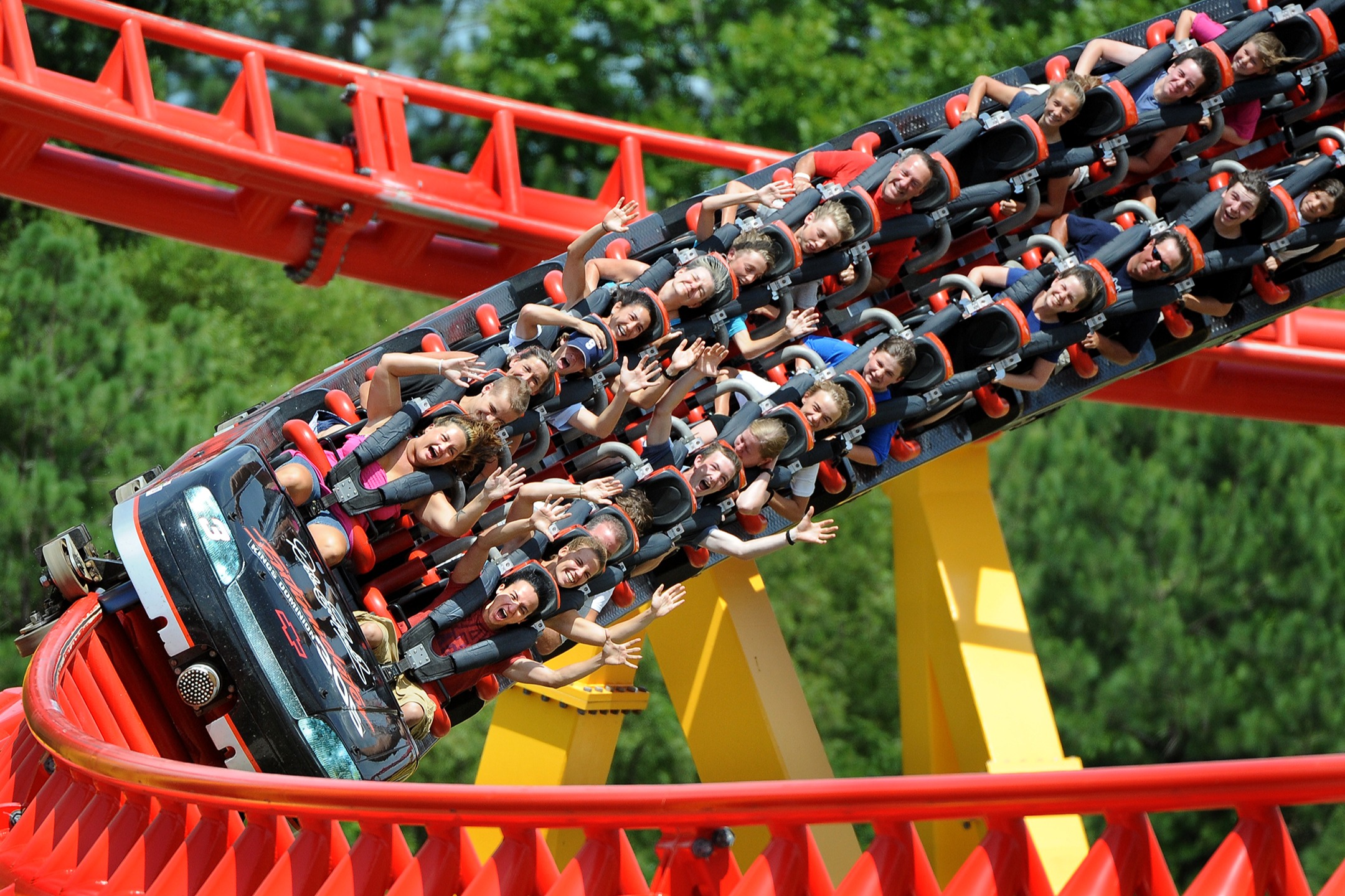
In 2010, for instance, the Intimidator 305 ride at Kings Dominion in Roswell, Va., was forced into modifications after several riders “grayed out,” temporarily losing consciousness because of the extreme G-forces the coaster subjected them to.
Jeffrey Stoneking, who rode it in its first week, sustained severe nerve and muscle damage and sued Kings Dominion; parent company Cedar Fair; ride manufacturer Intamin; and Werner Stengel / Ingenieurbüro Stengel GmbH, the engineers responsible for the ride calculation.
“I spent two months on my back,” Stoneking says.
You don’t even have to be on the ride to be in danger.
In August 2021, Rachel Hawes was waiting in line to ride the Top Thrill Dragster at Cedar Point in Sandusky, Ohio, when a piece of metal came loose from the coaster and hit her in the head, leaving her permanently disabled. After racking up medical bills in excess of $2 million, Hawes reached a confidential settlement with the operators in April 2024.
For all the apparent danger, rollercoaster fatalities are exceptionally rare, with odds of dying on a fixed-site amusement park ride estimated at about 1 in 750 million rides.
When deaths do occur, however, they are largely the result of medical events that take place while riding or prohibited rider behavior, like standing, rather than any mechanical failure or lapses in safety procedures.
That means when they do happen, they tend to be big news.
Last year in September 2025, for instance, Kevin Rodriguez Zavala, a 32-year-old from Kissimmee, Fla., became unresponsive while riding the Stardust Racers roller coaster at Universal’s Epic Universe theme park and later died at hospital.
An official investigation by Orange County’s Sheriff’s Office concluded that, while Zavala had died from multiple injuries caused by his head repeatedly hitting the metal safety bar in front of him, his death was nevertheless an accident.
Despite the risks, the quest for faster, taller rides continues.
But Stoneking argues speed alone doesn’t make a good ride. “Anything above 100 mph is just a blur,” he says.
“The bigger question is whether going faster than that is really necessary.”