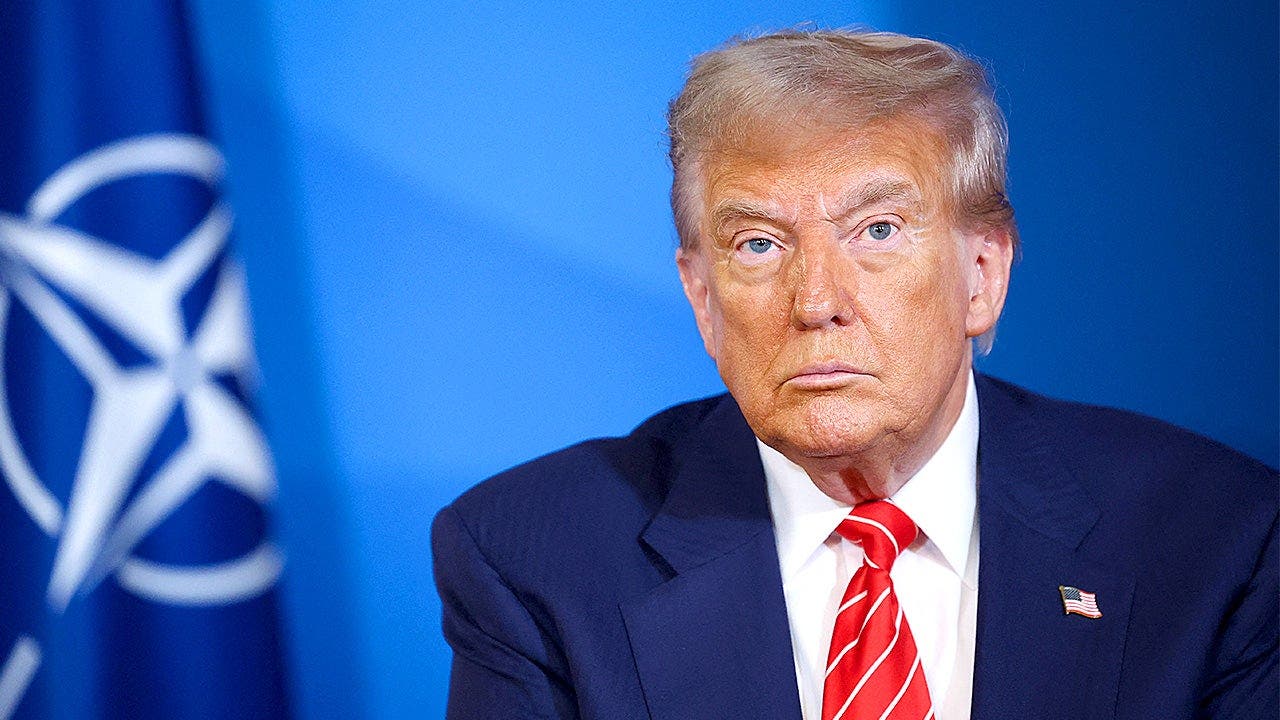
Video Trump pushes NATO for Strait of Hormuz security commitments Fox News senior foreign policy correspondent Gillian Turner reports on President Donald Trump’s criticism of NATO allies over the security of the Strait of Hormuz on ‘Special Report.’
Imagine, for a moment, the alternative. In the hours immediately following a successful decapitation strike, instead of criticism and handwringing, the European Union and NATO leadership step forward in lockstep with Washington and Jerusalem and say: We stand shoulder to shoulder with the United States and Israel; Iran will never possess a nuclear weapon; and the removal of this leadership has made the world safer.
Think about how Tehran would have processed that—not as a tactical setback, but as strategic isolation. Think about how Beijing and Moscow would have read it: a West that is unified, decisive, and willing to act in concert. That kind of clarity doesn’t just end a news cycle—it reshapes behavior.
Instead, what we saw was hesitation. Even NATO Secretary General Mark Rutte acknowledged, in effect, that some allies were slower to respond than the moment demanded. That matters. Because in moments like this, speed and unity are not cosmetic—they’re strategic.
NATO CHIEF SIGNALS ALLIES MAY ACT ON HORMUZ, WARNS OF ‘UNHEALTHY CODEPENDENCE’ ON US
I’ve spent enough time inside the system—both in business and as U.S. ambassador to the European Union—to recognize when frustration is tactical and when it’s structural. Donald Trump’s irritation with NATO falls squarely into the latter category. It’s not a passing complaint. It’s a fundamental disagreement about what the alliance is supposed to do—and whether it still has the will to do it.
NATO proudly defines itself as a defensive organization. Fine. But let’s be clear about what "defense" actually means in 2026. It does not mean waiting politely until the next missile hits or the next proxy attack kills Americans or Israelis. Defense, in the real world, includes deterrence, disruption and, when necessary, decisive action against actors who have spent decades making their intentions clear.
Iran has been running that playbook for 47 years: dead American soldiers, attacks on shipping, and a relentless campaign against Israel, one of the West’s most important allies. This isn’t theoretical. It’s not episodic. It’s sustained hostility.
So when the United States moves to degrade that threat, even in a limited and targeted way, the expectation from Washington—particularly from Trump—isn’t that NATO jumps into the fight. It’s far simpler than that. Let us use bases. Give us airspace. Provide political cover. Stand with us publicly.
MORNING GLORY: PRESIDENT TRUMP LEADS THE WEST TO A BIG WIN AGAINST IRAN
And yet, time and again, the response from parts of Europe is hesitation, legal hand-wringing and carefully calibrated distance.
Let’s address the issue of advance notice, because it’s become a talking point. Critics argue that not fully briefing allies ahead of sensitive operations is disrespectful or destabilizing. That’s a Washington talking point that doesn’t survive contact with reality.
In an alliance this large, with this many domestic constituencies and internal divisions, leaks are not hypothetical—they’re a certainty. Anti-war factions, staff-level dissent, political maneuvering—it all creates risk. And when you’re talking about high-value targets or leadership decapitation, surprise isn’t a luxury. It’s the mission.
TRUMP IS RIGHT ABOUT NATO’S WEAKNESS — THE REAL QUESTION IS HOW DOES AMERICA FIX IT
The psychological impact of those operations matters as much as the physical outcome. You want the adversary disoriented, off-balance and unsure of what comes next. That only works if you preserve operational integrity. So no—this isn’t about sidelining allies. It’s about making sure the mission succeeds.
And let’s not pretend NATO is operating in a vacuum. Allied governments know when tensions are escalating. They see force posture changes. They understand, at a strategic level, what’s coming. The idea that they’re blindsided is more political theater than operational truth.
What happens after is what really matters—and that’s where the alliance keeps falling short.
Instead of a unified response—something as simple and powerful as "when and where do you need us?"—we get fragmentation. Statements about escalation. Concerns about legality. Efforts to create daylight between Washington and European capitals.
From a geopolitical standpoint, that’s a mistake.
GEN KELLOGG SAYS NATO ALLIES ARE 'COWARDS,' CALLS FOR NEW DEFENSE ALLIANCE
Adversaries like Iran are not just watching what the United States does. They’re watching how aligned the West is when it does so. A united front—even if only the United States and Israel are conducting strikes—has enormous psychological impact. It signals that the alliance is cohesive, that political backing is firm and that there’s no easy way to divide and exploit.
When that unity cracks, even rhetorically, it invites testing. It tells Tehran there’s room to maneuver, to push incrementally, to escalate in ways that stay below the threshold of a unified response. Over time, that raises the cost of deterrence and increases the risk of a much larger conflict down the road.
Trump understands this instinctively. He’s not looking for consensus for its own sake. He’s looking for leverage.
NATO CHIEF SAYS WORLD IS ‘ABSOLUTELY’ SAFER UNDER TRUMP
And leverage, particularly with regimes like Iran, doesn’t come from endless negotiation. It comes from pressure—economic, military, psychological. Negotiations become productive when the other side believes the alternative is worse. Until then, they’re just buying time.
That’s not a theoretical critique. It’s an observed pattern.
European leaders often take a different view, rooted in decades of prioritizing diplomacy and avoiding escalation. I understand that instinct. But there’s a difference between diplomacy backed by strength and diplomacy that substitutes for it.
STEVE FORBES: IRAN’S NUCLEAR INSANITY LEAVES AMERICA AND ALLIES NO ROOM TO BLINK
If the latter becomes the default, you don’t get stability. You get erosion.
And eventually, you get adversaries who believe they can act with relative impunity—until the only options left are far more extreme.
This is where burden-sharing comes back into focus. The United States still carries a disproportionate share of NATO’s financial and military load. That’s not controversial—it’s arithmetic. Even NATO Secretary General Mark Rutte has acknowledged that Europe has been slow to step up on defense spending and responsiveness.
TRUMP SAYS HE'S CONSIDERING PULLING US OUT OF NATO OVER IRAN WAR STANCE
So when Washington asks for access, cooperation or even just unambiguous political support, it’s not an unreasonable request. It’s the basic expectation of an alliance where one member is doing the heavy lifting.
What Trump is effectively saying is this: if we’re underwriting the system, the system needs to work when it matters.
Now, to be fair, European governments are not operating in a vacuum. Domestic politics matter. Public opinion matters. There is deep skepticism about military engagement, particularly in the Middle East. Leaders have to navigate that reality.
TRUMP RATES MACRON 'AN 8' AS FRANCE AND US SPLIT OVER MIDDLE EAST STRATEGY
But leadership is not about mirroring public hesitation. It’s about shaping public understanding—especially when the stakes are rising.
There are moments when you have to bring your population along, not hide behind it. Moments when the right answer is not to deflect, but to lead.
TRUMP, RUBIO FACE NATO CHIEF AS US MOVES TO 'REEXAMINE' ALLIANCE AFTER IRAN CLASH
Because the alternative is a slow erosion of deterrence. A pattern where the United States acts, Europe distances itself and adversaries adapt. That’s not a stable equilibrium—it’s a glide path to a larger crisis.
And here’s the uncomfortable truth: if that crisis comes after years of incremental escalation, the options available at that point will be far worse than the ones being debated today.
That’s the strategic risk embedded in Europe’s current posture.
DAVID MARCUS: IN TRUMP'S DEPARTMENT OF WAR, IT'S SOLDIERS — NOT EXPERTS — CALLING THE SHOTS
Trump’s approach—pressure first, negotiation second—isn’t universally popular. But it’s grounded in a clear understanding of how regimes like Iran operate. They don’t respond to goodwill gestures. They respond to credible threats.
Or, to put it more bluntly: negotiations tend to work when the other side feels like it is on the ground, bleeding, with a gun to its national forehead.
That’s not elegant language. But it reflects a real-world dynamic.
ECONOMIST EDITOR SAYS EUROPEAN LEADERS NOW FEAR A TRUE NATO 'DIVORCE' AFTER TRUMP PULLOUT THREAT
So the question for NATO isn’t whether it agrees with every American decision or every presidential instinct. That’s not how alliances work. The question is whether it’s prepared to act like a strategic partner when it counts.
Because in the end, alliances are judged by behavior, not by communiqués.
Right now, there’s a gap between what NATO says it is and how parts of it are behaving under pressure. Trump is calling that out—forcefully, sometimes inelegantly, but not inaccurately.
CLICK HERE FOR MORE FOX NEWS OPINION
Closing that gap doesn’t require Europe to become something it’s not. It requires clarity, consistency and a willingness to stand shoulder to shoulder—even if the operational burden falls primarily on the United States.
Sometimes leadership means explaining to your public why action is necessary.
Sometimes it means acting first and bringing them along after.
CLICK HERE TO DOWNLOAD THE FOX NEWS APP
And sometimes, it simply means answering the call with the words that, right now, we’re not hearing nearly enough:
CLICK HERE TO READ MORE FROM GORDON SONDLAND
Gordon Sondland served as the 20th U.S. ambassador to the EU. He is the founder of Provenance, a national hospitality business, and the author of, "The Envoy: Mastering the Art of Diplomacy with Trump and the World."
Get the recap of top opinion commentary and original content throughout the week.
By entering your email and clicking the Subscribe button, you agree to the Fox News Privacy Policy and Terms of Use, and agree to receive content and promotional communications from Fox News. You understand that you can opt-out at any time.
You've successfully subscribed to this newsletter!