play Live Sign upShow navigation menuplay Live Click here to searchsearchSign upNews|Israel attacks LebanonHospitals in Beirut struggle to deal with casualties after Israeli attacksDoctors warn of worsening crises as vital supplies run low and Israeli attacks devastate Beirut and surrounding areas.
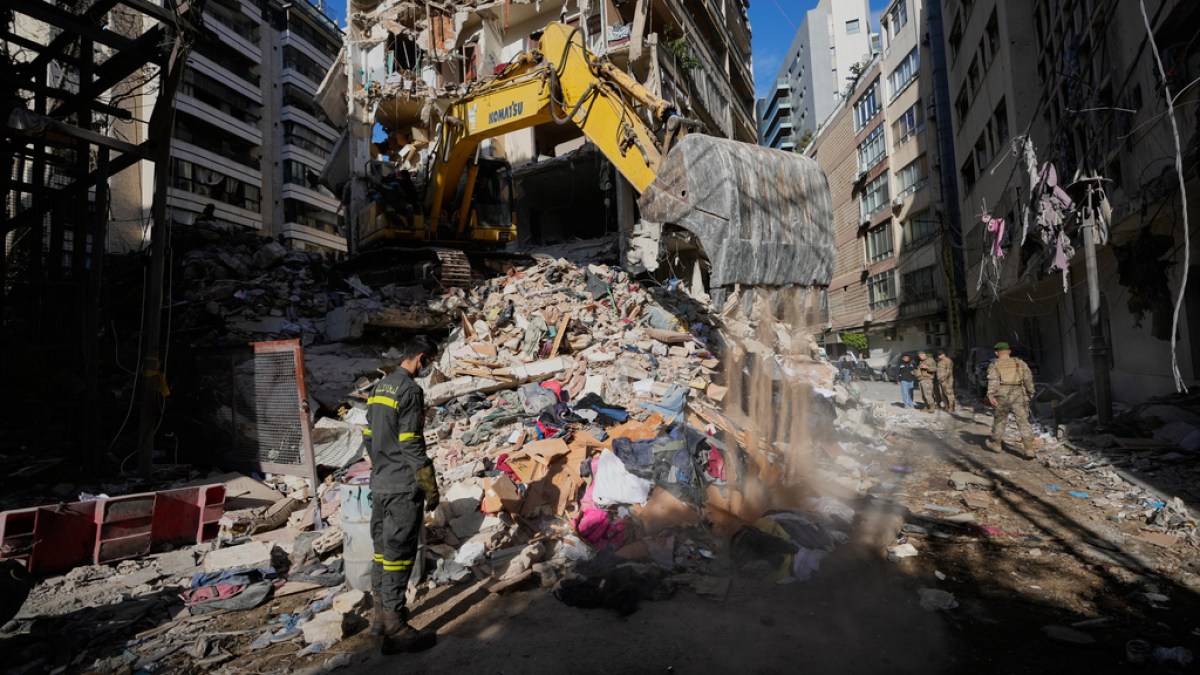
xwhatsapp-strokecopylinkgoogleAdd Al Jazeera on GoogleinfoA Lebanese civil defence worker looks on as an excavator operates on the rubble of a building destroyed in an Israeli air strike a day earlier in Beirut, Lebanon, Thursday, April 9, 2026 [Hussein Malla/AP Photo]By Alexander DuriePublished On 9 Apr 20269 Apr 2026Beirut, Lebanon – As bombs rained down on Lebanon’s capital, hundreds of people rushed to the American University of Beirut (AUB) Hospital, many crying, many scared. Children were looking for their siblings or their parents, unsure if they were dead or alive.
Israeli forces had bombed 100-plus targets across the country in 10 minutes on Wednesday, despite a ceasefire agreement between the US and Iran that many thought would include Lebanon.
“In under an hour, we received around 76 injured people. Unfortunately, six people didn’t make it,” Dr Salah Zeineldine, AUB’s chief medical officer, told Al Jazeera, as the hospital became an “epicentre” for victims of the Israeli attacks.
The death toll from Israel’s attacks across Lebanon on Wednesday has now risen to 303, with 1,150 injured, according to a preliminary toll released Thursday by the Lebanese Ministry of Public Health.
Dr Zeineldine noted that a lot of critically injured patients at AUB Hospital were children. The eldest child was 12 years old, while the two patients who had to go directly to the ICU were babies: one a few months old, another only a few weeks old.
The Lebanese Health Ministry said that at least 110 children, women, and elderly people were among those killed on Wednesday.
The main causes of deaths and injuries were from people being crushed due to the blast and parts of buildings falling on them, causing fractured bones and head trauma.
Lebanon is no stranger to war or Israeli air strikes, and medical workers in the country have dealt with many crises in recent years, notably during the 2023-2024 war with Israel, but Dr Zeineldine insists that what happened on Wednesday was “a different ballgame altogether”.
“It was a big challenge for us, in Beirut especially. We’ve never lost this many people in a single day. This intensity is not something we’ve ever experienced,” he said.
“All the patients we got were civilians,” Dr Zeineldine said, adding that the attack was “very random”, not targeting any specific place or group of people. Israel had claimed the attacks targeted the Iranian-backed Hezbollah, but the victims, according to Dr Zeineldine, included “lots of children, women, men, elderly people, all kinds of people in the civilian strata”.
At Rafik Hariri University Hospital, a medical coordinator from Doctors Without Borders, known by its French acronym, MSF, reported that “injured parents were calling out for their children. Families were coming with children’s pictures, asking if anyone had seen their loved ones”.
The number of casualties is still likely to rise, as rescue workers were still pulling people out of the rubble on Thursday. But even the current figure is already higher than the estimated 218 people who died from the Beirut port blast in 2020, one of the largest non-nuclear explosions in history, and another recent event that devastated Beirut and stretched Lebanon’s healthcare system to its limits.
In several Beirut hospitals, many medical workers were tired yet determined to keep going. Speaking on Thursday at the Hotel-Dieu de France Hospital in Beirut, Dr Antoine Zoghbi, the president of the Lebanese Red Cross, shook his head in disbelief in his office, his eyes tired and mouth dry. “This is a nightmare, a nightmare,” he repeated over and over again.
Medical officers in Beirut hospitals told Al Jazeera that they prepare their teams for crisis situations to react quickly and effectively to help patients, but added that no one could have expected intense days like these with indiscriminate attacks on civilians.
“It’s different today because they struck without warning,” Dr Zoghbi said. “They struck many regions at the same time, and they struck hard – to cause harm, to inflict pain. It’s a war with no rules. It’s a war with no limits.”
The Hotel-Dieu de France Hospital received 15 patients from the attacks on Wednesday, much fewer than in AUB Hospital, but Dr Zoghbi noted that this attack was adding an extra strain on an already depleted healthcare system in Lebanon.
“If Israel carries on like this, it’s going to result in many more injuries, many more deaths,” Dr Zoghbi said. “So far, the hospitals have been able to hold out. Will we be able to withstand the second strike, the fourth strike? I don’t know. Will we still have the equipment, the medicine, to keep doing what needs to be done?”
The concern about how the war is worsening economic and social issues in Lebanon was echoed in several Beirut hospitals. Dr Alain Kortbaoui, head of the Emergency Medicine Department at Geitawi Hospital in Beirut, said the war has limited imports and exports, which were already restricted due to the economic crisis in Lebanon since 2019. “We don’t have any more imports of medication. We never know when we’re going to defeat whatever patients have,” Dr Kortbaoui told Al Jazeera.
The World Health Organization also said that some of Lebanon’s hospitals could run out of life-saving trauma medical kits within days, as supplies near depletion following mass casualties from large-scale Israeli strikes.
With oil prices increasing due to the United States-Israel war on Iran, Dr Kortbaoui said that Lebanese hospitals have been indirectly impacted, since “everything here works on generators”. The hospital suffers from frequent power cuts, despite medical workers continuing to work as normal to support incoming patients, reeling in pain.
“Unless the hospital is directly hit, it’s going to always perform,” Dr Kortbaoui told Al Jazeera. Lebanese doctors seemed doubtful that hospitals would become targets for Israeli attacks as they had been in Gaza, but after one of the most intense attacks in modern Lebanese history, nobody could predict what Israeli forces would do next. “I still don’t understand why they hit so many regions in Lebanon,” Dr Kortbaoui said. “Sometimes we understand the way they’re thinking, but it’s not always the case.”
The doctor added that all four patients he treated from the attacks were still in shock, their memories of the event almost erased. “They don’t understand what’s going on. The first one that arrived here had two floors that fell on him. He woke up without remembering anything.”
But like in previous crises, Lebanese people showed their solidarity despite the devastation. The Lebanese Red Cross is the sole supplier of blood banks to hospitals, and its open call for blood donations was widely shared by people on social media. Many Lebanese and foreigners went to Beirut hospitals to donate blood shortly after Israel’s attacks. “Whenever there is a crisis, the Lebanese people stand together,” Dr Zoghbi said.
But still, the Lebanese Red Cross president recognised that local initiatives and donations would only go so far in healing the scars that wars and mass displacement have made on the country. “We are a people who are wounded,” he said. “What we can do is remain here, maintain our supplies, and keep operating.”
While for Dr Zeineldine of AUB Hospital, the most direct way to help people in Lebanon right now remains political. According to him, supporting Lebanon’s overwhelmed healthcare system could be summarised in three words: “Stop the war.”