Orban strongly suggests explosives found near a key gas pipeline in Serbia are evidence of Ukrainian sabotage. Serbia's intelligence chief publicly disagrees.
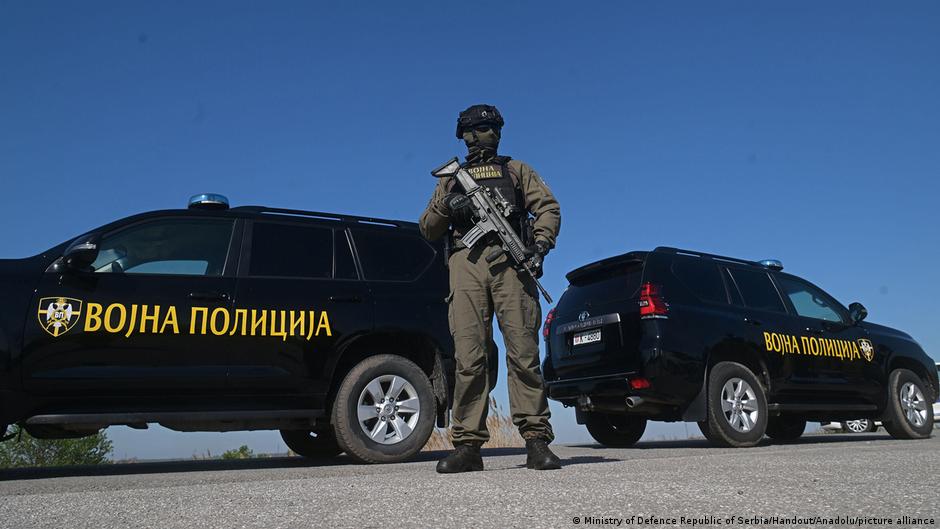
https://p.dw.com/p/5BmpSSerbian military police officers stand guard near vehicles as explosive materials are reported to be found close to a gas pipeline connecting Serbia and Hungary.Image: Ministry of Defence Republic of Serbia/Handout/Anadolu/picture allianceAdvertisementDuring Easter, Serbian officials discovered two backpacks containing bombs and detonators near a key gas pipeline that transports Russian gas through the Balkans to Hungary.
"Our units found an explosive of devastating power," Serbian President Aleksandar Vucic said in a post on Instagram.
Hungarian Prime Minister Viktor Orban and his Foreign Minister Peter Szijjarto immediately hinted that the Ukrainians were to blame. DW Fact check had a closer look.
Claim: "The Ukrainians organized an oil blockade against us, then tried to put us under a total energy blockade by firing dozens of drones at the TurkStream pipeline while it was still on Russian territory, and now there is today's incident, where Serbian colleagues found explosives sufficient to blow up the pipeline next to the TurkStream pipeline," Szijjarto said in an Instagram video on April 5.
"We reject in the strongest possible terms this latest attack on our sovereignty, because an attack on the security of our energy supply cannot be interpreted as anything other than an attack on our sovereignty."
While Szijjarto stopped short of explicitly blaming the Ukrainians, the insinuation was clear: Ukraine had planned a sabotage operation on the pipeline.
Serbian investigators, however, have denied any connection between the explosives that were found near the TurkStream pipeline and Ukraine.
"It is not true that Ukrainians tried to organize this sabotage," said Duro Jovanic, director of the Serbian Military Security Agency (VBA), in a press conference, according to a Serbian news outlet.
According to Serbian President Aleksandar Vucic, the explosives were placed a few hundred meters from the TurkStream pipeline, which supplies more than half of Hungary’s gas. Serbian authorities have launched an investigation to determine the origin of the explosives and the circumstances of their placement.
To date, no verifiable evidence has been made public to identify the possible perpetrators. The materials were originally manufactured in the United States, though the origin of the materials is not sufficient to determine the perpetrator, according to officials.
Ukraine also denied any involvement. "We categorically reject attempts to falsely link Ukraine to the incident with explosives found near the Turkstream pipeline in Serbia," Heorhii Tykhyi, a spokesperson for the Ukrainian Ministry of Foreign Affairs, wroteon X.
"Ukraine has nothing to do with this. Most probably, it is a Russian false-flag operation as part of Moscow's heavy interference in Hungarian elections."
To Donatienne Ruy, a Europe and Russia expert at the Center for Strategic and International Studies, it was a sign of "desperation."
Coincidence or not, the explosives were found just six days before Hungarians elections, which will be held on April 12. In the opinion polls, Orban and his ruling party Fidesz trail behind the opposition party Tisza.
"Immediately, Viktor Orban seized on this — and not just him, people in his government as well — to really inflate the risk of attacks," said Ruy.
After the explosives were found, Orban rushed to the Hungarian side of the border with soldiers.
The same day, he made a statement connecting the incident to a broader pattern of Ukraine targeting Hungary's energy supplies, saying "Ukraine's ambitions pose a mortal threat to Hungary".
Hungarian intelligence officials were predicting back in February that an attack on energy infrastructure might be engineered and blamed on Ukraine in the lead-up to the vote.
Weeks before the Serbia pipeline incident, Hungarian security analyst Andras Racz publisheda fictional narrative on Facebook describing, in striking detail, a Russian false flag operation involving Ukrainian explosives targeting energy infrastructure right before the election. Then, three days before the explosives were found, Racz made another post, specifying that the operation would target the TurkStream pipeline in Serbia.
Ukraine and Hungary have a tense relationship, especially regarding energy infrastructure. Hungary imports the vast majority of its oil — some 93% — from Russia, making it uniquely dependent on pipelines compared to other EU states.
The Druzhba pipeline, which carries oil from Russia through Ukraine into Hungary, has also become a flashpoint during the Hungarian election. Ukraine has said that Russian attacks on the pipeline forced a halt to oil flows; Hungary has said it’s a deliberate blockade and that Ukraine has slow-rolled repairs.
Hungary has also citedUkrainian drone strikes on Russian compressor stations feeding TurkStream as evidence of a deliberate campaign against its energy supply. The Ukraine-based Kyiv Independent was unable to verifythat claim.
Orban's promise to keep cheap Russian oil flowing has been the cornerstone of his election campaign. He has repeatedly blamedUkraine for threatening Hungary’s energy security and is often the only EU member state to oppose sanctions on Russia.
"Orban has really erected Zelenskyy as a scapegoat for everything that's happening in Hungary," Ruy said.