As a tenuous truce takes hold after over a month of bombing, Iranians fear a wounded yet surviving regime will clamp down even more harshly on its opponents at home.
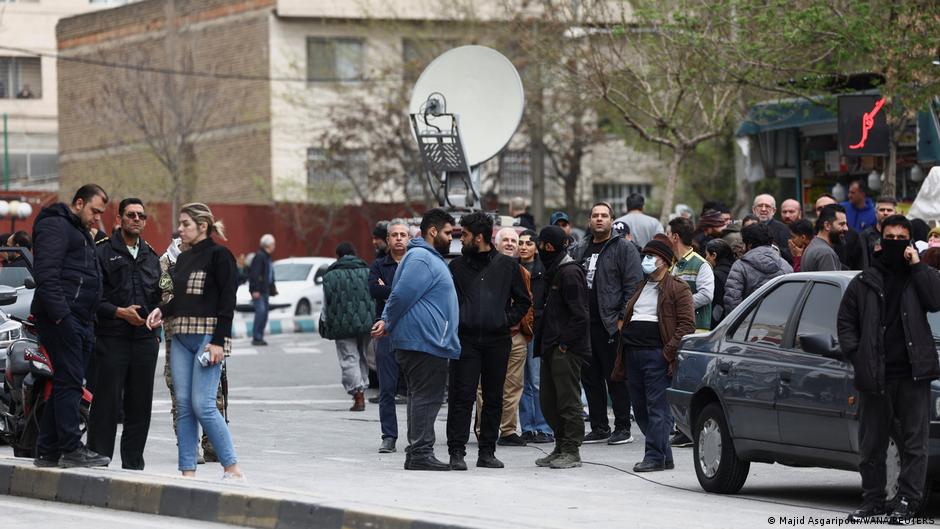
https://p.dw.com/p/5Bva7State media and officials have tried to frame the ceasefire as a triumph, but for many Iranians, that language feels detached from realityImage: Majid Asgaripour/WANA/REUTERSAdvertisementThe joint US-Israeli bombing campaign against Iran may have paused, but for many people inside the Islamic Republic, the fear has not.
After more than a month of war, Tehran and Washington have agreed to a conditional two-week ceasefire brokered by Pakistan. US and Iranian negotiators are due to meet in Islamabad this weekend for direct talks aimed at forging a permanent deal.
Shortly after the temporary truce was announced, Iranian officials moved quickly to frame the deal as a political victory, insisting that the Islamic Republic had resisted military pressure and forced its adversaries to step back.
Iranian state messaging has portrayed the ceasefire as proof that Iran's "victory on the battlefield" will now be secured politically.
But that is not how many inside the country are experiencing this moment. For them, the ceasefire has brought relief, but not peace.
The war may have paused, yet Iran's political system remains intact, heightening public anxiety that a government battered by war but still in power may now respond by tightening repression at home.
The tenuous truce so far means many fear things could unravel at any time. Tehran is approaching post-ceasefire talks with deep caution, the Reuters news agency reported, while US officials have made clear they are ready to resume fighting if diplomacy fails.
Is the Iran truce already unraveling?To view this video please enable JavaScript, and consider upgrading to a web browser that supports HTML5 video
One Iranian citizen, who asked not to be named for security reasons, told DW that the ceasefire had not eased the deeper fear now spreading among many people.
"Now that there is a ceasefire and the regime did not change, there is real concern that the government will become harsher with people and that the atmosphere will become even more suffocating," the source said.
That fear runs through many of the conversations now taking place inside Iran, with people worrying about what happens next.
Another Iranian told DW that many had initially believed the war might quickly produce a political outcome if senior leaders and Islamic Revolutionary Guard Corps (IRGC) commanders were killed. But that expectation proved wrong.
"We thought it would be over," the source said. "Now the war is paused, but nothing is resolved."
State media and officials in Iran have tried to frame the ceasefire as a triumph, as though the country had turned military survival into political success. But for many Iranians, that language feels detached from reality.
The leadership may still be standing, but much of the war's cost is impossible to hide.
The conflict killed some of the Islamic Republic's most senior figures, including Supreme Leader Ayatollah Ali Khamenei, while also damaging vital infrastructure and exposing how close the country had come to a far wider disaster.
The system survived, but survival at such a cost does not automatically feel like victory to those living through it.
And that is what is shaping the current public mood, with many citizens feeling only exhaustion, uncertainty and dread.
Israelis wary despite Iran war ceasefireTo view this video please enable JavaScript, and consider upgrading to a web browser that supports HTML5 video
The reality of Iranian public sentiment is also more complicated than either side's propaganda admits.
Many people blame the Islamic Republic for the conditions that brought the country to this point. At the same time, they also blame US President Donald Trump and Israeli Prime Minister Benjamin Netanyahu for driving a war that threatened even greater destruction.
Iranians reject both the state's repression and the logic of military escalation.
People speaking to DW described a different reality, saying that they are against the war, but not on the regime's terms. They do not want more bombing, more destruction or more suffering, but that does not mean they have stopped opposing the Islamic Republic.
These people fear that the regime will now use the ceasefire to present itself as victorious and silence society more aggressively than before.
Babak Dorbeiki, a former official at Iran's Strategic Research Center, told DW that parts of the Revolutionary Guard may not be genuinely interested in ending the war. "The IRGC is not anti-war. On the contrary, it wants war now," he said. In his view, the real anti-war position belongs to what he called "the rational part of society."
Dorbeiki argued that opposing the war should not be separated from opposing repression at home. In his view, it is possible — and necessary — to condemn war, executions, arrests and authoritarian rule at the same time.
Any meaningful anti-war position, he suggested, must also demand that the Islamic Republic change the way it governs society and move toward peace.
That argument reflects a broader fear among some critics of the regime that a prolonged conflict could help the regime blur the line between Iran as a country and the Islamic Republic as a political system, which would make it harder for people to oppose one without seeming to weaken the other.
In the final days before the truce, Trump's threats to destroy bridges and power plants inside Iran were viewed by Iranians as a direct threat to civilian life.
One source inside Iran told DW that after Trump's warnings, prices for home generators rose sharply as people rushed to buy them.
What frightened people most, the source said, was not only the possibility of another strike, but the feeling that the country's most basic civilian infrastructure had become bargaining chips in a war they could not control.
The sense of insecurity was also exacerbated by the prolonged internet blackout, which left many Iranians cut off from external information and increasingly dependent on restricted domestic networks.
The war has also deepened an already severe economic crisis. One person inside Iran told DW that their family had sold savings and gold just to stay afloat. Their income had depended on Instagram-based work, but internet disruption had effectively wiped that out.
Another described how the economic pressure had become so severe that even temporarily moving in with relatives no longer seemed possible, because those relatives were already struggling themselves.
For families like these, the war has meant shrinking incomes, rising prices and broken routines, leading them to view the two-week ceasefire not as a triumph but as a brief relief.
The war has also made life harder for journalists, especially Iranians outside the country who want to oppose the war without being accused of repeating the regime's narrative.
Behrouz Tourani, a veteran journalist and journalism instructor, told DW that occasional overlap with the state's line is not, by itself, a problem. The real issue, he said, is whether journalists lose their independence and begin to internalize that narrative.
To avoid pitfalls, he advised reporters to primarily focus on the human, political and social costs of the conflict.
Although the ceasefire may have stopped an immediate military escalation, it has not resolved the deeper crisis. It remains unclear how the US, Israel and Iran will address critical issues such as sanctions, reconstruction and political repression — leaving a sense of fragility looming over life in Iran.