President Donald Trump’s two-week cease-fire with Iran is a huge gamble — and allowing Pakistan to act as the go-between only raises the stakes.
Pakistan, after all, is the nation where Osama bin Laden found refuge for a decade after the 9/11 massacres.
It’s where the Taliban enjoyed sanctuary for 20 years while continuing to kill US and NATO troops on its way back to power in Afghanistan.
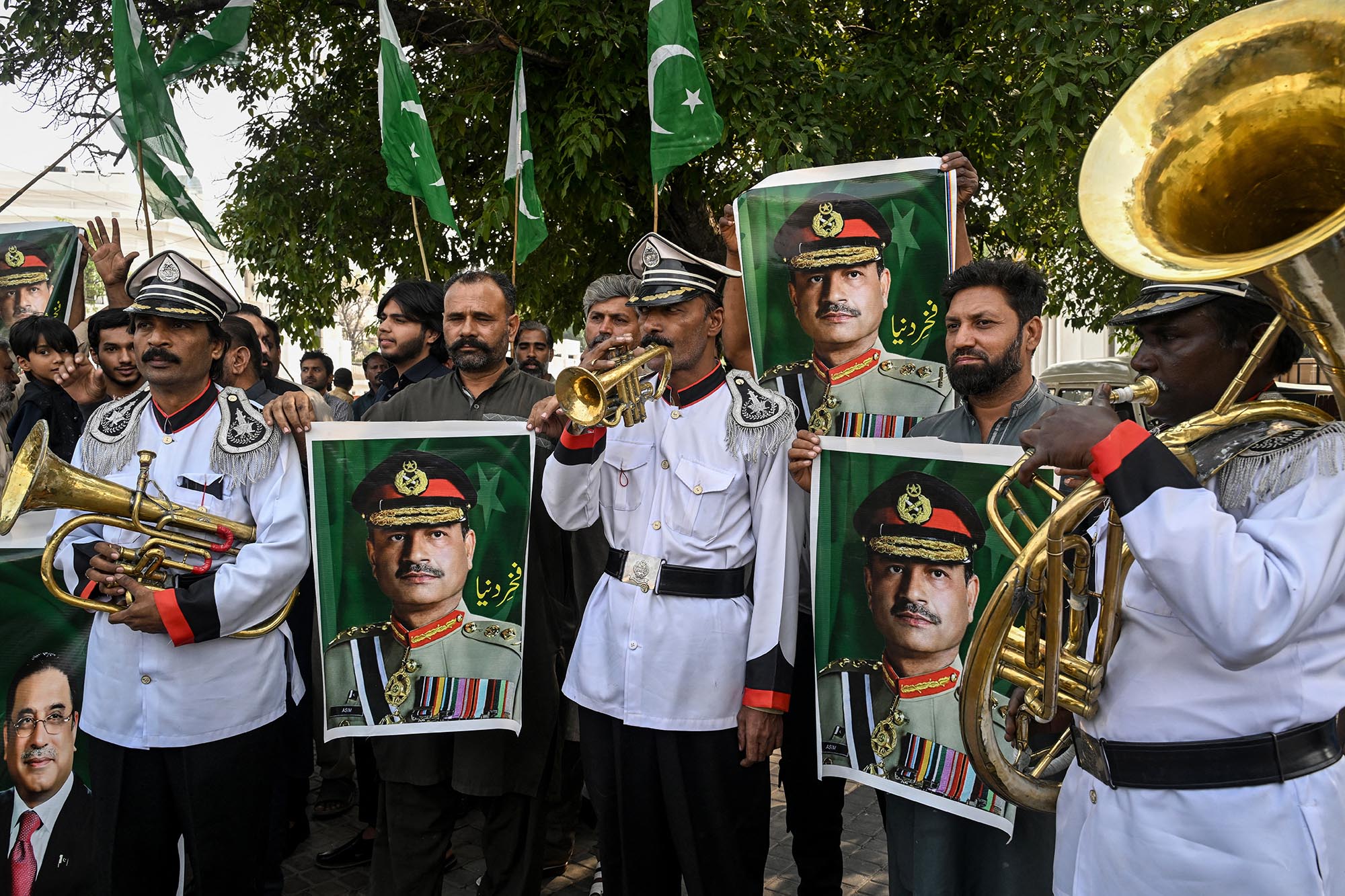
Awami Rickshaw Union workers hold posters of Pakistan’s Chief of Army Staff Field Marshal Asim Munir, after the United States and Iran agreed to a two-week ceasefire, in Lahore on April 8, 2026. AFP via Getty Images And today, Pakistan serves as China’s regional agent.
Tehran, with Islamabad’s help, has offered a 10-point plan as a baseline for negotiations.
But it’s a bad deal that the US shouldn’t take seriously.
Iran isn’t offering concessions on its ballistic missile program, or pledging to unwind its web of terror proxies across the region.
There’s no commitment to dismantle militias, halt weapons transfers or roll back threats to US forces and allies.
Instead, Tehran is demanding sweeping sanctions relief, an economic lifeline that would pour billions back into regime coffers.
On the most critical issue, nuclear enrichment, Tehran demands the right to enrich uranium as it pleases, with no set limits on how far it can go.
That’s an obvious non-starter, preserving Iran’s potential path to a nuclear weapon.
It should be a tip-off that the entire offer has been made in bad faith.
Yet Trump has allowed Pakistan to position itself as the bridge between the US and Iran ahead of negotiations in Islamabad this weekend.
For its own reasons, Pakistan does want peace, but a peace that favors Iran.
It’s acting less as an honest broker — and more as Tehran’s lawyer.
Under Field Marshal Asim Munir, Pakistan’s army chief and de facto ruler, Islamabad has moved to ingratiate itself with Trump.
Last year it handed over a suspect tied to the Abbey Gate bombing that killed 13 US servicemembers during the chaotic Afghanistan withdrawal, and nominated Trump for a Nobel Peace Prize.
Pakistan has also taken a seat at the table of the Board of Peace — Trump’s effort to remake Gaza into a hub of “opportunity, hope, and vitality” — in its continuing effort to curry favor with Trump and cash in on his Middle East vision.
Trump had a clearer view of Pakistan in his first term.
In 2018, he complained that despite receiving $33 billion of US aid over 15 years, Islamabad delivered only “lies and deceit.”
Correctly, Trump added, “They give safe haven to the terrorists we hunt in Afghanistan, with little help. No more!”
Trump should recall that instinct now as Pakistan seeks to broker a deal that will shield Tehran from sustained American military pressure.
Pakistan and Iran share a porous border that runs through insurgency-plagued regions.
A destabilized Iran would spill violence and refugees across that frontier and intensify militant activity that Pakistan already struggles to contain.
At the same time, Pakistan depends heavily on Gulf energy imports.
Disruption to shipping through the Strait of Hormuz has severely weakened its economy.
Islamabad’s defense ties with Saudi Arabia are another reason why Pakistan wants to end this war.
Continued Iranian attacks on Saudi territory could force Islamabad to choose between friends, risking backlash at home.
Pakistan has the second-largest Shiite Muslim population in the world after Iran, and the war is already inflaming sectarian tensions: Violent protests erupted in Karachi and elsewhere last month following the death of Ali Khamenei.
More important, though, is Pakistan’s increasingly close alignment with China.
Islamabad operates Beijing’s most advanced weapon systems and trains closely with the People’s Liberation Army.
Pakistan anchors China’s strategic footprint in the Indian Ocean, giving Beijing access to critical maritime routes and a position near key global energy corridors.
China, for its own economic benefit, is intent on restoring stable energy flows from the Gulf, and it’s also sought to position itself as a guarantor of regional energy stability in Asia, a role long dominated by the United States.
Beijing has publicly backed Pakistan’s mediation effort, using its ties with Tehran to nudge it toward negotiations.
That pressure is meant to secure an arrangement that pauses the war while protecting the regime itself.
In his first term, Trump experienced Pakistan’s unreliability up close.
Islamabad in 2020 helped bring the Taliban to the negotiating table, earning credit as a facilitator.
That deal supposedly included provisions that would prevent al Qaeda from taking advantage of US concessions — but turned out to be merely window dressing.
The agreement paved the way for the disastrous US withdrawal from Afghanistan and the Taliban’s return to power in 2021.
The risks of a bad deal with Tehran are enormous — and even a delay in the negotiations would give the regime time to rearm itself and its proxies, enabling them to resume attacks with greater precision.
A durable peace must halt the Iranian nuclear threat for good and terminate its five-decade campaign of subversion and intimidation of its neighbors.
A dishonest broker like Pakistan has no business being at that table.
Ahmad Sharawi is a senior research analyst at the Foundation for Defense of Democracies.