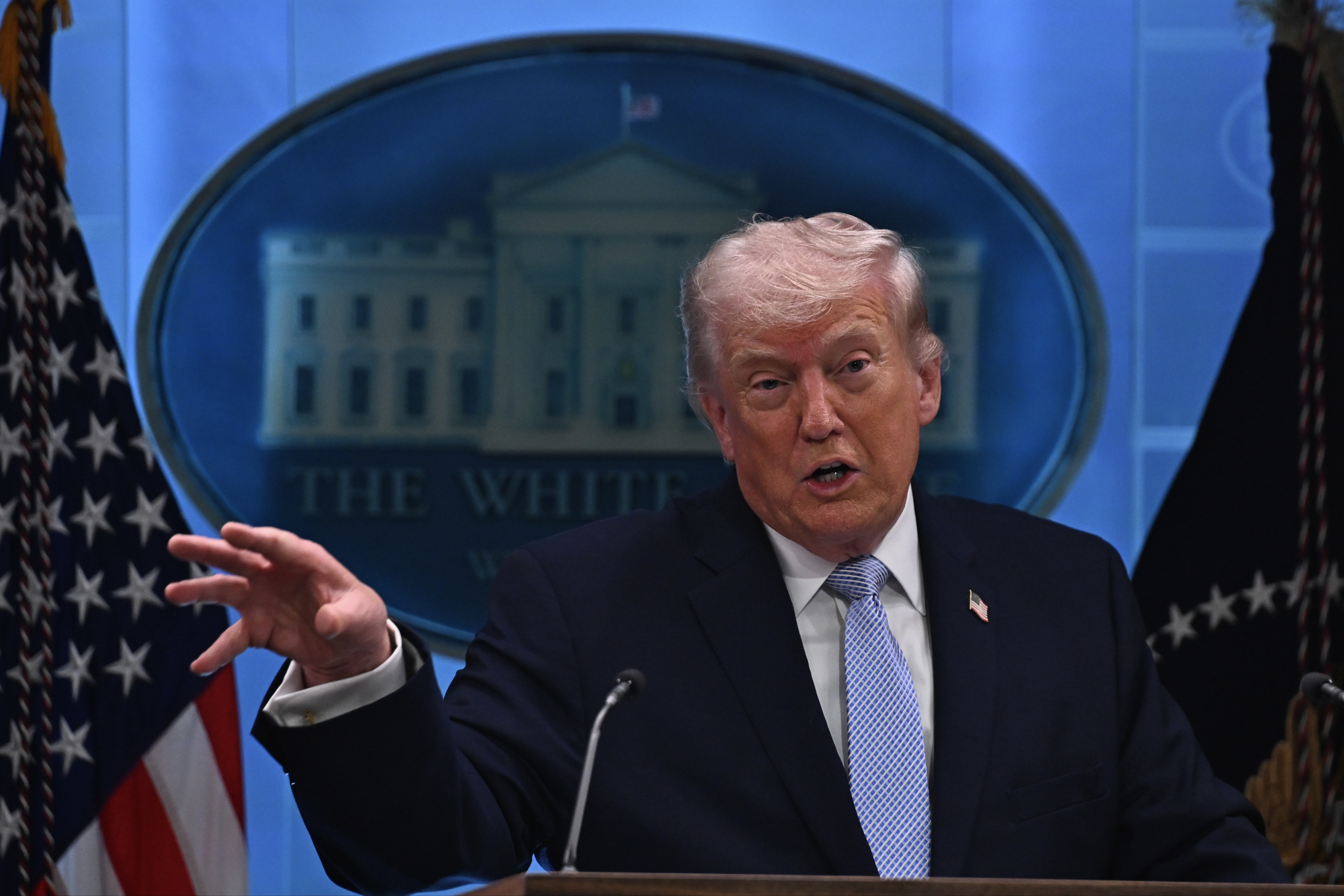
President Donald Trump must work out a comprehensive deal that does not allow Tehran any ability to threaten the world. Anadolu via Getty Images The world breathed a sigh of relief Tuesday night on news of a cease-fire in the Iran war, but this is certainly no time for President Donald Trump to go wobbly.
If he can’t work out a comprehensive deal to end the Iran threat for good, he needs to get the jets back in the air over Iran pronto — and let the bombs drop.
Trump saw enough hope for a peace deal — and an “immediate” opening of the Strait of Hormuz — to hold off, for now, on the enormous additional devastation he threatened to inflict on the Iranian regime. Fine.
But it’s far from clear what, exactly, the Iranian leaders he’s dealing with (whoever they are) will ultimately agree to. And stick to.
That’s why any deal to be worked out over the next weeks must be absolutely air-tight.
It must cover all the bases, paving the way for a future Iran that can’t continue to threaten the world and wreak havoc, whether through actual violence or economic terrorism.
Nor can Iran’s negotiators be allowed to drag out the talks indefinitely, spared of fresh airstrikes from the United States or Israel.
Trump must be prepared to resume bombing, including of infrastructure used by Iran’s military, if — as he would put it — he smells BS.
Indeed, he should warn publicly (and not just threaten but mean it) that he’s ready to restart the attacks, and even ratchet them up, if Iran refuses to meet his conditions.
Let’s face it: This is the world’s one chance to end the 47-year Iran nightmare once and for all — or at least to set conditions that can lead to its end.
It’s Trump’s chance to make good on his promise that Iran will never have nuclear weapons. Not in a year. Not in 10 years.
Remember, it took 47 years for any US president to confront the ayatollahs the way Trump has. No other leader will have the guts to do it again. Look at North Korea’s nukes if you doubt it.
Yet Trump himself may be less willing to prolong the war now: Oil prices fell the minute he announced the cease-fire. The markets shot up.
He may be tempted to think he can declare full victory and be done with it, rather than see oil price jump back up, with Republicans damaged politically just as the midterms near.
But if he doesn’t finish the job, and Democrats take control of Congress, they surely won’t let him finish it even if he later wants to.
That would leave Iran in a position to rebuild, with an even greater incentive to rush to acquire nukes.
Its leaders would be once-bitten and they survived, making them twice as less shy to hold the world’s oil hostage through the Strait.
History would not look kindly on Trump should that happen.
Which is why a return to the pre-war status quo, with the Strait open and the missiles silent, won’t be good enough.
Yes, Iran’s military has been seriously degraded, but clearly not to the point where it can’t close the Strait at will or hit its enemies.
It even fired missiles and drones at sites around the region after the cease-fire went into effect, and threatened to destroy any ship that attempted to pass through the Strait without its permission, which could be had for a price.
So what must the deal include? Pretty much everything that was needed from the beginning — starting with ending Tehran’s control of the Strait, an international waterway that never imposed tolls of any kind, and never should.
Iran has managed to retain use of the Strait as a weapon, as its missiles, launchers and drones dwindled.
It can’t be allowed to hang onto that power and deter future attacks meant to stop it from acquiring nukes, should it attempt that.
To strip it of that power, the deal might need to ensure the destruction of all weapons and bases it’s used to attack shipping.
Obviously, it must also give up all its enriched uranium and agree not to enrich, or acquire, any more.
It must agree to have its entire nuclear-production capabilities destroyed and never rebuilt.
And, to assure that it lives up to that, it must consent to thorough, unimpeded “anytime, anywhere” monitoring and verifications protocols, administered by trustworthy officials — from, say, the United States, Israel or some Arab countries.
Not everything needs be worked out in the next two weeks, of course.
But ultimately, Iran’s new leaders must also guarantee Iranians the right to peaceful protest.
It must end support for terrorism and its terror proxies in the region, including Hezbollah, Hamas, the Houthis and militias throughout the region.
Trump can hold out the prospect of sanctions relief, but that needs to be earned over time, by having Iran shed its fanaticism and commit to civilized behavior.
Vice President JD Vance, who reportedly opposed Operation Epic Fury, now has a chance to prove that negotiations can bring about the desired result.
We’re wishing him all the luck in the world, but again, Iran needs to know that an intense military response is Plan B. No more deadline extensions.
And Vance’s reputation is on the line given many believe declaring a cease-fire now has removed an opportunity to gain further leverage over the regime before talks began.
To Trump’s enormous credit, he’s brought Iran — with Israel’s help — closer than ever to serious change.
Its military threat is severely diminished, and countless leaders of the “old” regime are dead.
It’s possible new Iranian leaders are emerging who are willing to take a different path.
But if the hardliners prevail, and Iran shows any unwillingness to reform, Trump must be ready to tighten the screws.
It’s now or never — for Iran and Trump’s legacy.