@rockmarooned Published April 8, 2026, 6:00 p.m. ET Photo: ©Sony Pictures/Courtesy Everett Collection Where to Stream: 28 Years Later: The Bone Temple Powered by Reelgood The 28 Days Later series has a history of divisive endings. The original film was famously reworked to finish on a less downbeat note, pointing to the likely survival of three major characters, including Cillian Murphy’s point-of-view character Jim. (Director Danny Boyle and writer Alex Garland’s original ending, which featured Jim’s death, was eventually included as a post-credits scene later in the film’s theatrical release, and that, along with two other bleak alternates, were showcased on the DVD release.) 28 Weeks Later ended with the zombie virus making its way to France after seemingly being contained and beaten back in England. That turn was walked back by the legacy sequel 28 Years Later, which mentions how the infection was quelled and quarantined in England, rather than overtaking the world.
28 Years Later, in turn, had an ending that confounded some audiences. It bears its own explanation in greater detail, but suffice to say that after a reflective coming-of-age narrative ended with young Spike (Alfie Williams) striking out on his own in the zombie-ravaged landscape, the film throws him into cliffhanging peril by introducing the “Jimmy gang,” a bunch of identically outfitted hooligans who dispatch a group of zombies chasing Spike, but seem to offer their own menacing problems as the film ends. Now 28 Years Later: The Bone Temple becomes the first film in the series not to start with a time jump; it picks up nearly immediately following its predecessor, with Spike forced to join the Jimmy gang on their rampages of terror. (Turns out, they don’t just kill zombies.) The story of this film is more straightforward than the shifting and wonderfully unpredictable storyline from 28 Years Later. Nonetheless, it ends with a major question mark. Lucky for you survivors, the zombie experts at Decider are here to explain, and not murder anyone!
As mentioned, the storytelling in the immediate 28 Years Later sequel, still written by Garland but now directed by Nia DaCosta, is not nearly so complicated as last time. It follows two characters we know from the earlier film: Spike, who is being held hostage by the violent Jimmy Gang, led by so-called Sir Lord Jimmy Crystal (Jack O’Connell), who appears a young boy in the opening scene of 28 Years Later. The gang roams the countryside, capturing people and brutally killing them as sacrifices to Satan (“Old Nick,” as Jimmy Crystal calls him), while their leader keeps his minions in line with threats of further violence. Spike is terrified and wants no part of any of it, but he’s unable to escape.
Meanwhile, Spike’s old friend Ian Kelson, brilliantly played by Ralph Fiennes, continues to work on the titular Bone Temple, an ongoing monument to the many dead lost in this zombie plague. He encounters Samson (Chi-Lewis Parry), the “alpha” zombie who menaced the characters in the previous film — a bigger, stronger, faster zombie who nonetheless shows glimmers of humanity when Kelson is able to drug him with morphine. They form an unlikely, tentative friendship of sorts; the drug not only sedates Samson but seems to clear some of the rage-virus fog from his head. Kelson theorizes that the virus might actually be able to be cured.
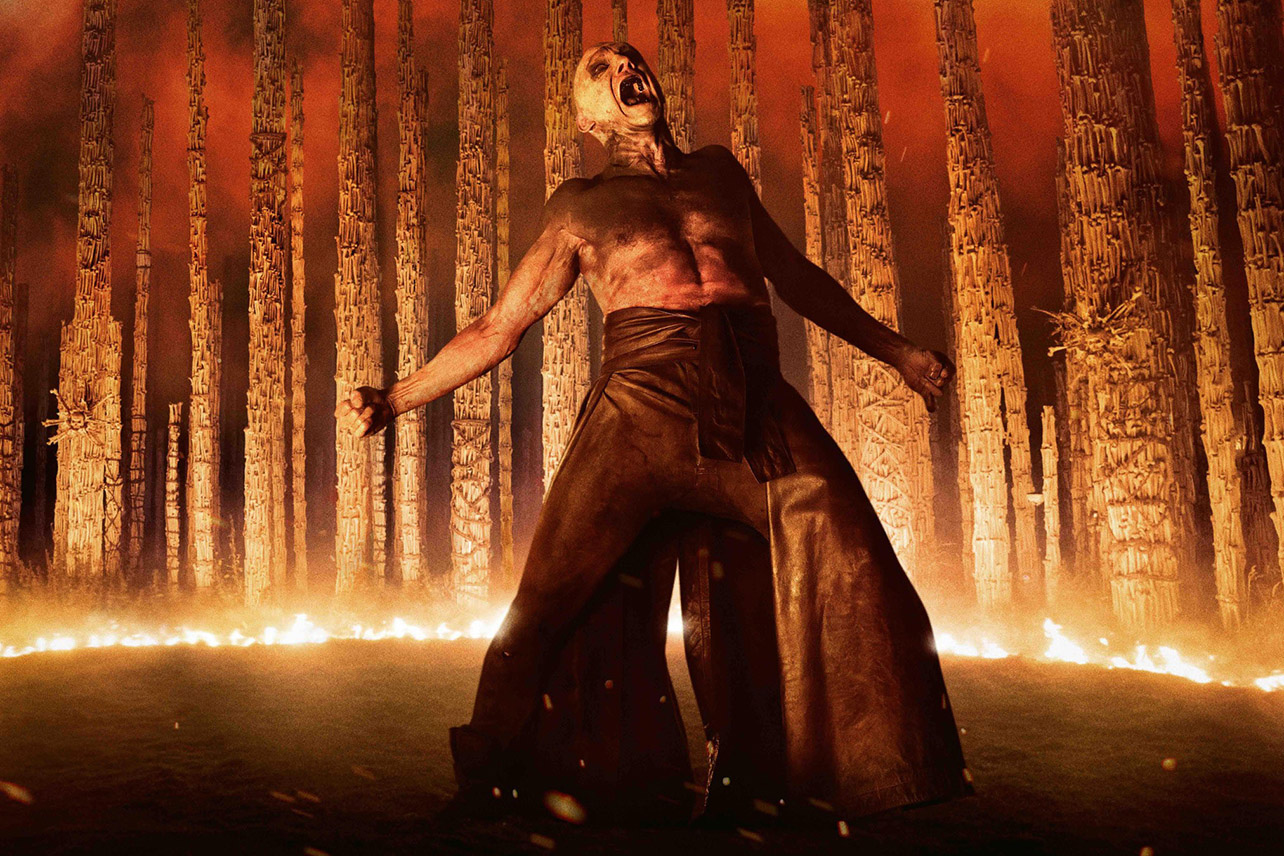
The two storylines intersect when the Jimmy gag spies Kelson and assumes from his iodine-painted body (a precaution against the zombies) that he must be Old Nick. Jimmy Crystal talks with him privately and learns that he’s not, but threatens Kelson to pretend to be Old Nick in front of the others, so that he’ll be able to maintain his leadership over the gang. Kelson puts on a spectacular show, using his Iron Maiden records and a lot of makeshift pyro to seem like he really is Satan, straight from hell; it’s simultaneously one of the funniest, wildest, and most kick-ass sequences of the movie year so far. But once Kelson spots Spike among the Jimmys, he uses his newfound quasi-Satanic power to order the rest of the gang to turn on their leader, in hopes of freeing Spike. Jimmy Crystal fatally stabs Kelson, while Spike stabs Jimmy Crystal, and the other gang members turn on each other, leaving only Spike and “Jimmy Ink” (a girl actually named Kellie, played by Erin Kellyman) alive. They leave Crystal for dead, and Samson, who does appear to be cured, takes Kelson’s body away.
28 Years Later: The Bone Temple also ends with a cliffhanger of sorts, but one far less immediately confounding than its predecessor. After the Spike/Kellie/Kelson/Jimmy stories are more or less resolved, the film cuts to a quiet outpost in the mountains, presumably some time after what has transpired. Shots of the exterior and interior reveal something resembling a farmhouse, which looks comfortably lived-in. The first person we see is a young woman named Sam (Maiya Eastmond), seemingly around 13 or 14, taking notes from an unseen lecturer. Then, he enters: It’s Jim (Cillian Murphy) from the first film, bearing tea and talking about World War II as his daughter’s teacher. Specifically, he’s discussing the hope that helping Axis countries rebuild following the war would avoid the postwar mistakes of World War I and “allow the ideas to go bankrupt,” rather than the countries. “Fascism, nationalism, populism… totally dismantled, never to return,” he says, creating a grim irony with our current state of affairs. (Churchill’s famed aphorism “Those who don’t learn from history are doomed to repeat it.”)
Now, remember, this is an alternate present (ish) for Britain, which is 28 years into a zombie-like virus outbreak. We haven’t seen what’s become of the rest of the world beyond the vague knowledge that it’s been spared the virus. We don’t know whether it bears some resemblance to our 2026 or if the virus has set history on a different path for the rest of the world. On a more micro level, we might presume that Sam, who is Black, is also the daughter of Selena (Naomie Harris), from the first 28 Days Later, though she’s nowhere in sight.
Those questions are put on pause when Sam hears something in the distance. We can infer that this isn’t an unprecedented occurrence, but isn’t necessarily an everyday one, either. She and Jim spring into action, heading into the nearby hills with a rifle and a telescope, where from their distant vantage they spy two people, seemingly Spike and Kellie, being pursued by a hoard of the infected. “Do we help them?” Sam says. A pause. “Dad,” she says more emphatically, “do we help them?” “Of course we do,” Jim says, and the two rush off camera to the strangers’ aid. Cut to credits.
Now, like the rest of the film, this is more straightforward than 28 Years Later. Jim and his daughter are living in relative seclusion and peace, and will help Spike and Kellie escape the infected. The lingering questions — is Selena still alive? Will this action bring the infected to the family’s door? Will Samson work to help cure other infected using Kelson’s work? — are less ambiguities for this movie than deferred questions for another sequel. 28 Years Later was conceived as a trilogy from the jump; Garland has written all three, and the first two were filmed back-to-back with a greenlight on the third waiting on the box office results of the first two. They were mixed; 28 Years Later did well, but The Bone Temple was a financial disappointment. The third movie was supposedly given the go-ahead in the weeks running up to the second film’s release, but without a firm shooting date or release date, that seems to be in flux now. Maybe the movies’ Netflix success will assure a trilogy-capper in some form, whether direct to streaming or in theaters.
Thematically, though, The Bone Temple offers some hints in its closing moments. Jim’s dialogue about fascism probably isn’t just a wink at the audience; it seems likely that the next film will address the rise of nationalism over the past couple of decades, whether within a changed post-virus world, or one that, outside of Britain, looks more like our present-day situation. All of these movies are about the potential for both empathetic and monstrous behavior in humankind; Kelson’s work in The Bone Temple further drives home the idea that the victims of the rage virus aren’t really undead zombies, but humans clouded with violent hallucinations. In the film’s final moments, Jim rejects isolationism and selfishness out of hand. There’s even something moving about the way he phrases his answer to Sam’s pressing question: “Of course we do,” he says, even knowing that it could jeopardize their own presumably workable living situation to help these strangers. The implication is that he has learned from the mistakes of history, even if the broader world remains a scary question mark.
Jesse Hassenger (@rockmarooned) is a writer living in Brooklyn podcasting at www.sportsalcohol.com. He’s a regular contributor to The A.V. Club, Polygon, and The Guardian, among others.