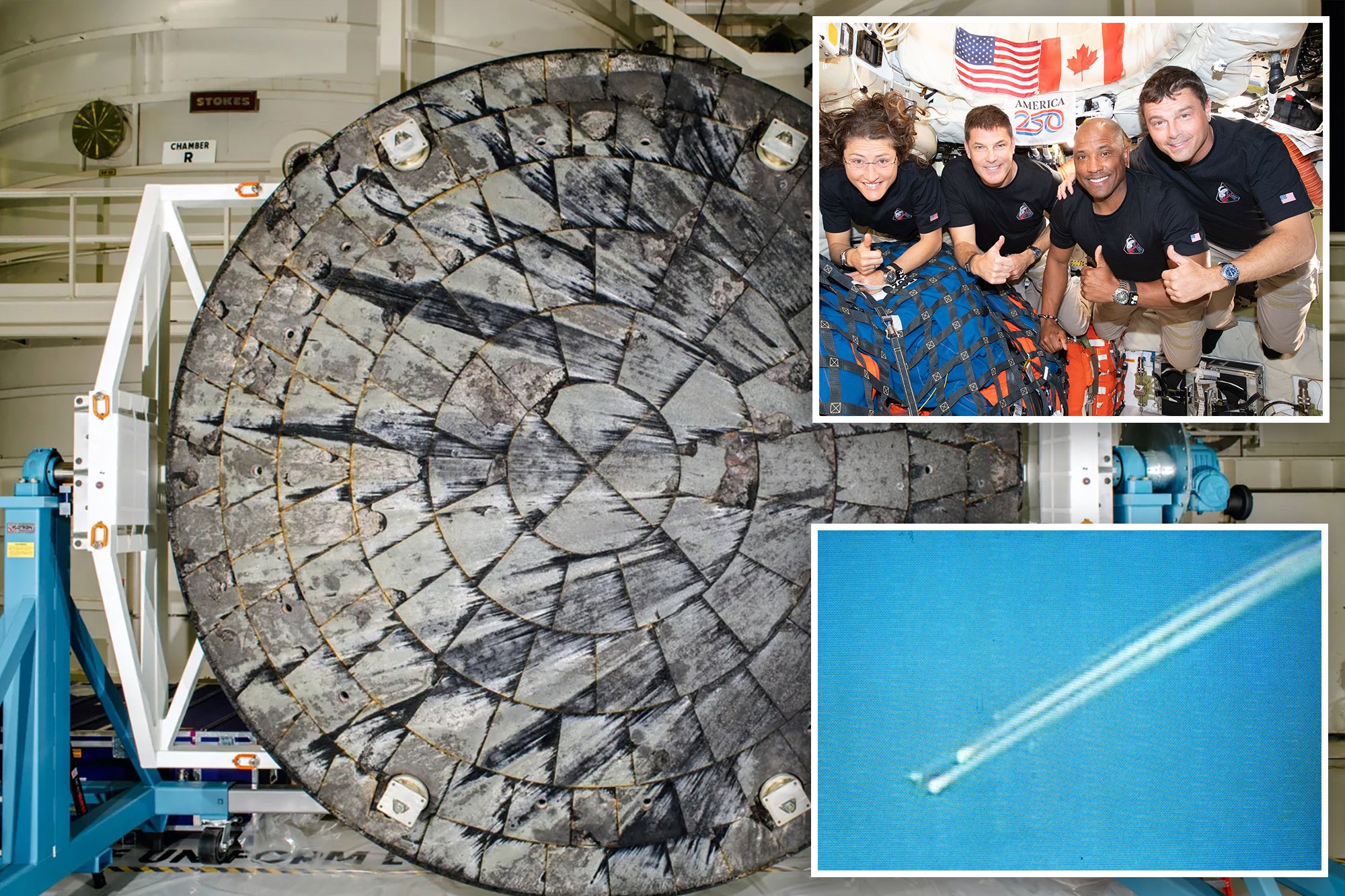
The most dangerous part of Artemis II’s 10-day mission is fast approaching — when the capsule plunges through the atmosphere on its journey back to Earth and is scorched by temperatures half as hot as the sun’s surface.
The crew’s survival through that inferno will depend on Orion’s heat shield, a 16.5-foot-wide dome on the bottom of the spacecraft designed to slough away at controlled rates as they plummet 25,000 mph and endure temperatures of 5,000 degrees Fahrenheit.
But the mission’s heat shield design doesn’t have a clean record — the shield on the uncrewed Artemis I in 2022 was left pocked with over 100 cracks and abrasions where the material “chipped away unexpectedly.”
“The unexpected behavior of the [shield material] creates a risk that the heat shield may not sufficiently protect the capsule’s systems and crew from the extreme heat of reentry on future missions,” a 2024 NASA assessment of the Artemis I heat shield read, according to Spacenews.com.
It’s the kind of flaw that could lead to a disaster like the 2003 Columbia space shuttle explosion, which left seven-astronauts dead after the shuttle returned to Earth with an unknown fracture in its heat shield.
Photos from the Artemis I reentry are alarming — the shield is littered with pockmarks where chunks of the fist-sized protective material appeared to have blown away during the violent re-entry.
NASA later determined the problem was caused because Artemis I’s heat shield material — called Avcoat — had been applied too densely, which prevented hot gases from releasing and led to cracking, according to Space.com.
Orion capsule manufacturer Lockheed Martin adjusted the shield’s Avcoat application, and NASA gave Artemis II the go-ahead to fly — with its reports noting that the Artemis I cabin temperature would have been safe for astronauts, despite the shield fracturing.
“We just slightly modified the density to allow gases in the [Avcoat] to escape during high heating and cool down,” said Blaine Brown, the Lockheed Martin systems director who helped direct construction of the Artemis Orion capsules.
“We support NASA’s decision to fly the Artemis II mission with its current heat shield and are committed to seeing Orion safely launch and return on its historic mission to the moon with crew onboard,” he told Space.com.
Avcoat was used on the heat shields throughout Apollo. But it was exhaustively applied by hand to a honeycomb-like framework back then, while the Artemis shields were assembled from about 200 Avcoat blocks.
And no matter the assurances of the new design’s integrity, Friday’s re-entry will be the first time the shield has been fully put to the test.
Dozens of crewed spacecraft have successfully returned to Earth without problem since manned rockets first flew in 1961, with the Columbia shuttle being the only ship lost because of reentry heat.
That disaster is believed to have been caused by a piece of debris which struck the shuttle’s wing during launch, knocking off a thermal tile and allowing hot gases to penetrate and destroy the shuttle as it was exposed to severe temperatures.
All seven astronauts on board died in the 2003 disaster, which happened right as the shuttle re-entered the atmosphere.
Russian cosmonaut Vladimir Komarov was killed during the reentry of Soyuz 1 in 1967, but that was caused by an electrical failure which prevented his parachutes from deploying.
Artemis II is scheduled to begin its entry interface — the moment when the capsule properly enters the Earth’s atmosphere and begins its descent — at 7:53 ET, with splashdown expected by 8:07 p.m.