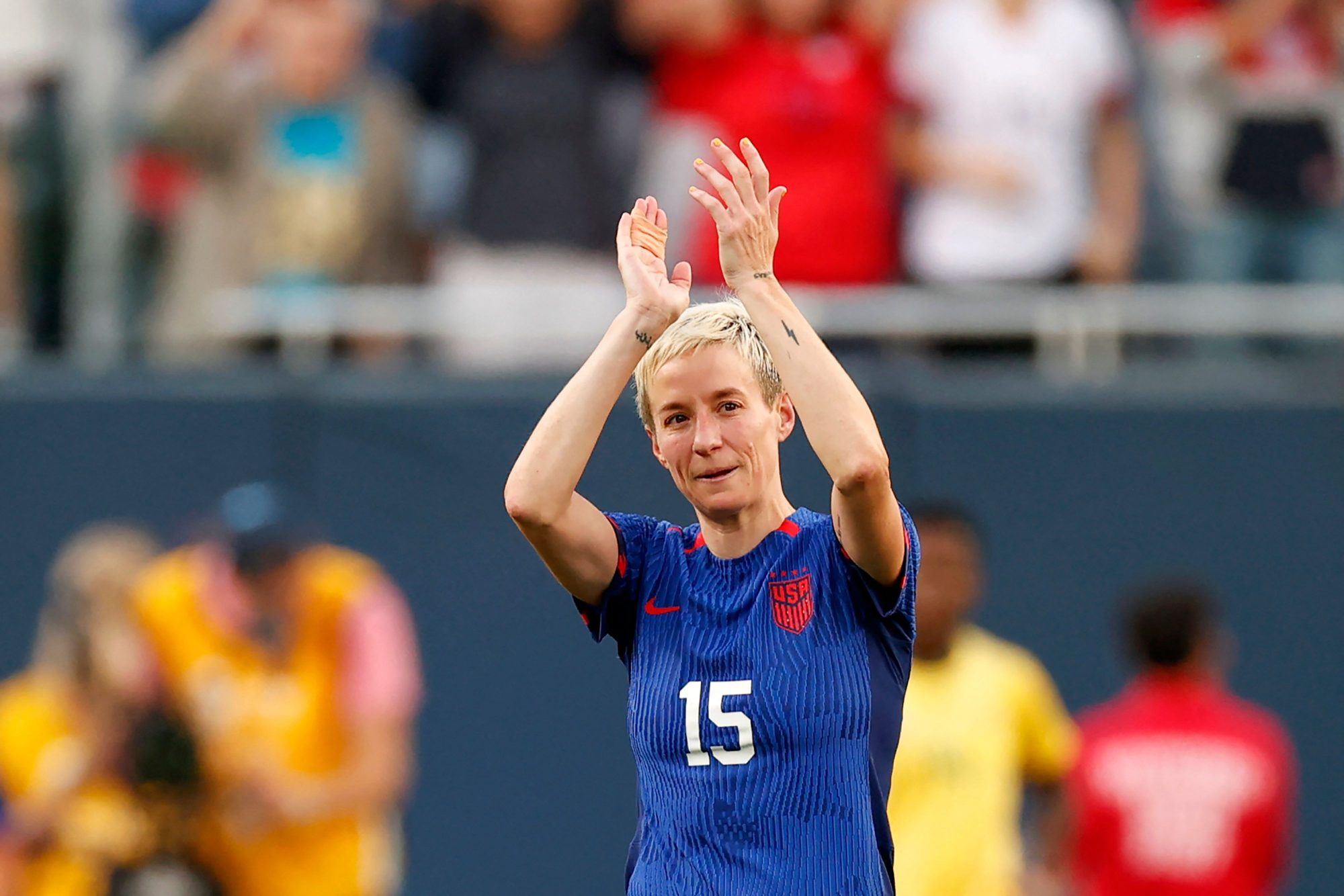
Megan Rapinoe leaves the pitch after being substituted during the women's international friendly football match between the USA and South Africa at Soldier Field in Chicago on September 24, 2023. AFP via Getty Images American soccer star Megan Rapinoe is furious that the International Olympic Committee has decided to protect the female category.
She called the IOC’s new eligibility standards for women’s Olympic sport “a really horrible rule” that’s “not based in science,” and claimed it had nothing to do with protecting women.
That reaction is ironic, given that Rapinoe owes her entire career to the existence of a protected female category.
Without sex-segregated sport, there is no women’s soccer as we know it, and no Megan Rapinoe as an international star.
What makes her comments so maddening is that it amounts to pulling up the ladder on the next generation of girls and women who deserve the same protection that allowed Rapinoe to become a star in the first place.
The IOC’s new policy, announced late last month, limits eligibility for the female category at Olympic events to biological females, determined by a one-time screen for the SRY gene — the gene responsible for triggering male development in utero — with narrow exceptions for rare conditions like complete androgen insensitivity syndrome.
The rule will take effect for the 2028 Los Angeles Olympics.
After years of muddying the water and deflecting blame, the IOC is finally implementing a standard grounded in biological reality.
That reality was never difficult to understand: The women’s category exists because male development creates large and durable athletic advantages.
The IOC’s own policy says the male advantage is around 10% to 12% in most running and swimming events, more than 20% in many throwing and jumping events, and can be even larger in sports built around punching, lifting or explosive power.
It also states what we’ve known for many years now: Testosterone suppression does not erase that advantage.
South Africa’s former “women’s” gold medal Olympic runner Caster Semenya has threatened to encourage a class action against the IOC, calling the regulation a “disgrace,” “totally shameful,” and insisting there is “no scientific proof” behind it.
But Semenya’s case is exactly why sex screening is necessary.
Semenya is a biologically male athlete with 5-alpha-reductase deficiency, or 5-ARD, a condition that affects the body’s ability to convert testosterone into dihydrotestosterone during fetal development.
As a result, some affected males are incorrectly recorded female at birth because their external genitalia appear female or ambiguous.
But at puberty, the body still undergoes typical male development that confers significant athletic advantages.
The threat to women’s sports Semenya poses is not some tiny, theoretical problem cooked up by culture warriors.
At the 2016 Rio Olympics, the entire women’s 800-meter podium consisted of male athletes with 5-ARD.
Semenya won gold. Francine Niyonsaba took silver. Margaret Wambui took bronze.
When the whole podium in a women’s Olympic final is occupied by males, something has gone badly wrong.
Something similar happened again at the 2024 Paris Olympics, when Imane Khelif and Lin Yu-Ting — both male athletes with 5-ARD — won gold in their respective women’s boxing weight classes after earlier eligibility disputes.
In some ways, it poses an even greater threat to the integrity of women’s sport than transgender inclusion, because the medical complexity and scientific jargon makes it easier for activists to obfuscate about their sex.
Many commentators seem to think athletes like Semenya, Khelif and Lin need some solution that still allows them to remain Olympic stars, because sport has become their livelihood and identity.
The Olympics are brutally selective, and vast numbers of highly talented male athletes never make them.
But here is the hard truth: The only reason the world knows these athletes’ names is that they were allowed to compete in the women’s category in the first place.
Had they been accurately classified from the start, they would never have become Olympic stars.
They would have joined the ranks of countless other decent male athletes who are nowhere near good enough for Olympic competition.
While that may be unfortunate for them personally, it is not a reason to deny fair competition to women generally.
Rapinoe’s objection to the new IOC policy shows how deeply even successful female athletes have absorbed the rhetoric of inclusion at the expense of the very category that made their own success possible.
But it’s not cruel to tell the truth about sex — and say that women deserve a category of their own.
What was cruel was forcing female athletes to keep quiet in the face of obvious unfairness.
For years, the IOC failed at one of its most basic responsibilities, by letting ideology blur the line that fair competition depends on.
Now that it’s finally drawing that line again, female athletes should be celebrating, not helping tear it down.
Colin Wright is an evolutionary biologist and a Manhattan Institute fellow.