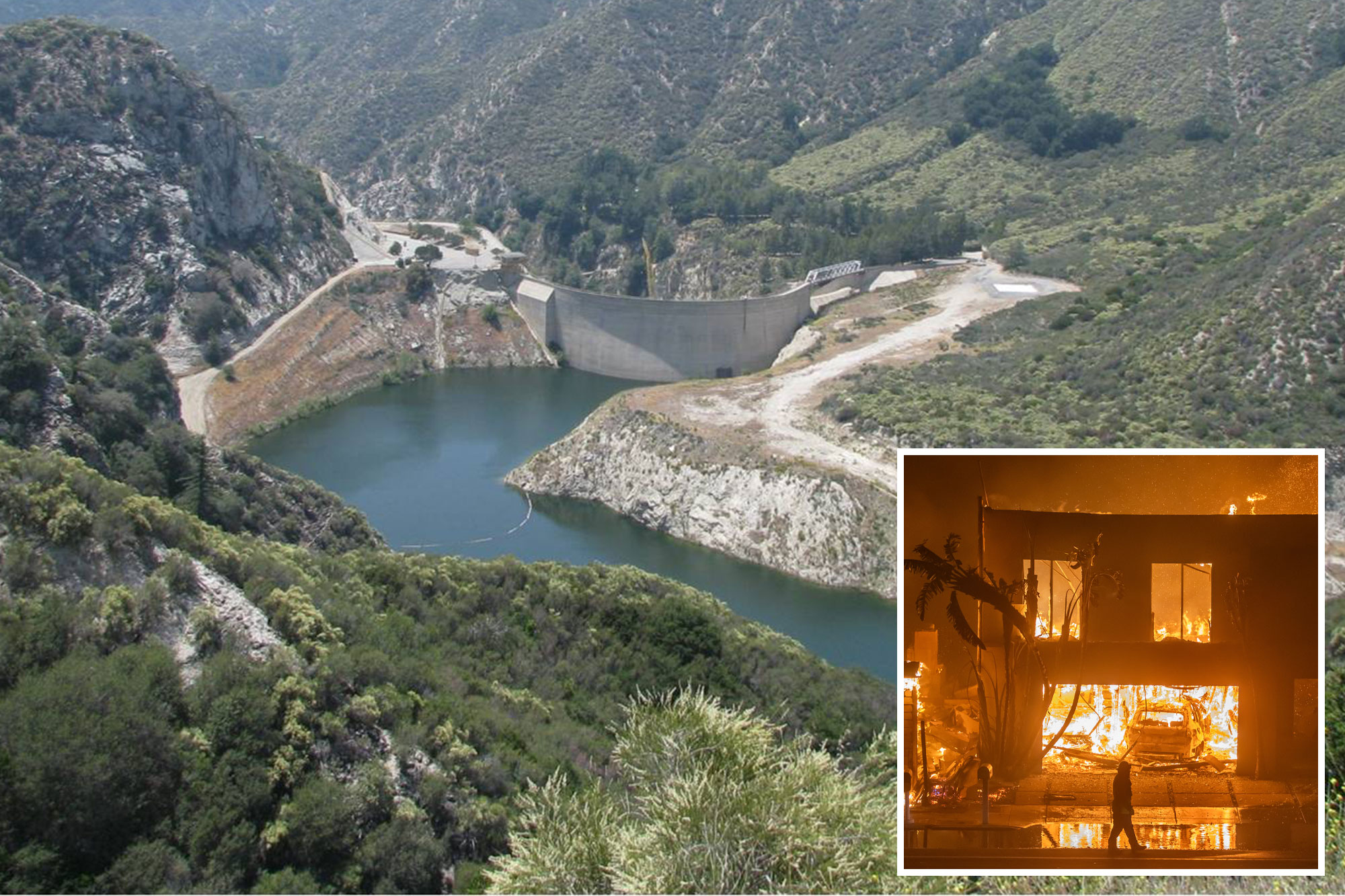
Fury is erupting in a fire-prone corner of Los Angeles after residents learned two key reservoirs meant to protect their community will be taken offline, raising fears of a repeat of the devastation in the Palisades.
The Pacoima Reservoir and Big Tujunga Reservoir, both located in the Sunland Tujunga area — where steep canyons press up against dense neighborhoods — are both slated to undergo restoration projects.
The county-led efforts include the Pacoima Reservoir Restoration Project and sediment removal work at Big Tujunga Reservoir. Both aim to address years of buildup caused by repeated wildfires and storm runoff that have filled the reservoirs with debris and reduced their capacity.
The big problem — Both projects require lowering water levels, sometimes significantly, during the dry season, when wildfire risk is at its peak.
“There’s such a disconnect between the city and the county that they’re putting people’s lives in danger,” said Lydia Grant, president of the Sunland-Tujunga Neighborhood Council.
That overlap is what has residents alarmed as reservoirs are critical infrastructure, storing and delivering the water used to fight fires and protect homes when flames break out.
“Over my dead body,” Grant said, reacting to the possibility that both reservoirs could be taken offline within a similar timeframe.
County officials say the work is necessary to restore flood control protection, maintain dam operations, and preserve water conservation capacity for downstream communities. Both projects are already in motion, with outreach, environmental review, and early planning underway.
Millions of cubic yards of sediment are expected to be removed, material that has accumulated over decades as fires stripped vegetation from surrounding hillsides and sent debris rushing into the basins.
The $60 million Big Tujunga Reservoir Restoration Project will remove an estimated 2 to 4.4 million cubic yards of sediment from the reservoir in the Angeles National Forest. Set to begin this summer, the effort is expected to span several years, with full completion projected in the early 2030s, as crews work to restore flood control and water storage capacity lost after the 2009 Station Fire.
The Pacoima Reservoir Restoration Project, estimated to cost roughly $80 million, is still in the community engagement and environmental review phase, with construction tentatively slated for 2027 and long-term maintenance stretching into the 2030s.
Grant said she uncovered the plans herself after losing trust in the county and pushed officials to present details at a recent neighborhood council meeting.
At that meeting, Los Angeles County Public Works officials outlined a multi-phase plan to remove sediment, haul debris, and manage long-term maintenance. But community members quickly raised concerns about truck traffic, environmental safety, and the possibility of both reservoirs being drawn down at once.
Grant pointed to past debris dumping in nearby areas, including Altadena, where residents complained of dust, odors, and potential contamination from sediment disposal.
“We don’t trust the county,” she said. “They’ve dumped material in our community before and didn’t follow the process.”
Beyond environmental concerns, the central fear is fire response.
“If there’s no water in those reservoirs, what happens when there’s a fire? Every minute matters,” Grant said.
County officials have said they are coordinating with fire agencies and developing contingency plans, including identifying alternative water sources if needed. They have also said soil testing will be conducted and that environmental mitigation measures are being developed in coordination with wildlife agencies.
But residents say those assurances are not enough, and that key questions remain unanswered.
They point to last week as proof the threat is already here. The Crown Fire ignited April 3 in Acton, just 15 to 25 miles away, burning 385 acres in the same wind-prone foothills and triggering evacuations, a stark reminder of how fast danger can move.
“They said they’d look for an alternative water source, but where?” Grant said. “You can’t just create one in the middle of a fire.”
The California Post has reached out to Los Angeles city and county fire officials, Los Angeles County Public Works, and the office of Karen Bass seeking details on coordination, timing, and fire readiness during any reservoir drawdown.