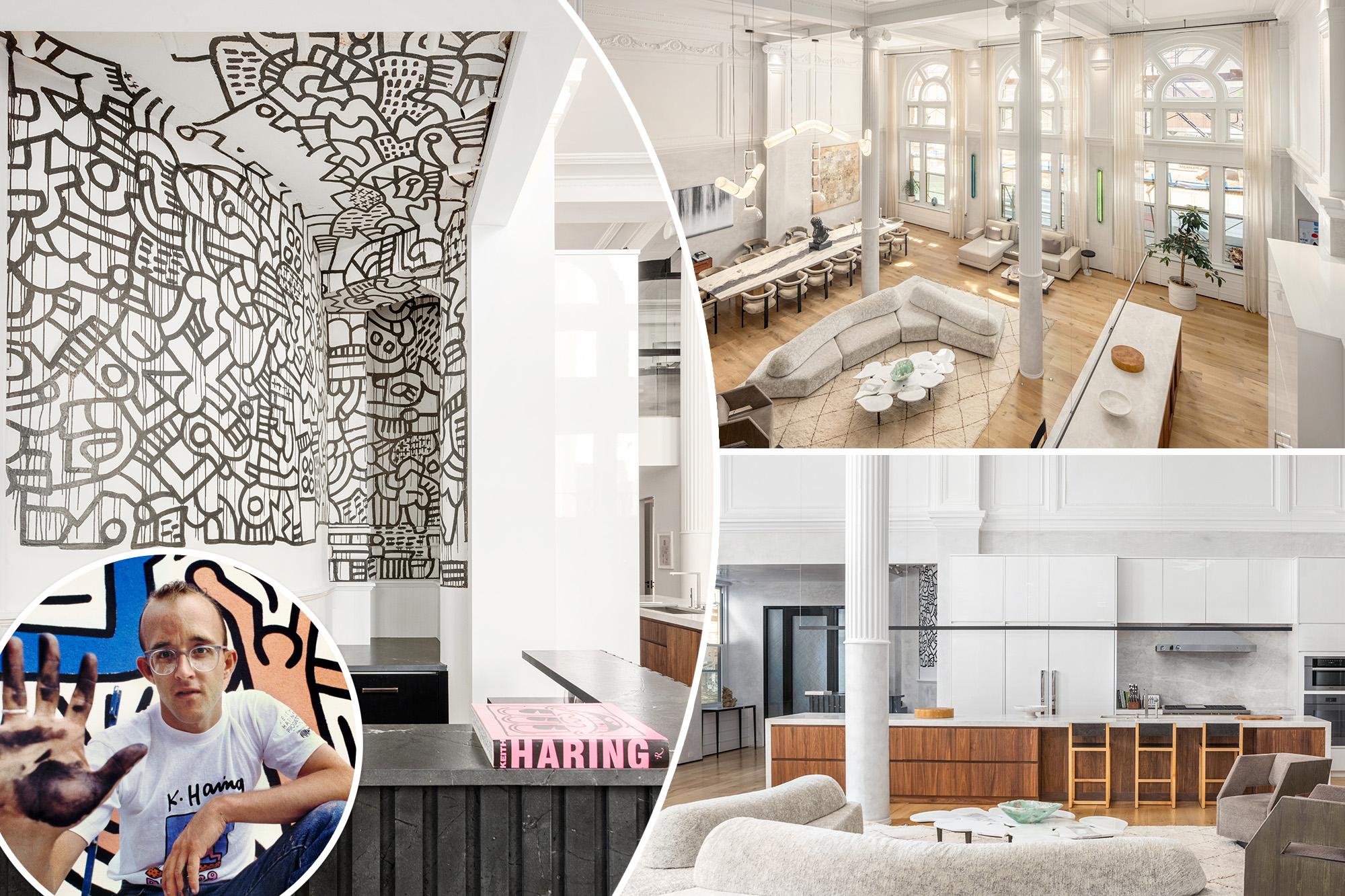
For years, downtown diners ate dinner a few feet from a Keith Haring and had no clue.
Now that long-buried mural, painted by the pop art icon back when he was a broke art student, is the main attraction in a $25 million Tribeca triplex that just landed on the market.
The 8,000-square-foot maisonette sits inside the American Thread Building at 260 West Broadway, a Renaissance Revival landmark built in 1896. Ian Slater, Michael Koeneke and Eduardo Martinez of Trove Partners at Compass are shopping the seven-bedroom, nine-bathroom spread.
There’s just one wrinkle for buyers. The Haring stays put.
“It’s a piece of New York City’s art history that can never be recreated or moved,” owner Adam Zoia told The Post.
Haring made the black-and-white work in 1979, when he was enrolled at the School of Visual Arts and the school ran a student gallery out of the building’s lower floor. He didn’t splurge on supplies. The future art star brushed on a homemade concoction of black shoe polish and alcohol, sending his trademark tangle of lines across two walls, the ceiling and a cast iron column that helps hold up the building.
“The Keith Haring mural is one of a kind,” Zoia said, adding that “it’s in a corner painted on both walls and even the ceiling, its scale is large, it’s painted in part over a cast iron column and it was painted by Keith before he was famous when he was only 20.”
The piece very nearly vanished. After SVA cleared out in the early 1980s, the space was turned into a restaurant and the mural was sealed behind sheetrock, where it sat in the dark for decades. That cover turned out to be a lucky break, shielding the fragile work until the unit’s previous owners tore into the walls during a 2007 renovation and found it largely intact. The Keith Haring Foundation later confirmed the unsigned piece as an early Haring.
Zoia, the CEO of Glocap Tech, snapped up the loft in 2021 and spent two years gutting it. Crews overhauled the HVAC and other guts of the home, laid marble floors, added Venetian plaster and reworked both the main level and the primary closet.
Protecting the Haring drove the redesign. Zoia built a custom bar in front of part of the mural to keep guests from brushing against it or splashing drinks on it, while the artwork keeps climbing up the wall and over the ceiling behind the bottles.
So what’s a shoe polish masterpiece worth? Nobody will say. Because it’s painted right onto the building’s columns, beam, ceiling and walls, the mural can’t be pried loose or sold on its own, according to reps for the sellers.
“You can put a price on real estate, but it’s nearly impossible to put a value on something this rare,” Slater said. “What makes this property so exceptional is that the artwork is inseparable from the home itself, creating a rare opportunity for a buyer to own an irreplaceable work by an artist of such significance.”
The developer who first spotted the mural told Slater the artwork runs “well beyond that little area” that was exposed, stretching across much of the wall in the home’s main room. That means whoever buys the place could, in theory, go looking for the rest.
The main floor centers on a 45-by-45-foot great room with 28-foot ceilings, three massive arched windows, white oak floors and designer lighting. There’s a chef’s kitchen with doubled-up appliances and room to seat 22 for dinner. A curved, marble-inlaid staircase leads up to two guest suites, the primary suite and a home office walled in curved glass that peers down over the great room.
The primary suite plays like its own apartment, with a five-piece bath, a powder room and a huge custom closet.
Downstairs, a nearly 2,000-square-foot lower level holds three more en-suite bedrooms and a kitchenette, plus a home spa and party zone. Think an eight-seat soundproof screening room, a brick-walled gym, an infrared sauna, a cold plunge and a game room.
Residents also get a 24-hour doorman, a building gym and a private roof deck. The property, once known as the Wool Exchange Building, was among Tribeca’s earliest luxury condo conversions and joined the National Register of Historic Places in 2005.
Zoia is selling as he looks to downsize, and he’s clear-eyed about who the next owner really answers to.
“Whoever owns this home next isn’t just buying a property that includes the trading floor of the American Wool Association,” he said. “They’re becoming the caretaker of a rare work of art.”