Which stocks will weather the AI correction? The Motley Fool's Bill Mann weighs in TheStreet Staff, CutterStudios.AI Fri, October 16, 2026 at 12:13 PM EDT 11 min read NVDA +0.07% Trade NVIDIA on Coinbase Trading disclosure Trading disclosure The above button links to Coinbase. Yahoo Finance is not a broker-dealer or investment adviser and does not offer securities or cryptocurrencies for sale or facilitate trading. Coinbase pays us for certain activity generated through this link. Prices displayed are informational.
A sharp sell-off in AI-linked stocks can look like a simple choice for investors: Buy a transformative technology at a discount or get out before the decline deepens.
Bill Mann, chief investment strategist at Motley Fool Asset Management, sees a less comfortable middle ground. He believes AI will reshape the economy, yet he also sees debt taken on for the industry's build-out as a reason to expect more volatility and to be selective about which companies investors own.
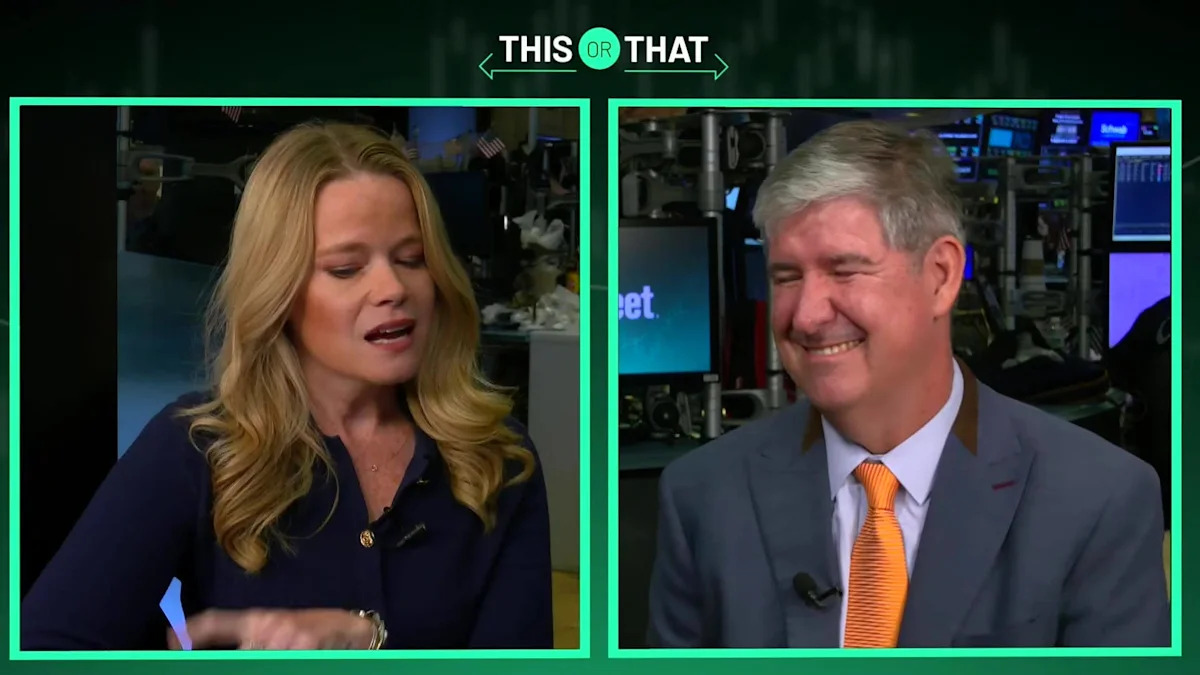
Mann, a 27-year market veteran, sat down with TheStreet's Caroline Woods to discuss how he plans to navigate the choppy waters of investing near record highs in the debt-riddled AI economy.
Mann is cautiously optimistic toward companies he considers foundational to the AI build-out, including Nvidia, but he is more wary of businesses whose borrowing creates an urgent need for profits.
The current investment landscape also informs his case for Adobe, The TJX Companies, Progressive Corporation, healthcare, and financials as areas investors can consider when technology leadership becomes too concentrated.
The practical test is whether an investor can hold through further declines without being forced to sell. Here is how Mann applies that test to an AI-heavy market.
Note: The market musings expressed herein are those of the interviewed guest and should not be treated as professional investment advice. Readers should consult a certified financial planner (CFP) for individualized advice based on their available capital, goals, risk tolerance, and time horizon.
Mann's concern is not that AI has no economic value. His concern is the financial structure around the effort to build it. Hyperscalers, the very large cloud computing companies that supply computing capacity, have borrowed heavily to expand AI infrastructure even as AI prices are falling, he said.
That combination can leave a company facing large financing obligations before its AI investments have generated enough cash.
For shareholders, the timing matters. Mann noted that debt holders have a higher claim on a company's assets than equity holders do. If borrowing costs rise or expected cash flows arrive later than hoped, the pressure is felt first in the value of the stock. That is why a company can have a credible role in AI and still be a riskier investment than its place in the technology ecosystem suggests.
Mann called a correction in AI-related shares potentially healthy, but also potentially large. His point is not that every AI stock will face the same outcome; it's that investors should separate a business's technological importance from its balance-sheet risk (i.e., the risk created by how much money it owes — and when).
I don't think that you should be pulling away from AI investments. You just have to be realistic about the fact that there is going to be a lot more turbulence than we've seen in the past.
Mann's answer is aimed at long-term, buy-and-hold investors, not traders trying to call the next bottom. He said it is difficult to sell out of an investment theme that an investor believes is real and then decide when to get back in.
His alternative is to keep exposure, reduce position sizes when needed, and make sure the overall portfolio's swings are tolerable.
Mann's preferred screen begins with a simple question: Is the company foundational to the build-out, and can it handle its financial commitments? He described Nvidia as foundational because of its role in supplying the AI build-out, a role he does not expect to change simply because the market becomes more volatile.
That view does not mean every company attached to AI infrastructure belongs in the same category. Mann said investors should focus on companies without debt obligations that create an immediate need to turn investment spending into profits. He singled out CoreWeave as an example of a business whose costly debt makes him uninterested, describing it as a signal of a distressed business rather than the type of quality company his team seeks.
Related: How much Nvidia stock does CEO Jensen Huang actually own?
By contrast, Mann said Micron Technology and Nebius were among companies connected to the build-out that he thought were probably okay, while acknowledging that their shares could still fall further. That qualifier is central to his approach.
A lower price after a purchase does not automatically invalidate an investment thesis for a long-term, buy-and-hold investor; it tests whether the investor understands the company's quality and the portfolio's capacity for volatility.
Mann applied the same debt lens to Meta Platforms and Alphabet Inc. He called both great companies and said he had no problem with investors having exposure to them.
Still, he said debt introduces a separate set of considerations because cash must arrive on a schedule that borrowing obligations do not ignore. A strong business can absorb that pressure better than a weak one, but the pressure remains part of the investment case.
Mann's broader concern is concentration. Investors in an S&P 500 index fund own a fund designed to track the large-company U.S. stock index, and Mann said the largest companies now account for a great deal of its technology exposure. An investor may therefore have more AI sensitivity than they intended, even without buying individual AI stocks.
In fact, as of mid-November, the top seven S&P 500 companies accounted for over 34% of the index's value. What do they all have in common? They're all heavily involved in the AI boom:
His proposed response depends on an investor's comfort with volatility. Motley Fool Asset Management offers exchange-traded funds, which are baskets of investments that trade on an exchange like stocks, and some of them offer lower exposure to the largest companies, Mann said. He presented those products as one option for investors who want to reduce exposure to the biggest technology names rather than make an all-or-nothing bet against AI.
Related: Dow Jones vs. S&P 500: Which index actually represents the market?
The more general lesson is to match a portfolio to the experience an investor can withstand. Mann said that if reducing technology exposure helps an investor stay invested during a difficult period, that can be a sensible adjustment.
Investors should avoid making changes simply because a stock has fallen; they should first assess whether the portfolio's potential losses would prompt them to sell at the wrong time.
Mann's case for looking outside technology starts with a market that he considers unusually split. While major indexes had been near their highs, he said many businesses outside technology had not participated in the advance. That creates possible opportunities for investors willing to examine companies that do not fit the institutional preference for AI exposure.
The TJX Companies is Mann's clearest retail example. The company owns TJ Maxx, HomeGoods, and Marshalls. He said the retailer benefits from consumers trading down, or seeking lower-priced merchandise, while also continuing to open stores. But he did not frame the idea as a bet that consumers will become so weak that they must shop at discount stores.
Instead, Mann described TJX as a valuation and quality argument. In his view, the market's heavy technology focus has left the discount-retail segment less appreciated than it should be.
Progressive Corporation offers a different example of the same search for businesses outside the AI trade. Mann recalled that Berkshire Hathaway annual meeting discussions had repeatedly addressed Progressive's competitive strength. He also said Progressive generated an underwriting profit, meaning profit from pricing insurance policies after claims and related costs, that he viewed as extraordinary.
He preferred Progressive to Berkshire Hathaway in the interview's rapid-fire comparison, but the more useful takeaway is his emphasis on operating performance rather than excitement.
Adobe is the counterintuitive technology idea in Mann's list. Software companies have often been treated as vulnerable to generative AI, and Mann said Adobe's stock had been hit earlier in the year amid fears that AI would damage software businesses. His argument is that Adobe has an asset that changes the analysis: A large proprietary catalog of images.
Mann said Adobe's AI revenue was up 150% year over year. He linked that growth to the company's image catalog and described the catalog as a walled garden, meaning content that Adobe controls rather than content generally available to competitors. In his view, that proprietary material can make Adobe's AI tools more valuable to users.
Adobe owns a huge catalog of images that's proprietary, so they have a walled garden, which means that AI will actually be augmenting their business rather than competing it away.
Mann's Adobe thesis shows why an AI investment screen cannot stop at whether a company is labeled an AI winner or loser. Investors also need to ask whether the company has proprietary assets, a credible way to earn from them, and enough financial flexibility to fund its strategy. Those questions apply to software companies as much as they do to infrastructure providers.
Related: Adobe's free-user bet shows 'cracks' before its CEO handoff
Mann also sees a distinction between companies building AI and companies using it. In healthcare, he said the early benefit may be lower costs and faster research rather than direct revenue from selling AI products. That matters because a productivity gain can improve a business even when it does not produce a new, separately visible AI revenue line.
He said the market's AI enthusiasm has focused on the development of the technology and paid less attention to its downstream benefits. Mann expects those benefits to become more visible in 2027, though that is a forecast rather than a certainty. He also favors broader sector exposure for financials rather than insisting that investors select a single financial stock.
For investors who want less dependence on a handful of giant technology companies, those sectors provide a different kind of AI exposure. The thesis is not that healthcare or financials are insulated from a market decline. It is that their potential economic benefit from AI may come through increased productivity.
Mann suspects that stocks will finish the year higher than their current level, but with leadership that looks very different from the first part of 2026. Investors should, of course, treat this as his market view, not as a timing signal. His larger point is that the next leaders may not necessarily be the same stocks that led the last advance.
A useful decision procedure starts with a portfolio rather than a prediction. First, identify how much exposure already comes from an S&P 500 fund and from individual technology holdings. Second, review whether the companies an investor owns have manageable debt and a realistic route to cash generation. Third, decide whether the position sizes allow the investor to hold through another decline.
If the answer to the final question is no, Mann's framework suggests reducing concentration or choosing a fund with less exposure to the largest technology companies. If the answer is yes, the investor can focus on business quality and remain open to opportunities beyond the AI trade.
Mann's message is not to abandon AI or to assume every falling AI stock is a bargain. It is to distinguish durable businesses from debt-dependent ones, keep position sizes consistent with the investor's tolerance for losses, and look beyond the market's most crowded trades for overlooked diamonds in the rough.
Related: What was the dot-com bubble & why did it burst?
This story was originally published by TheStreet on Oct 16, 2026, where it first appeared in the Investing section. Add TheStreet as a Preferred Source by clicking here.
Some or all of this content may have been generated by AI. While we strive for accuracy, AI can occasionally produce incorrect information. If you buy something via one of our links, we may earn a commission.