CASY +1.24% ^GSPC -0.11% NVDA -0.01% Explore stocks on Coinbase Trading disclosure Trading disclosure The above button links to Coinbase. Yahoo Finance is not a broker-dealer or investment adviser and does not offer securities or cryptocurrencies for sale or facilitate trading. Coinbase pays us for certain activity generated through this link. Prices displayed are informational.
Casey's General Stores (NASDAQ: CASY) is the third-largest convenience store chain and fifth-largest pizza maker (by kitchen count) in the United States, but its stock performance over the last several months has been disappointing.
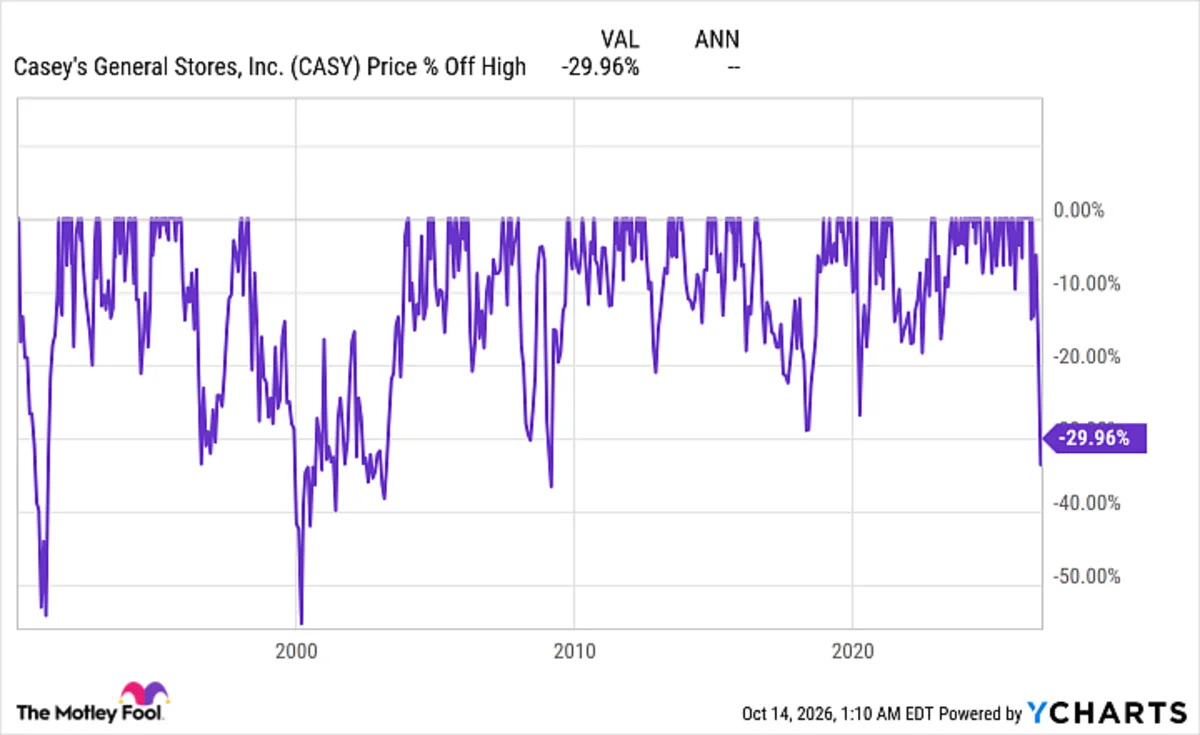
Down 30% from its all-time high set in June, Casey's is in the midst of its largest pullback since the Great Recession.
Missed Nvidia in 2009? This Rare Signal Is Flashing Again. In 2009, a "Double Down" signal flashed for a little-known chipmaker called Nvidia. For the first time in years, that same "Total Conviction" signal is flashing for a company 1/100th the size of Nvidia. Continue »
However, while Wall Street frets over short-term valuation concerns, Casey's long-term investment thesis remains intact -- and I'll be looking to add to my position on the dip.
It has been a rough few months for Casey's for a variety of reasons.
An underwhelming earnings "beat": While Casey's sailed past Wall Street's estimates with sales and earnings per share rising 24% and 28% in its fiscal 2027 first quarter (which ended July 31), a lot of that outperformance was the result of soaring gas prices and higher fuel margins. Expanding its fuel margins from $0.41 per gallon to $0.478 per gallon over the last year served its bottom line well, but it doesn't reflect the actual strength of Casey's earnings, and the feat will be hard to repeat.
Slowing inside sales growth: Rising fuel margins protected the company's earnings, but they may also have eroded its inside sales growth, which slowed to 3.2% from 4.5% last year. Furthermore, while Casey's has a growing assortment of private-label offerings, guests' ongoing shift from national brands to discounted private-label products (for example, sales of name-brand chips dropped 8% as sales of Casey's brand chips grew 16%) suggests consumers are financially stressed.
Full-year guidance unchanged: Management reiterated guidance for earnings before interest, taxes, depreciation, and amortization (EBITDA) growth of 8% to 10% in fiscal 2027, which seemed to disappoint the market. It grew EBITDA by 17% in fiscal Q1, so this would indicate a pretty sharp deceleration, though management stated it may adjust guidance when it delivers its fiscal Q2 numbers.
On top of these issues, perhaps the biggest weight on Casey's stock was its ballooning valuation.
Simply put, Casey's valuation had gotten way out over its skis this summer, but now, it's trading at a much more reasonable level. Valuation isn't everything in Foolish investing, but paying nearly 50 times earnings for a steady Eddie growth stock like Casey's is a bit of a stretch, as much as I love the stock.
Now trading at 31 times earnings, Casey's looks reasonably valued again relative to its growth potential, as it plans to add at least 120 new stores this fiscal year to its existing count of 2,959. Management has proven quite adept at making smart acquisitions, a strategy that has helped the company grow from 1,978 stores in 2017. Management plans to add more than 400 stores through 2029, in line with its long-term algorithm of growing its store count by 4% annually.
With roughly two-thirds of U.S. convenience stores owned by small-time operators that run one to 10 locations, Casey will have plenty of opportunities to exercise its serial acquisitiveness. This is especially true considering its success in achieving dramatic improvements in sales of prepared food and dispensed beverages at its newly acquired locations. For instance, after acquiring CEFCO Convenience Stores in November 2024, food-and-beverage sales at those locations have risen 30%. By acquiring locations with lackluster or non-existent food-and-beverage operations, Casey's generates an outsize return on investment from its M&A activity after adding its know-how and branding.
This steady expansion -- paired with Casey's 25 straight years of inside same-store sales growth -- makes the company an elite compounder. Its locations serve as the cornerstone stores in many of the small towns it operates in throughout the Midwest, so Casey's should not only prove hard to disrupt, but also capable of replicating its playbook across the country as it spreads into underserved markets within reach of its current distribution centers.
That said, while I'm bullish on Casey's General Stores over the next decade and beyond, I don't think investors necessarily need to rush in and make a huge bet on the stock today. Operationally, Casey's is great -- but its stock looks like a falling knife right now. While I will feel comfortable adding to my position in two or three tranches between now and the end of 2026, I wouldn't fault investors at all if they'd rather wait to buy until they see sustained signs that the stock's upward momentum has returned, perhaps in tandem with inside sales growth reaccelerating.
Before you buy stock in Casey's General Stores, consider this:
The Motley Fool Stock Advisor analyst team just identified what they believe are the 10 best stocks for investors to buy now… and Casey's General Stores wasn't one of them. The 10 stocks that made the cut could produce monster returns in the coming years.
Consider when Netflix made this list on December 17, 2004... if you invested $1,000 at the time of our recommendation, you'd have $391,581!* Or when Nvidia made this list on April 15, 2005... if you invested $1,000 at the time of our recommendation, you'd have $1,334,780!*
Now, it's worth noting Stock Advisor's total average return is 936% — a market-crushing outperformance compared to 213% for the S&P 500. Don't miss the latest top 10 list, available with Stock Advisor, and join an investing community built by individual investors for individual investors.
*Stock Advisor returns as of October 16, 2026.
Josh Kohn-Lindquist has positions in Casey's General Stores. The Motley Fool has positions in and recommends Casey's General Stores. The Motley Fool has a disclosure policy.
S&P 500 Stock Casey's Dropped 30% in Its Biggest Pullback Since the Great Recession -- Here's Why I'm Buying More was originally published by The Motley Fool