During a visit to a memorial for Taiwan's founding father in Nanjing, KMT leader Cheng Li-wun called for "reconciliation and unity" with Beijing. Taiwan's ruling democrats say China needs to stop its aggression.
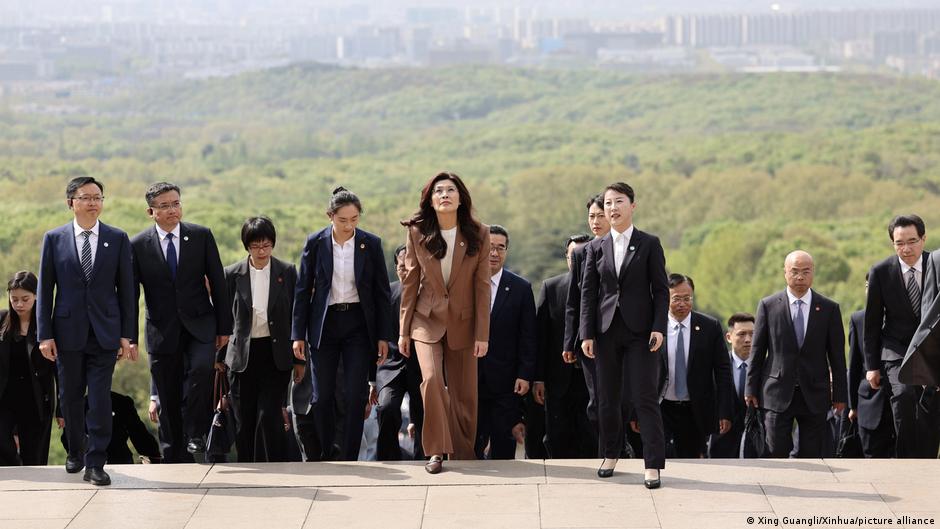
https://p.dw.com/p/5BqNPKMT leader Cheng Li-wun visiting the Sun Yat-sen Mausoleum in NanjingImage: Xing Guangli/Xinhua/picture allianceAdvertisementThe leader of Taiwan's Kuomintang (KMT) opposition party Cheng Li-wun was in China's eastern city of Nanjing on Wednesday in a visit heavy with historical symbolism.
Seen as a proponent of closer ties with Beijing, Cheng is the first KMT leader to visit China in a decade, amid tensions over Taiwan's ruling Democratic Progressive Party (DPP), whose leadership Beijing doesn't recognize.
Cheng wasinvited to China by President Xi Jinping in March. In accepting the invite, Cheng had said she hopes to meet with Xi, although a meeting has not been officially announced.
Beijing sees self-ruled Taiwan as a breakaway province that one day will be "reunited" with the mainland, and bristles at any political direction towards "independence."
The split goes back to the Chinese civil war. Nanjing was the capital of the KMT-led Republic of China government before it fled to Taiwan in 1949 after losing the civil war to Mao Zedong's communists, who founded the People's Republic of China (PRC). Taiwan's official name remains the Republic of China (ROC).
On Wednesday, Cheng visited the mausoleum of KMT founder Sun Yat-sen in Nanjing, who is revered both in Taiwan and on the mainland.
Sun is seen as a revolutionary figure in China, and is credited with overthrowing the last imperial dynasty in 1912, paving the way for Mao's "revolution." In Taiwan, Sun is officially the "father of the nation."
Cheng said the KMT had honored Sun's founding principles by turning Taiwan into a democratic society, while also acknowledging the 38 years of KMT-imposed martial law that lasted until 1987, known as the "white terror."
"Likewise, on the mainland, we have also seen and witnessed progress and development that exceeded everyone's expectations and imagination," she added.
China severed high-level contact with Taiwan in 2016 after the DPP's Tsai Ing-wen won the presidency and publicly rejected Beijing's claims to the island.
How China uses fishing boats for military power To view this video please enable JavaScript, and consider upgrading to a web browser that supports HTML5 video
Since then, cross-strait relations have steadily deteriorated, with rhetoric from Chinese President Xi Jinping not ruling out the use of force to bring Taiwan under direct rule. China carries out regular large-scale military drills around Taiwan using fighter jets and warships to sometimes simulate a blockade of the island.
Beijing refuses to speak to Taiwanese President Lai Ching-te, saying he is a "separatist."
Cheng tried to downplay the tensions during her remarks on Wednesday. "The two sides of the Taiwan Strait are not doomed to war, as the international community has feared," she said.
"I hope that today we plant the seeds of peace not only for Chinese people on both sides of the Strait, but for all humankind," Cheng said on Wednesday, in comments broadcast by Taiwanese media.
"We should work together to promote reconciliation and unity across the Strait and create regional prosperity and peace."
Taiwan simulates response to Chinese invasionTo view this video please enable JavaScript, and consider upgrading to a web browser that supports HTML5 video
Speaking to reporters at parliament in Taipei earlier on Wednesday, Taiwan National Security Bureau Director-General Tsai Ming-yen said China uses military intimidation and harassment to create an atmosphere of rising military danger and instability across the Taiwan Strait.
"This is intended to make Taiwan's society and public feel the psychological pressure and anxiety of a possible conflict," Tsai said.
"It aims to divide Taiwanese society internally, boosting the visibility of pro-China positions. It can also further obstruct efforts to push forward US arms procurement deals."
Amid Cheng's China visit, DPP spokesperson Wu Cheng said if the KMT really wanted stability across the strait, it should stop blocking a $40 billion defense spending supplement in parliament.
"Peace has never come from the charity of dictators; it must be safeguarded by Taiwan's own strength," he said in a statement.
Lai's government has said Cheng should tell officials in Beijing, including President Xi — should she meet him —, that China should stop its military aggression and respect the right of the Taiwanese people to choose their own future.
How China uses religion for political influence in TaiwanTo view this video please enable JavaScript, and consider upgrading to a web browser that supports HTML5 video