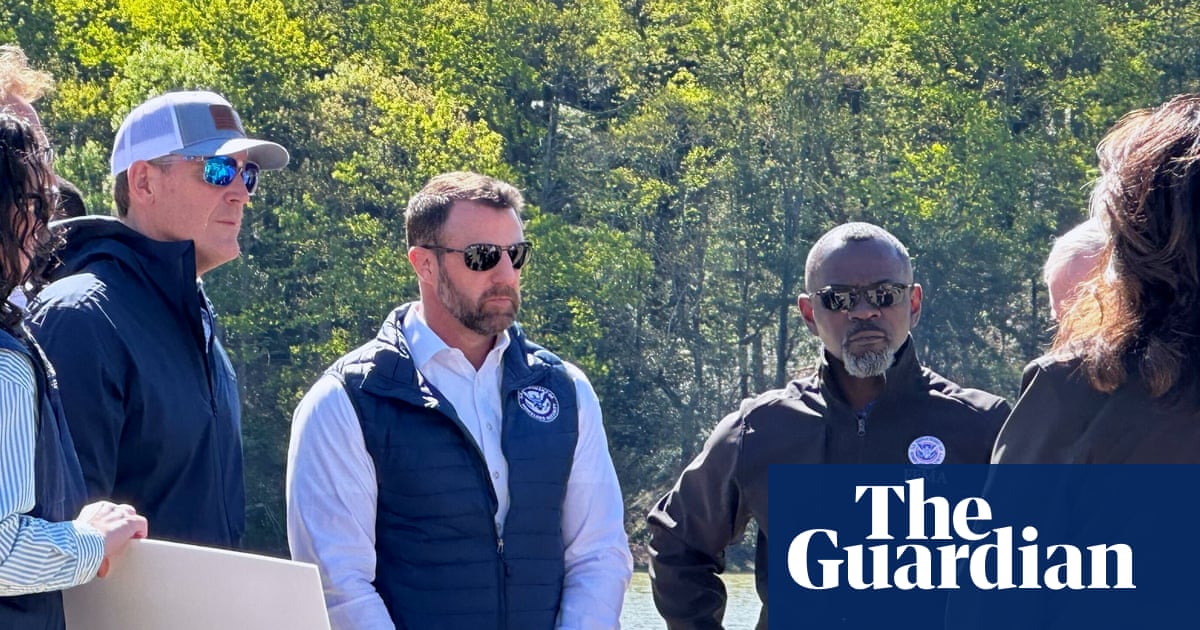
Markwayne Mullin, center left, listens to a briefing on hurricane recovery efforts, on Tuesday in Lake Lure, North Carolina. Photograph: Rebecca Santana/APView image in fullscreenMarkwayne Mullin, center left, listens to a briefing on hurricane recovery efforts, on Tuesday in Lake Lure, North Carolina. Photograph: Rebecca Santana/APDHS secretary calls for US states to lead disaster response instead of FemaMarkwayne Mullin visits Asheville to survey Hurricane Helene recovery in first big trip since Kristi Noem’s ouster
Markwayne Mullin, the US homeland security secretary, used a visit to Asheville, North Carolina to call for a fundamental shift in the role of the Federal Emergency Management Agency (Fema), arguing that states and local governments – not the federal agency – should lead disaster response.
“We shouldn’t look at Fema as being a first responder, but look at Fema as supporting the first responders you already have,” Mullin told reporters at a roundtable discussion.
Mullin’s remarks came as he toured western North Carolina to highlight federal recovery efforts after Hurricane Helene, which devastated the region in September 2024. It marked Mullin’s first major public visit since being confirmed by the Senate last month and as the shutdown of the Department of Homeland Security (DHS), which oversees Fema, enters its eighth week.
Mullin’s record on the climate crisis and disaster preparedness has sparked criticism from recovery experts. Critics also note that Mullin does not appear to have a background in disaster management, having never served on either the House homeland security committee or the Senate homeland security committee.
But earlier this week, Mullin moved to clear a backlog of home buyout requests that Fema acknowledged had been “severely stalled” by red tape, and rescinded a rule requiring personal approval of contracts over $100,000 that critics said had hobbled the agency’s response.
He explained that he’ll be “briefing the president on 22 other disasters around the nation”.
“The state is much more equipped. Neighbors are much more equipped. Local mayors are much more equipped. Emergency response from the states have much better equipment than Fema,” Mullin said.
Mullin’s comments come as the agency has faced intense scrutiny over its handling of Helene recovery.
Mullin’s predecessor, Kristi Noem, came under fire by Fema staff and disaster experts for insisting upon personally reviewing all agency spending over $100,000. That policy became a bottleneck for the distribution of recovery funds to Asheville.
Thom Tillis, a North Carolina senator, last month accused the homeland security department of violating federal law by enacting the policy and thereby restricting Fema recovery funds.
“ It begs the question: why? Why would you be involved in that? Why would that be a policy?” Tillis asked at a Senate judiciary committee hearing.
During his confirmation hearing, Mullin pledged to revoke Noem’s policy of personally reviewing all Fema expenditures over $100,000. “That’s called micromanaging,” he said. “I’m not a micromanager.”
He also said that Fema should be “restructured, not eliminated”, responding to concerns about Noem floating the idea of eliminating the agency entirely and shifting the responsibility for disaster recovery on to states.
As recently as 2019, Mullin also questioned the existence of the global climate crisis. But there is scientific consensus that global warming is real, human caused and dangerous. An analysis conducted in the aftermath of Hurricane Helene found that the storm was made 200 to 500 times more likely because of the climate crisis, and 10% wetter.
When it comes to delays in helping North Carolina recover, Mullin pointed to the disaster backlog, and insisted that “they haven’t been forgotten”.
He said: “I know because I work with this federal delegations – that conversation happens almost every day.
“Fema can be there to get them past the first heavy lift, to let them start rebuilding, and then we can just be, hopefully, help fund the recovery after that.”