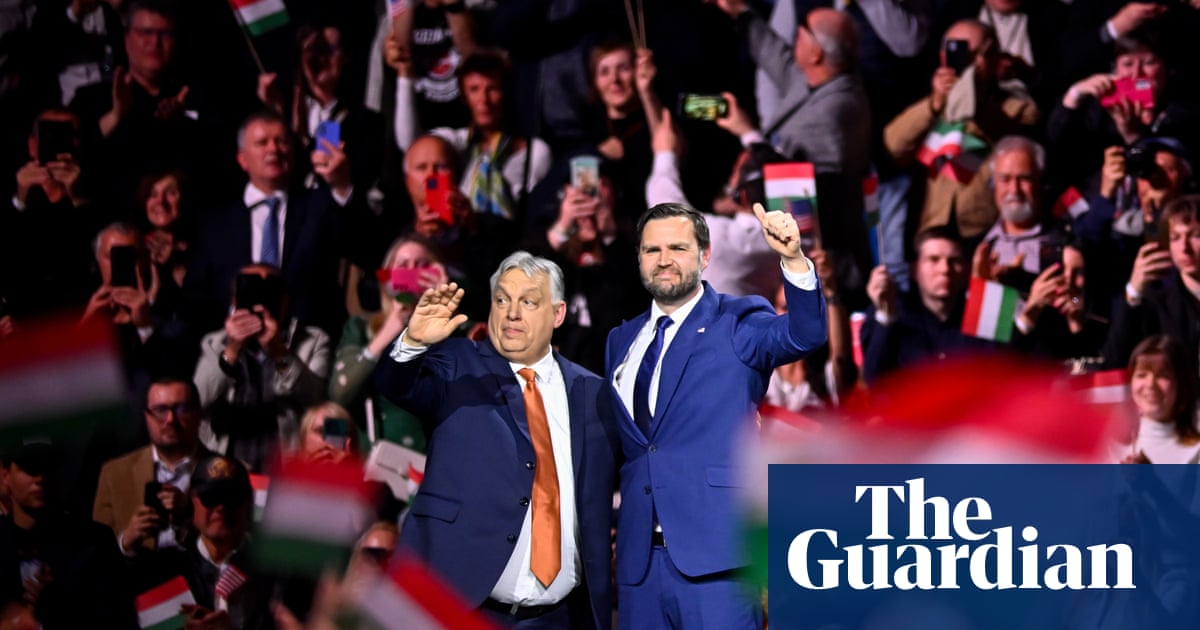
Viktor Orbán, left, and JD Vance at a pre-election rally in Budapest on Tuesday. Polls show the Hungarian leader could lose his 16-year grip on power. Photograph: Dénes Erdős/APView image in fullscreenViktor Orbán, left, and JD Vance at a pre-election rally in Budapest on Tuesday. Polls show the Hungarian leader could lose his 16-year grip on power. Photograph: Dénes Erdős/APAnalysisVance’s whirlwind visit may not help Orbán to the election victory he cravesAshifa Kassam in BudapestAs the US vice-president wades into a heated campaign, Hungary’s leader faces the real possibility of defeat
Even before the plane carrying JD and Usha Vance had landed in Budapest, the Hungarian government had hailed their two-day visit as a new golden age in the relationship between Washington and Budapest.
What came next was a whirlwind of politics in which the US vice-president waded directly into the country’s heated election campaign, just days before Hungarians cast their ballots.
As Vance crisscrossed the capital, turning up at the city’s Carmelite monastery and a later at a pre-election rally, he lauded Viktor Orbán and lambasted the US and Hungary’s “shared threat from within” of far-left ideology in universities, media and entertainment, all while breaking sharply with the unspoken convention that has long kept most politicians from playing an active role in foreign elections.
Read moreVance’s sharpest criticism of the day was reserved for the EU in comments that were likely to roil the already tense transatlantic relationship. Vance attacked the bloc, accusing it of foreign interference, even as he repeatedly stressed he had travelled to Hungary to “help” Orbán in the elections.
Hours later Vance joined Orbán at a pre-election rally, sending the packed football stadium into a frenzy as he dialled up Donald Trump and put the US president on speaker. “I love Hungary and I love that Viktor,” Trump told the cheering crowd as Vance held up the phone, describing him as a “fantastic man”.
The president, who earlier had warned that “a whole civilization will die tonight” if Tehran did not accept his demands in the US war in Iran, appeared to shift easily into campaign mode. “He’s kept your country good,” he told the crowd, as giant flags of the US and Hungary hung from the rafters. “And let me tell you, I like him a lot but if I didn’t think he did a good job, I wouldn’t be making a call like this.”
Meanwhile, the president’s eldest son was in Bosnia’s Serb Republic, making a show of support for its ousted pro-Russian leader Milorad Dodik, and criticising the European Union as “a disaster”.
Vance’s visit thrusts the US administration into a hard-fought campaign in which most polls suggest Orbán is facing the possibility of losing his 16-year grip on power. As Hungarians grapple with economic stagnation, deteriorating public services and rampant corruption, Orbán is facing an unprecedented challenge from Péter Magyar, a former top member of Orbán’s Fidesz party.
While officials in Budapest had held hopes that Trump himself would show up to help the Orbán campaign, they erupted in excitement when the White House confirmed Vance’s visit.
On Tuesday, as Air Force Two landed in Budapest, the country’s foreign minister, Péter Szijjártó, described the visit as historic. “There is no question that this is a golden age for Hungarian-American relations,” he said.
The day laid bare the shared playbook between Orbán and the Maga movement as the leaders railed against Brussels, migration, Ukraine and praised what Vance described as “the values of western civilisation.”
Read moreThroughout it all, Vance made little effort to conceal his intentions. “I am here for a simple reason, because I admire what you are fighting for,” he told the evening rally, sending the sea of Hungarian flags waving. “You are fighting for your freedom, for your sovereignty, and I am here because President Trump and I wish for your success and we are fighting right here with you.”
There was no mention, however, of the grievances that have propelled the opposition Tisza party to the top of the polls; a long-neglected public health system, wages that remain the third lowest in the EU and systemic corruption that ranks as the worst in the bloc.
Nor was there any mention of the scandals that have dogged Orbán during the campaign, from the allegations that Russian intelligence agencies, along with disinformation networks with links to Russia, were working to sway the election in his favour to the call in which Orbán reportedly told Vladimir Putin: “I am at your service”.
The clash of narratives has given rise to a polarising electoral campaign, in which Orbán has sought to portray the war in Ukraine as the country’s greatest threat, arguing that his personal relationships with world leaders makes him singularly capable of keeping Hungary peaceful, while Magyar has called on Hungarians to cast their vote based on domestic issues.
Even as the visit made headlines across the globe, analysts doubted it would do much to shift the election result. “The vast majority of Hungary’s 7.6 million voters have made up their minds regarding where their crosses are going on Sunday’s ballots,” said Mujtaba Rahman, the managing director for Europe at Eurasia Group, a political risk consultancy on social media. “Few of the 350K or so who haven’t and who might yet vote are unlikely to be persuaded by the razzamatazz provided by Vance’s soiree in town.”
Adding to this was the fact that Trump’s popularity among Hungarian society is questionable, while far fewer know who Vance is, Márton Bene, a political analyst at the TK Institute for Political Science in Budapest. “Consequently, [Trump’s] support in itself constitutes a real advantage only in the eyes of an increasingly narrow segment of voters.”
However, Bene saw potential for Vance’s visit to stir up controversy in the days following the election, given Vance’s sharp accusations of electoral interference from Brussels. “This provided an external reference point, articulated at the highest level, for that narrative, which could later offer important discursive resources for attempts to question the election result,” he said.
But the visit could have done more harm for Orbán than good, added Bene. For months the prime minister had sought to argue that he – and his connections – were the only means of keeping Hungary safe in a volatile world. During the press conference, however, Vance had said the US administration would work with any Hungarian administration that was elected.
“Péter Magyar was quick to seize on this statement,” said Bene, in a reference to the swift rejoinder the opposition candidate posted on social media, in which he said a Tisza government would regard the US as a key partner.
The result, said Bene, had “cast doubt” on one of the central claims of the Orbán campaign – one that the entire visit was aimed at highlighting. “Namely, that effective Hungarian interest representation is conceivable only through Orbán’s personal relationships.”