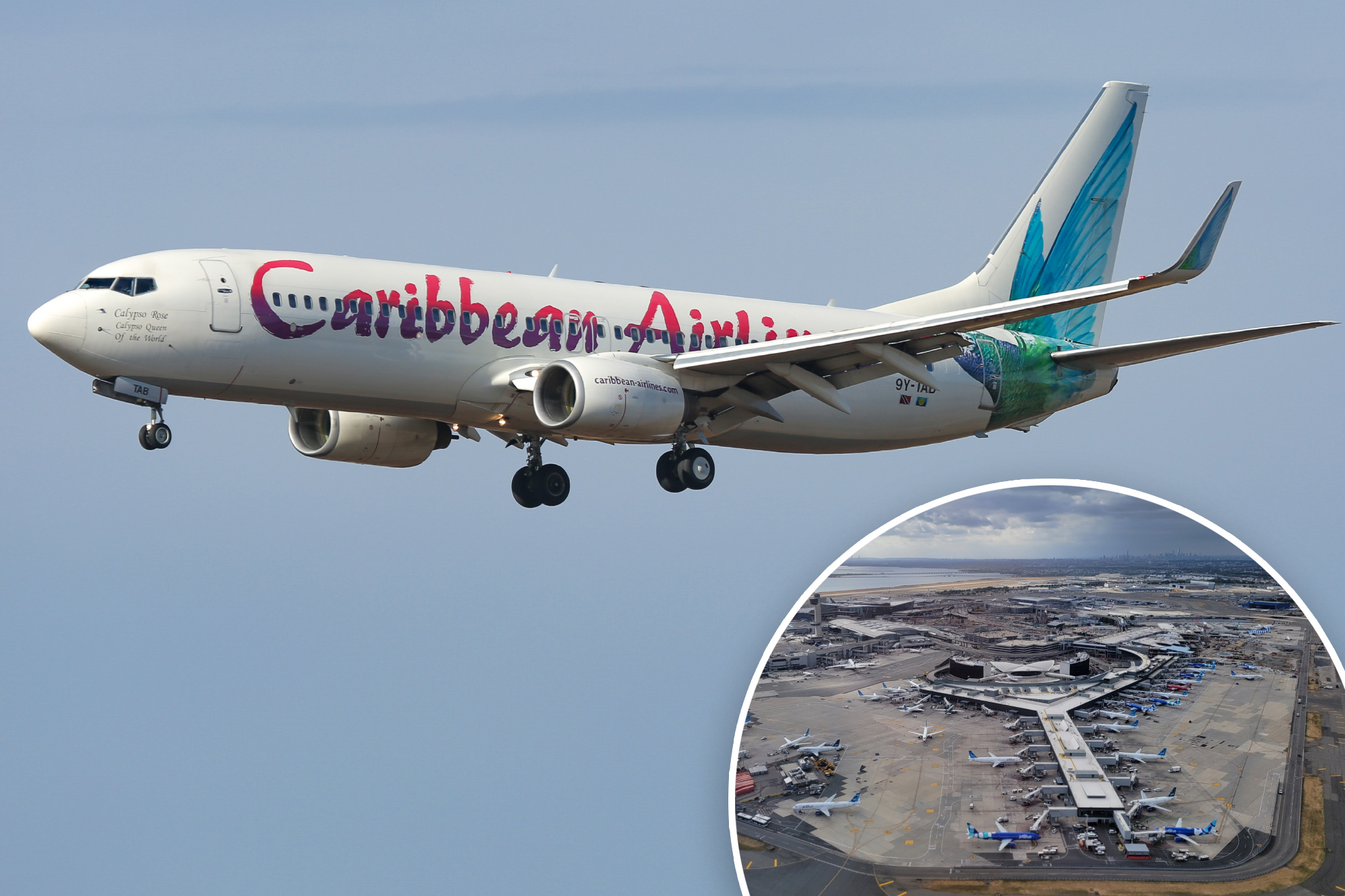
A passenger traveling on Caribbean Airlines from Jamaica to New York went into labor and gave birth as the flight was landing — leaving the baby’s citizenship unclear.
In a press release, the airline noted that the passenger gave birth on flight BW005 on April 4, en route from Kingston, Jamaica, to New York City just before noon.
The mother and newborn were attended to by medical personnel upon arrival at John F. Kennedy International Airport.
A passenger traveling on Caribbean Airlines from Jamaica to New York gave birth as the flight was landing. Nicolas Economou/NurPhoto via Getty Images “The airline commends the professionalism and measured response of its crew, who managed the situation in accordance with established procedures, ensuring the safety and comfort of all onboard,” the airline said. “Caribbean Airlines also confirms that no emergency was declared during the flight.”
In air traffic controller audio obtained by CBS News, a ground controller quipped that the child should be named “Kennedy” after the airport the flight landed at.
Caribbean Airlines allows pregnant passengers to fly without medical clearance up to the end of the 32nd week of pregnancy, but does not accept passengers after the 35th week, according to their website.
A situation like this is extremely rare, with 74 infants born on 73 commercial flights, of whom 71 survived delivery, between 1929 and 2018, according to a March 2020 study by the National Library of Medicine.
The baby’s citizenship could depend on who controls the airspace, experts say. Nate Hovee – stock.adobe.com However, the birth brings up some legal questions regarding the baby’s citizenship status.
Law by Mike said in a YouTube video, noting that, depending on the country, the baby’s citizenship could depend on the airspace or parental nationality.
“Now the big question is… is that baby a US citizen?” Brad Bernstein, an immigration lawyer, said in a video on his YouTube page. “Here’s the answer — depends on one thing: Where exactly that plane was in the sky at the moment of birth?”
Bernstein explained that if the baby was born in US airspace, then the child is automatically a US citizen under the 14th Amendment and State Department regulations.
However, if the baby were born “even a few minutes earlier outside of the United States airspace,” they wouldn’t be a US citizen.