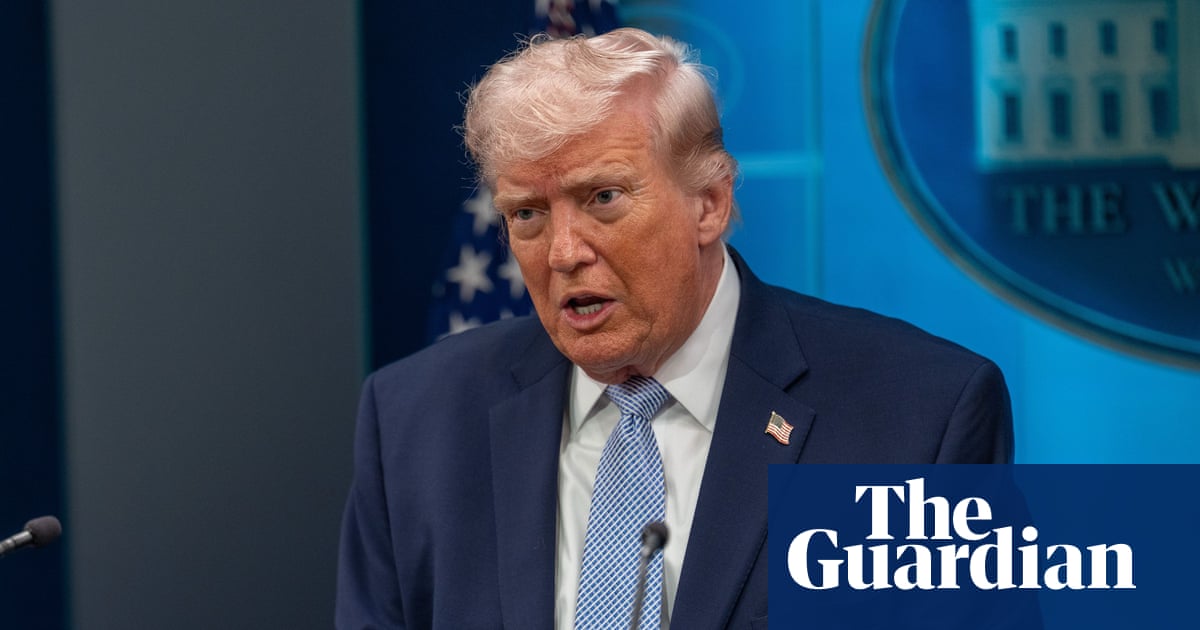
Donald Trump speaks in the White House press briefing room on Monday. Photograph: Andrew Leyden/Zuma Press Wire/ShutterstockView image in fullscreenDonald Trump speaks in the White House press briefing room on Monday. Photograph: Andrew Leyden/Zuma Press Wire/ShutterstockTrump warns ‘a whole civilization will die tonight’ unless Iran makes dealPresident threatens in Truth Social post to annihilate Iran if government ignores deadline to reopen strait of Hormuz
Donald Trump on Tuesday morning threatened to completely annihilate the entirety of Iranian civilization should their government ignore his 8pm ET deadline to reopen the strait of Hormuz.
“A whole civilization will die tonight, never to be brought back again,” the US president posted on Truth Social about the country with more than 90 million people. “I don’t want that to happen, but it probably will.”
Trump followed with a reference to “complete and total regime change” and signed off with “God Bless the Great People of Iran”, making a formulation that suggested the destruction of the state and the benediction of its people were in his telling, compatible.
“47 years of extortion, corruption, and death, will finally end,” he wrote, referencing the Islamic regimes takeover of the country in 1979. “We will find out tonight, one of the most important moments in the long and complex history of the World.”
Trump’s own words, posted publicly and tied to a specific deadline and set of demands, provide unusually direct evidence of intent to violate international law.
Neither the US nor Iran is a member of the international criminal court, meaning no formal ICC jurisdiction applies. The more immediate legal framework is the Geneva conventions of 1949 onwards, which both countries have ratified. Article 33 of the Fourth Convention explicitly prohibits collective punishment of a civilian population. Article 54 of Additional Protocol I – whose core principles are binding as customary international law even on states, like the US and Iran, that never ratified it – prohibits attacks on infrastructure indispensable to civilian survival, with only a narrow exception for objects used exclusively to sustain enemy armed forces.
The US has itself acknowledged this customary obligation, though the position came under the Biden administration in 2024. In one formal UN submission, Washington said it treats the fundamental protections of Additional Protocol I as legally binding even without ratification.
The Truth Social post came the morning after a chaotic White House press conference in which Trump voiced his threats to reporters. “The entire country could be taken out in one night,” he told reporters on Monday, “and that night might be tomorrow night.”
When a reporter noted that deliberate attacks on civilian infrastructure violate the Geneva conventions, Trump did not dispute the point. “I hope I don’t have to do it,” he said, then pivoted: “Forty-seven years they’ve been negotiating with these people. They’re great negotiators, and because they’re not going to have a nuclear weapon.” Asked whether the war was winding down or escalating, he said only: “I can’t tell you.” Asked about a ceasefire, he said: “I can’t talk about the ceasefire.”
He reiterated the 8pm ET Tuesday deadline for Iran to reopen the strait or face strikes on energy infrastructure and bridges. Iran’s Islamic Revolutionary Guard navy for their part said on Monday that the strait of Hormuz “will never return to its previous state” for the US and its allies.
Trump also claimed, without providing evidence, that US intelligence had intercepted communications from Iranian civilians near active bombing sites urging American forces to continue. “Please keep bombing,” he quoted the alleged intercepts as saying. He dismissed concerns that destroying power and water infrastructure would harm ordinary Iranians, insisting they would willingly endure such losses for the chance at regime change.
The military campaign is being followed by Trump’s $1.5tn Pentagon budget request, submitted last week alongside sweeping cuts to domestic programs.
The rhetorical escalation of recent days also sits alongside a pattern of contradictions. Trump said in recent weeks that the US had no strategic need for the strait of Hormuz; days later he made its reopening the central condition of his ultimatum to Tehran. He claimed total dominance of Iranian airspace even as a US fighter jet was shot down over the country.
And he declared the war won, but now threatens its most destructive phase yet.