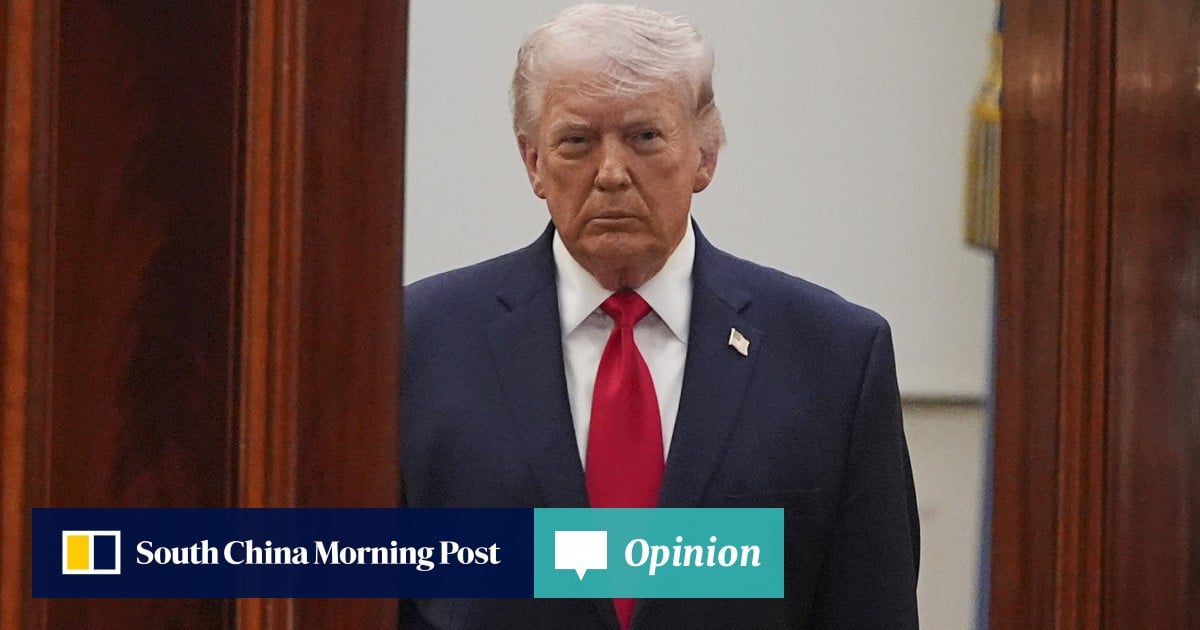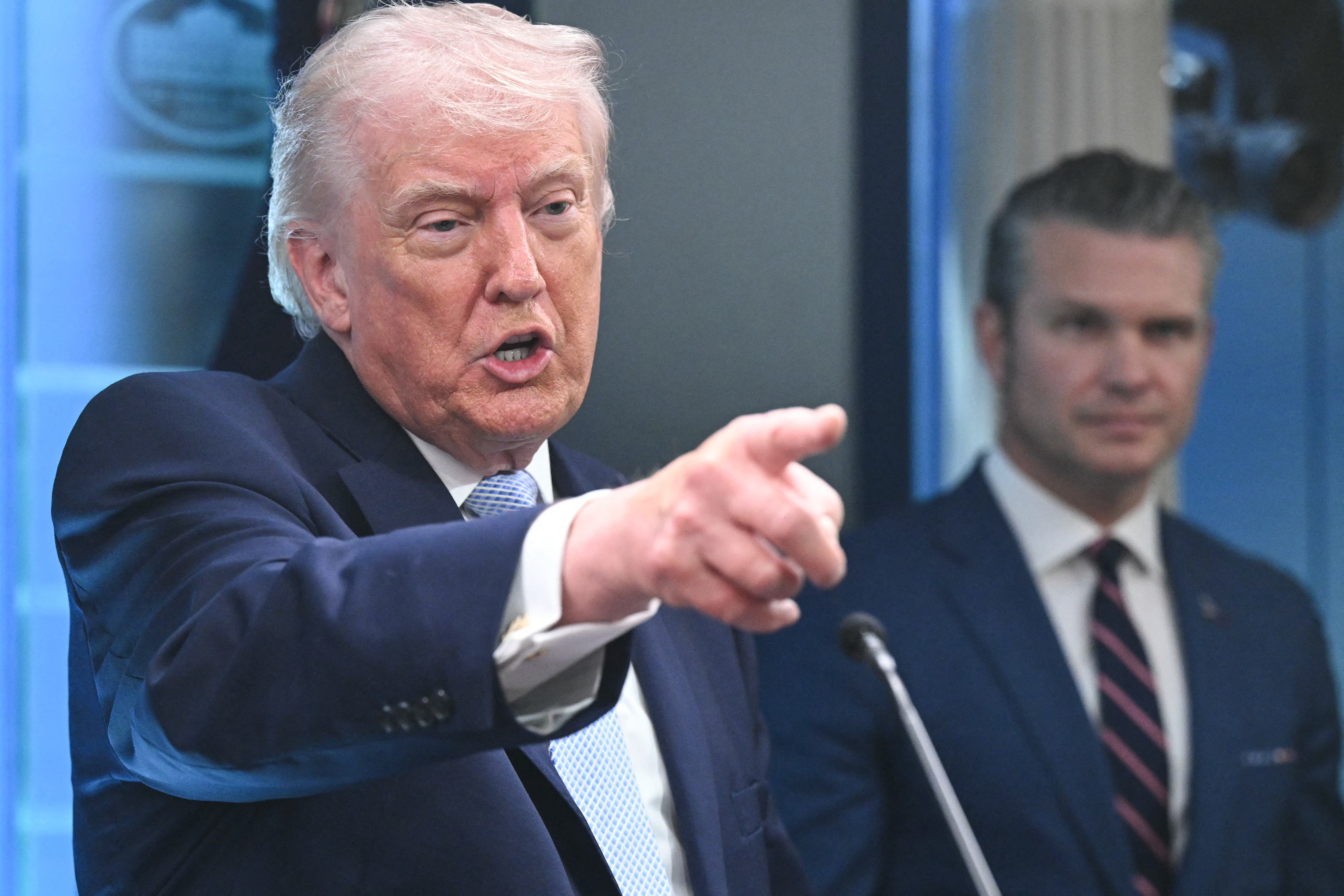
President Trump, alongside Secretary of War Pete Hegseth, speaks about the conflict in Iran at the White House on April 5, 2026. AFP via Getty Images If he has to choose between guns and butter, President Donald Trump has made it clear he wants the guns.
This is the right choice for our national security, and reflects, as well, a correct assessment of what should be the federal government’s priority — not funding social services, but providing for the common defense.
Trump’s new budget proposes $1.5 trillion in defense spending in fiscal year 2027, a staggering 40% increase over 2026.
At the same time, it outlines a 10% cut in so-called domestic discretionary programs (a category that excludes entitlement programs like Medicare and Social Security).
Trump’s new budget proposes $1.5 trillion in defense spending in fiscal year 2027, a staggering 40% increase over 2026. via REUTERS
Progressives consider this tantamount to a crime against humanity.
Senate Minority Leader Chuck Schumer called the budget “rotten to the core.”
Sen. Patty Murray of Washington said its vision is “bleak and unacceptable.”
Her colleague from Oregon, Jeff Merkley, deemed the document “an out-of-touch plea for more money for guns and bombs, and less for the things people need.”
Well, people do need a military to protect us from enemies who want to kill Americans and end US geopolitical pre-eminence, bringing all manner of negative consequences for our economy and safety.
We are not exactly living in a time of peace and stability.
The United States is embroiled in a war in the Middle East that has rocked global energy markets, while Russia has repeatedly invaded a neighboring country to its west, and China could be on the cusp of precipitating the greatest major-power conflict since World War II.
This is not a time — if one ever existed — when the fate of the country depends on robust federal funding for community development block grants.
“The United States can’t take care of day care,” he said last week.
“That has to be up to a state. We’re fighting wars.
“Medicaid, Medicare — they can do it on a state basis. We have to take care of one thing: military protection.”
Fighting and deterring wars should indeed be the prime responsibility of the federal government, rather than sending federal dollars sluicing throughout the nation to fund priorities large and small, worthy and utterly ridiculous.
In characteristic fashion, The New York Times noted of Trump’s budget that some of “the most severe cuts would reduce or eliminate funding that benefits minority groups and their communities,” and also remarked that the administration seeks “to scrap money designed to reduce racial disparities in health and those supporting gay, lesbian, bisexual and transgender people.”
The mock headline writes itself: “Trump Seeks World-Class Military — Minorities and LGBTQ+ Community Hardest Hit.”
There is no doubt that the scale of Trump budget, which would be the biggest single-year increase in defense spending since the Korean War, is equal to the international challenge that we face.
Much depends, though, on what specifically the budget funds, and how effectively the money is eventually spent.
Start your day with all you need to know Morning Report delivers the latest news, videos, photos and more.
In broad gauge, the priorities are the right ones, reflecting a new age of high-tech warfare and our shortfalls in shipbuilding.
The Pentagon is requesting $11.36 billion for Air Force missile procurement in 2027, an enormous increase from $3.7 billion in 2026.
The missile budget is projected to keep growing: In 2029, it would be $16 billion, an 8-fold increase from 2021.
As for the Navy, it wants roughly $65 billion for building ships, more than doubling the $27.2 billion in 2026.
In terms of bang for the buck, the administration has begun to fund more nimble, tech-driven defense firms, while it pushes the traditional big players like Boeing and Lockheed to become faster and more efficient.
As a practical matter, the president is unlikely to get all the defense spending that he wants from Congress — which, when confronted with a choice between guns and better, always chooses both.
But Trump is right to go big, to focus on the federal spending that could win or lose a war, and to determine our fate as a great power.