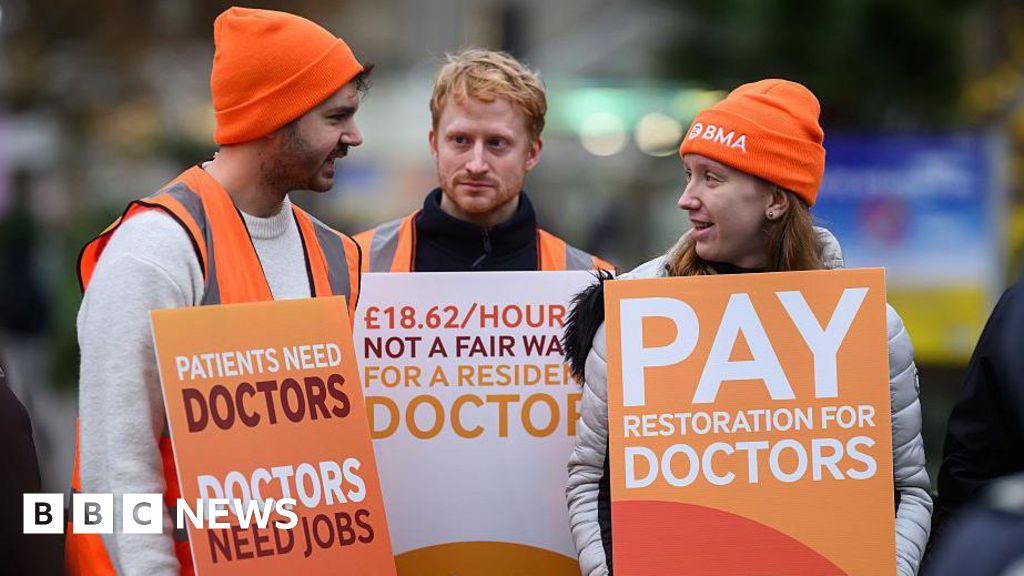
ShareSaveAdd as preferred on GoogleGetty ImagesResident doctors in England have begun a six-day strike, their 15th in a long-running dispute over pay.
The BMA, which represents doctors, says not enough has been done to address concerns about pay and job shortages, while the government says their expectations are unreasonable and unrealistic.
The NHS is urging patients not to put off seeking help during the strike, telling those with emergency and urgent needs to use 999 and 111 as normal.
Resident doctors are qualified doctors who have completed a medical degree.
They make up nearly half of all doctors in England, and work across the NHS including in A&E and GP surgeries.
After their initial degree and the mandatory two years of post-graduate foundation training, many choose to specialise in a particular area of medicine or surgery.
They used to be known as junior doctors, but in September 2024 the government agreed to change the name of their role to better reflect their expertise.
Full training can take a long time, so although some resident doctors may have only recently finished medical school, others could have more than a decade of practical experience and be responsible for most aspects of care.
During their first foundation year after finishing their medical degree, resident doctors in England earn a basic salary of just over £40,000.
After several years, the most senior resident doctors get £76,500 in basic pay.
Medics are often expected to work night shifts, weekends and longer hours, for which they receive extra payments on top of their base salary.
In 2023 and 2024, resident doctors received pay rises totalling 22%, and got an additional 5.4% in 2025.
Pay rose by 3.5% in April 2026 as part of the annual settlement for all doctors.
The BMA has called a series of strikes in England over pay and working conditions since 2023.
Despite receiving pay rises worth 33% over the past four years, the union argues that doctors are still being paid a fifth less than they were in 2008 once inflation is taken into account.
The government uses the Consumer Prices Index (CPI) measure of inflation to calculate public sector pay increases.
However, the BMA says many resident doctors have large student loans and that interest on these is calculated using a different inflation measure called RPI, which is higher.
Using the CPI measure, the government has repeatedly said resident doctors' current pay is fair.
Health Secretary Wes Streeting insists resident doctors have received the largest pay rises of any public sector employees over the last three years.
Speaking to the BBC as the latest strike began, he said the government had negotiated with the BMA "in good faith", and criticised its decision to reject the latest offer made in March.
As part of a package of measures, ministers promised to accelerate the expansion of specialist training posts, which resident doctors move into in their third year of training.
In 2025, there were more than 30,000 applicants for 10,000 of these jobs - some from abroad.
The government said it would increase the number of posts by 4,000 by 2028 – with the first 1,000 available in 2026 – and would let the NHS prioritise doctors who had studied and worked in the UK when filling these posts.
It also offered to cover some out-of-pocket expenses such as exam fees as well as ensuring faster pay progression through the five salary bands that span training.
But the BMA ended the talks saying the deal - and in particular the pay progression element - had been watered-down at the last minute.
As a a result the offer to create the additional 1,000 posts was withdrawn.
Dr Jack Fletcher, chair of the BMA's resident doctor committee, told the BBC that he was "genuinely very sorry" about disruption to patient care, but noted that such delays also occurred "without strike action" because of a lack of specialists and GPs.
"The way out of this is to get around the negotiating table, as we were for eight or so weeks, talk constructively to get a deal, to get us out of this."
The latest polling from YouGov suggests 53% of people oppose the strikes, with 38% supporting them.
The strike in England is due to last from 0700 BST on 7 April to 0659 on 13 April.
The NHS says patients should continue to come forward for care during the strike period.
Those with emergencies should use 999 and 111 as normal, with senior medics are being drafted in to provide cover.
For urgent, non-life-threatening issues, the advice is to use the NHS 111 website or to call the helpline.
Patients who have planned appointments and treatments scheduled should attend unless they are told otherwise. GP services are largely unaffected.
During previous industrial action, hospitals were told they should only cancel routine appointments in exceptional circumstances.
But it's possible that appointments and operations could be disrupted for thousands of patients.
Scotland, Wales and Northern Ireland are not affected by this planned walk-out.