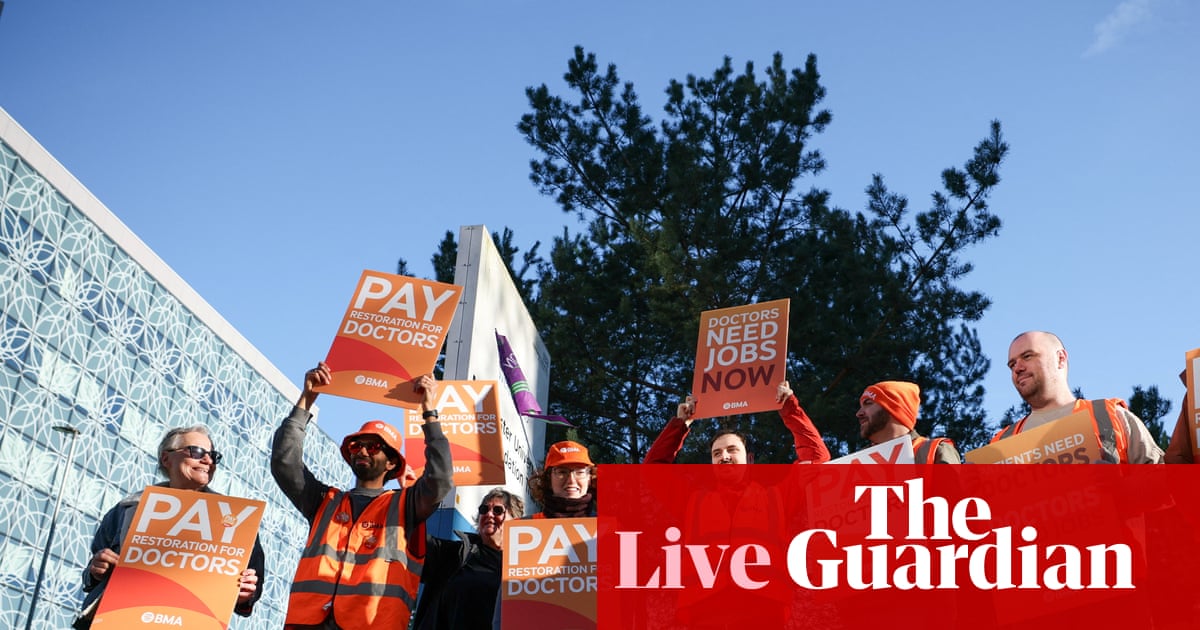
Good morning. Resident doctors in English hospitals started a six-day strike at 7am this morning. Many of them will continue to work, but there will be enough of them joining the strike to have a significant impact on the care hospitals can deliver. It is the 15th resident doctors (who used to be known as junior doctors) have been on stage since they launched a campaign in 2023 to get their pay back to the equivalent level it used to be before austerity kicked in after the financial crash.
This morning Wes Streeting, the health secretary, deployed a new statistic in his PR battle against the BMA, the doctors’ union organised the strikes. He confirmed a figure highlighted in the Daily Mail’s splash saying strikes by resident doctors have now cost the country £3bn.
In an interview with the Today programme, asked if that was an official government figure, Streeting replied:
double quotation markWe think that strikes cost £50m a day. And so that is, an accurate reflection of the cost of these strikes.
But, when it was put to him the BMA is saying that £3bn is about what it would have cost to give the resident doctors the pay rise they are demaning, Streeting would not accept this. He replied:
double quotation markWhat is true is that in order to deliver a full pay restoration back to 2008 levels, using the RPI account of inflation, it would cost in the order of £3bn a year.
Let’s then assume that other NHS staff would understandably demand the same. Then that cost would be more like £30bn a year. That is more than the entire cost of the Ministry of Justice’s entire budget for running the criminal justice system.
Now, this goes to the heart of the intransigence of the BMA. Despite being the biggest winner by a country mile of public sector pay increases – since this government came in, 28.9% is what they got from us – within weeks of taking office, they still went out on strike.
Andrew Gregory and Peter Walker have more from what Streeting has been saying about the strike here.
Read moreI will post more from Streeting’s broadcast interviews this morning shortly.
7am: Resident doctors started a six-day strike in England. (Rather, some of them did – in the past, many doctors have chosen to work rather than to join the BMA strike.)
9.15am: John Swinney, SNP leader and Scottish first minister, holds a campaign event focused on fuel prices. Anas Sarwar, the Scottish Labour leader, is holding a campaign event focused on pothole policy (at 9.30am), and Russell Findlay, the Scottish Conservative leader, is launching his manifesto (at 2pm).
11.30am: Downing Street holds a lobby briefing.
Morning: Ed Davey, the Lib Dem leader, is campaigning in Newcastle.
12.30pm: Nigel Farage, the Reform UK leader, is holding a press conference in Warwickshire.
Afternoon: Military planners from around 35 countries interested in plans to keep the strait of Hormuz open after the Iran war ends meet to discuss options at the UK’s Permanent Joint Headquarters in Northwood, north-west London.
If you want to contact me, please post a message below the line when comments are open (between 10am and 3pm), or message me on social media. I can’t read all the messages BTL, but if you put “Andrew” in a message aimed at me, I am more likely to see it because I search for posts containing that word.
If you want to flag something up urgently, it is best to use social media. You can reach me on Bluesky at @andrewsparrowgdn.bsky.social. The Guardian has given up posting from its official accounts on X, but individual Guardian journalists are there, I still have my account, and if you message me there at @AndrewSparrow, I will see it and respond if necessary.
I find it very helpful when readers point out mistakes, even minor typos. No error is too small to correct. And I find your questions very interesting too. I can’t promise to reply to them all, but I will try to reply to as many as I can, either BTL or sometimes in the blog.