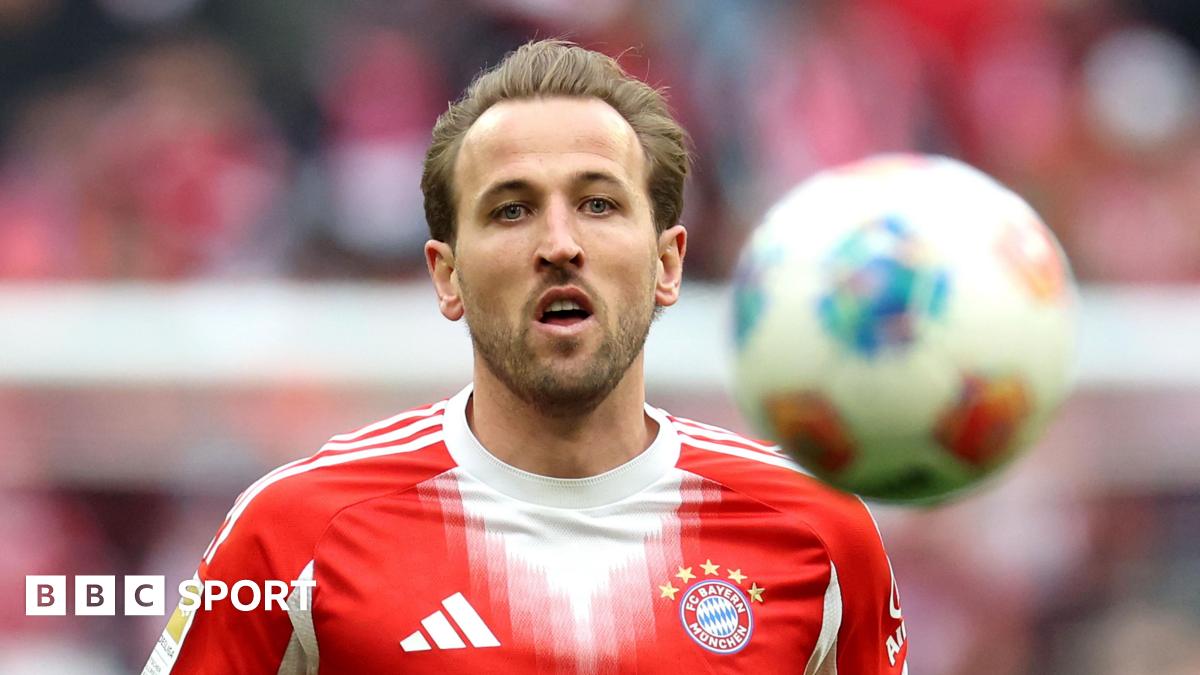
The Englishman has scored 53 times in 45 appearances for club and country this term but knows goals alone won't be enough to land the award, which is why he will be desperate to be fit for Bayern Munich's crunch Champions League game against Real Madrid on Tuesday (20:00 BST).
Kane, who missed Saturday's dramatic 3-2 victory at Freiburg because of the injury, ended his trophy drought by winning the Bundesliga last season, but more domestic honours in Germany won't secure him football's most prestigious individual prize.
Rightly or wrongly, the Ballon d'Or isn't simply a case of rewarding solo brilliance. It is increasingly a prerequisite to also being part of a team that lands one of the game's biggest titles - the Champions League, World Cup or a continental equivalent such as the European Championship.
Kane will get two bites at the cherry this year, captaining England at the World Cup in the summer, but his first – and arguably best - chance comes with Bayern.
The Bavarians have been in scintillating form this season, winning 37 of 43 games, but will need their talisman fit and firing as their European credentials are tested in a quarter-final first leg at the Bernabeu.
"I could score 100 goals this season, but if I don't win the Champions League or the World Cup, you're probably not going to win the Ballon d'Or," Kane said in November. "It's the same with any player. You have to be winning those major trophies."
History suggests he is right. Since 2006, almost 80% of Ballon d'Or winners have claimed the accolade in a year when they also lifted either the Champions League or a major international tournament, such as the World Cup, Euros or Copa America.
Only two players have defied that trend in the past two decades and both are all-time greats who can be considered outliers. Lionel Messi won the award in 2010, 2012 and 2019 despite Champions League semi-final exits for his Barcelona side, with Cristiano Ronaldo taking the prize in 2013, when Real Madrid bowed out of the competition at the same stage.
The pattern is even more pronounced in recent seasons. Ten of the previous 11 Ballon d'Or winners did so off the back of a Champions League victory or major international title, including each of the past five.
Changes to the award, created by France Football magazine in 1956, may have exacerbated this. Until 2021, players were honoured for performances over a calendar year, straddling two different seasons. But since 2022 it has been aligned with a single campaign in the elite European leagues, starting in August.
Journalists from the top 100 Fifa-ranked nations decide who wins and are encouraged to factor in "individual performances" along with "class and fair play". But it appears the third element assessed – "team performances and achievements" – is the decisive factor.
Tuesday's game at the Bernabeu could be doubly significant for Kane's Ballon d'Or chances as he will go head-to-head with Real Madrid star Kylian Mbappe, who is also yet to win the award but is enjoying a stellar second season in Spain.
Mbappe has 38 goals and 43 goal involvements in all competitions this term, with both totals second only to Kane among players at clubs in the top five European leagues.
Like Kane, the 27-year-old has not won the Champions League before. But he is the top scorer in this year's competition with 13 goals, just four away from equalling the record in a single season.
France's captain also has 12 World Cup goals to his name, putting him within striking distance of Miroslav Klose's all-time record of 16. If he can fire Real Madrid or France to glory in the next few months, setting new milestones for good measure, his Ballon d'Or credentials could become irresistible.
Another French threat is Kane's Bayern team-mate Michael Olise, who has established himself as key player for Les Bleus in the past 12 months. The London-born winger has added end product to his game since leaving Crystal Palace in 2024 and has 24 assists this term, comfortably the most for a team in one of Europe's leading leagues.
Barcelona's Lamine Yamal, the 2025 Ballon d'Or runner-up, is also equally adept at creating and scoring goals. He doesn't turn 19 until July but has gone from strength to strength for La Liga leaders Barcelona and World Cup favourites Spain.
He has already shattered a host of age-related records and could become the first teenage winner of the award.
Wingers Vinicius Jr and Raphinha risk being overshadowed by Mbappe and Yamal for Real and Barca respectively but could catapult themselves into contention if they shine for Brazil at the World Cup.
The tournament in North America could also represent a final chance for eight-time winner Messi and five-time winner Ronaldo to add to their hauls. Players with non-European clubs have been eligible for the prize since 2007, though in reality the two veterans will be judged almost entirely on their international impact over the summer.
The Ballon d'Or has gone to a British player just seven times before and it has been almost a quarter of a century since the last winner.
England winger Stanley Matthews, then aged 41, claimed the inaugural title in 1956 before a golden period in the 1960s, with wins for Manchester United's 'Holy Trinity' of Denis Law (1964), Bobby Charlton (1966) and George Best (1968).
Kane can take inspiration from the example of Kevin Keegan, who scored goals galore in England but only won the award following a move to Germany, doing so in back-to-back years with Hamburg in 1978 and 1979.
The only Briton to top the voting since then is Michael Owen with Liverpool in 2001. Though only 22, the Englishman was at the peak of his powers, still boasting electrifying pace which eventually faded as a result of injuries.
He was chosen after helping the Merseysiders win three cup finals plus a famous hat-trick as England thrashed Germany 5-1 in a World Cup qualifier in Munich.
Since then the award has been dominated by players at continental clubs, particularly Barcelona and Real Madrid, who between them have provided 15 of the past 23 Ballon d'Or winners.
Just three Britons have made the top three during this period - Frank Lampard was runner-up in 2005, with Steven Gerrard third, while Jude Bellingham finished third in 2024.
Perhaps ominously for Kane, no player at a German side has taken the prize since Dortmund's Matthias Sammer in 1996, though Robert Lewandowski was unfortunate to miss out with Bayern in 2020, when the award was controversially cancelled because of the coronavirus pandemic.
There will also be a Champions League Match of the Day on BBC One on Wednesday, at 22:40.