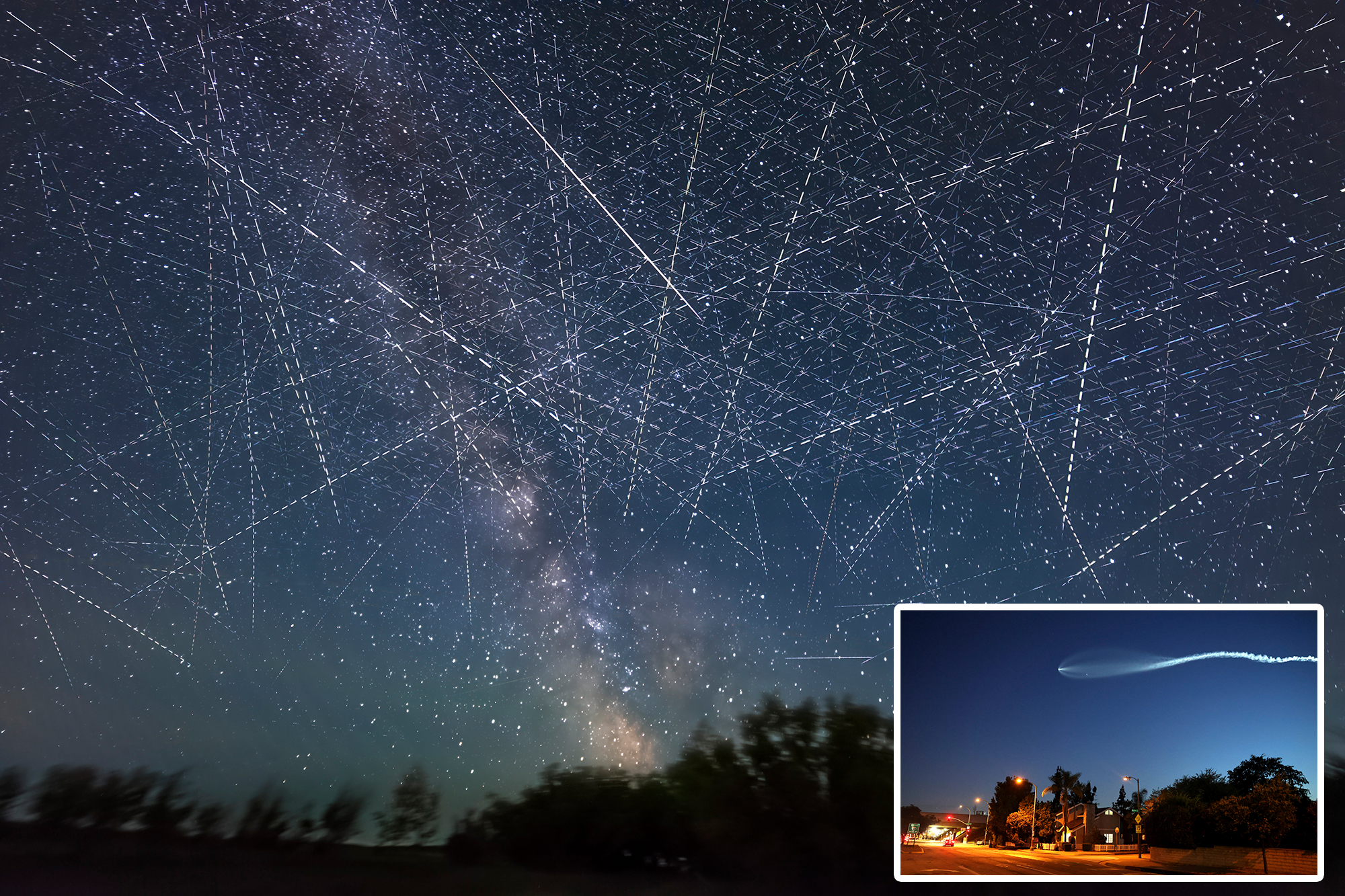
Scientists are ripping plans by Reflect Orbital to install thousands of mirrors in space, claiming that it could disrupt sleep and wreak havoc on the environment. VWPics/Universal Images Group via Getty Images It’s keeping scientists up at night.
Scientists around the world are sounding the alarm over an ambitious plan to install thousands of mirrors and myriad satellites in space, claiming that it will impact sleep and various ecosystems on a global level.
“The proposed scale of orbital deployment would represent a significant alteration of the natural night-time light environment at a planetary scale,” leaders of the European Biological Rhythms Society (EBRS), the Society for Research on Biological Rhythms, the Japanese Society for Chronobiology and the Canadian Society for Chronobiology declared in letters to the US Federal Communications Commission The Guardian reported.
The SpaceX Falcon 9 rocket launches EchoStar 25 from Launch Complex 40 at the Cape Canaveral Space Force Station, Florida on Tuesday, March 10, 2026. Joe Marino/UPI/Shutterstock They were referring to a James Bond movie-esque proposal by California startup Reflect Orbital to dispatch 50,000 mirrors in low orbit. In theory, these would redirect sunlight to the planet’s night side, potentially powering solar farms after sundown, providing light for rescue workers, and other applications.
The company could illuminate swaths between three and four miles with these cosmic night lights, whose brightness would range “from full moon to full noon,” per the firm. Reflect Orbital is already awaiting Federal Communications Commission (FCC) approval to launch a test satellite with a 60-foot-wide mirror into space with the potential to get the project off the ground as early as this summer, the New York Times reported.
This celestial “vanity” project coincides with a plan by SpaceX to launch a staggering one million satellites into space to form a veritable constellation of AI data centers, thereby taking a load off their terrestrial counterparts.
Environmentalists warned that these spacey installations would cause a catastrophe back on Earth. “Scientific studies have already shown that the existing number of satellites in orbit (around 15,000) has increased diffuse night sky brightness, or sky glow, by roughly 10%,” declared Ruskin Hartley, the chief executive and executive director of DarkSky International, a non-profit focused on fighting light pollution.
“The proposed scale of orbital deployment would represent a significant alteration of the natural night-time light environment at a planetary scale,” leaders of the European Biological Rhythms Society (EBRS), the Society for Research on Biological Rhythms, the Japanese Society for Chronobiology and the Canadian Society for Chronobiology declared in letters to the US Federal Communications Commission. Getty Images Meanwhile, biomedical science professor Professor Tami Martino, who is president of the Canadian Society of Chronobiology, cautioned that this could throw our biological clocks off-kilter.
“Circadian systems are sensitive to light levels far below what humans typically perceive as bright,” she declared. “If the night sky becomes permanently brighter, the consequences could ripple through ecosystems in ways we do not yet fully understand.”
Meanwhile, the presidents of World Sleep Society, European Sleep Research Society, Sleep Health Foundation, Australian Sleep Association and Australasian Chronobiology Society wrote in a letter that throwing the circadian rhythm is not mere inconvenience; it is a physiological mechanism driving major adverse health consequences.”
One could perhaps think of it like of Alaska’s endless, slumber-disrupting summer light, which natives combat using blackout curtains.
At an ecological level, the number of satellites could blot out the sky, potentially disrupting the migration routes of bugs, birds and other animals that use the stars as a navigation tool.
A coalition of astronomers used using the website of astrophysicist Jonathan McDowell to create a simulation of what SpaceX’s one-million satellite project would do to the night sky.
They found that there would indeed be more satellites than perceptible stars.
“Should a million new satellites be launched, in the orbits and with the sizes proposed, the stars we are able to see at night would be completely overwhelmed by artificial satellites — throughout the world,” they wrote.
They theorized that this cosmic overcrowding would up the up the collision risk, and even increase the atmospheric pollution due to waste heat from the orbital AI data centers, among other ramifications.
Meanwhile, falling satellites that don’t burn up upon reentry into Earth’s atmosphere could cause debris to hurtle to the ground and potentially kill and injure people on the ground.