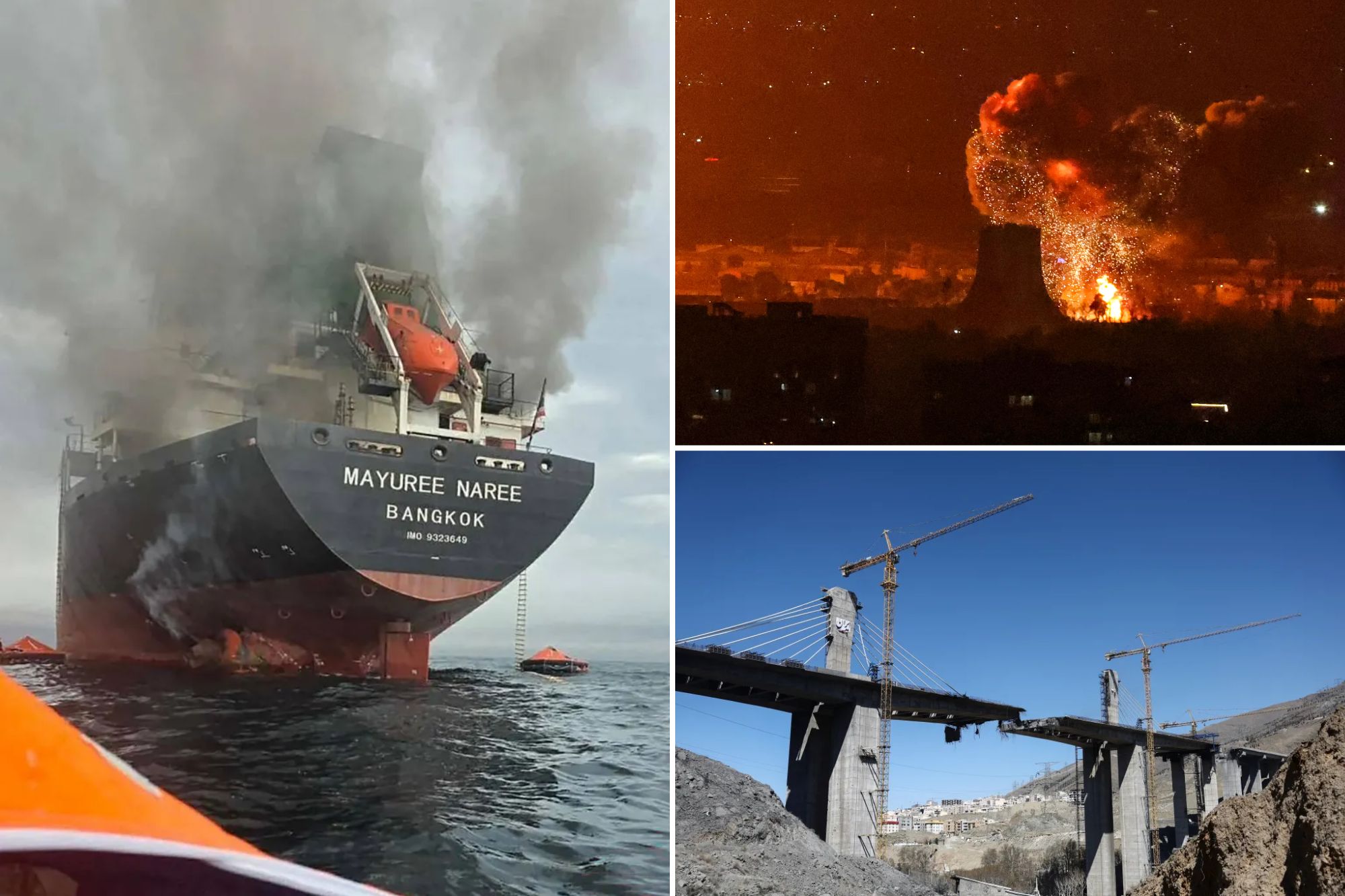
An explosion erupts after US-Israeli strikes in Tehran, Iran, on March 7, 2026. AFP via Getty Images As the war with Iran approaches the climactic phase, I would expect Americans to have a clear idea of what the fight is about.
Donald Trump excels as a cheerleader, not as a teacher or explainer. He’s a man bereft of doubt, who has trouble understanding the uncertainties that haunt the rest of us mere mortals.
And of course, the vast anti-Trump alliance has a stake in sowing confusion.
The president has a mighty voice, but his opponents are just as loud — and they believe that promoting an American catastrophe, if it hurts Trump, would be for the greater good.
So allow me, good reader, to cut through the Trumpian boasts, the fog of war, Democratic hysteria and media falsifications, and offer you simple answers to the 10 most important questions about the Iran war.
From its birth, when it kept our embassy personnel captive as hostages for 444 days, the Islamic Republic of Iran has been attacking the United States.
Both directly and through terrorist proxies, it has killed thousands of Americans around the world.
Hostility to the Great Satan — that would be us — is the reason for the regime’s existence.
For decades, every week, the ayatollahs have led crowds in chanting “Death to America.” It’s the core of their ideological creed.
Now they are developing thermonuclear bombs and missiles with the range to make their wishes come true.
Past presidents tried economic sanctions against Iran. That was peaceful but ineffective.
Other presidents tried to bribe the Iranians. That was peaceful and extraordinarily stupid.
Nukes plus missiles plus “Death to America” is the reason we attacked.
Victory, not fairness, is the objective of every war.
Combatants rarely wish to be proportionate or sporting. They aim to annihilate the other side as quickly and completely as possible.
We hit the ayatollahs when we did because they were in a vulnerable condition.
That ended with the US bunker-bombing two underground nuclear facilities.
That, in turn, was followed by months of anti-regime unrest that paralyzed the country and only ended with the slaughter of tens of thousands of protesters.
We could have waited until Iran picked itself off the ground, got its defenses together, stockpiled more missiles and drones.
Institutions that pretend otherwise, like the United Nations and the International Court of Justice, exist primarily to punish Israel.
A war is either just or unjust — and this is determined by the circumstances of the conflict and the moral valence of the combatants.
The circumstances of the present war are straightforward. The ayatollahs had threatened “Death to America” and were developing the means to achieve that goal.
As for moral valence — I happen to think the US is, and always has been, a force for good in the world.
But the Islamic Republic easily beats North Korea for the title of most abominable regime on earth.
In this year 2026, the ruling clerics still have women stoned to death for adultery.
They imprison, torture and murder their own people in industrial numbers.
They equip and train some of the bloodiest terrorist groups around — Hezbollah, Hamas and the Houthis, for example.
In brief, they are death and misery to their population and to those unfortunate enough to be their neighbors.
Any war that weakens or dethrones this gang of killers is more than morally justified — it’s an act of righteous retribution.
I find it baffling that anyone can watch Trump for 60 seconds and believe he’s being led around by the likes of Vladimir Putin or Benjamin Netanyahu.
For existential reasons, the Israelis need regime change in Iran.
Trump just wants a regime he can deal with. That’s what he did in Venezuela and is attempting to do in Cuba.
Israel is an amazing ally — but Trump’s driving the car. If it suits his purposes, he will bring the war to a conclusion well short of regime change.
Well, many clearly hope so — the Democrats, the news media, the Euro-elites, and anti-“Zionist” conspiracy-mongers like Tucker Carlson.
For them, this isn’t a fight between a democratic nation and a terrorist regime. It’s all about Trump, and they would gladly see the terrorists win big if it meant defeat for the president.
Iran’s top leadership is gone with the wind. So are the Iranian air force, navy and air defenses. Rocket launch sites and military industries have been degraded. The regime’s capacity to build a nuclear bomb has been set back for years.
But a political settlement will be tough and messy. And as I said, it’s not just the Iranian theocrats who are rooting for an American defeat.
It will fall on Secretary of State Marco Rubio and his diplomats to ensure that victory on the ground isn’t transformed into defeat at the negotiating table.
It’s a narrow bit of water opening into the Persian Gulf — a choke-point for the 20% or so of the petroleum shipped from the region to world markets.
In retaliation for US attacks, the Iranians have closed the Strait of Hormuz to navigation. The consequent spike in energy prices has had an unhappy effect on the economy.
The Iranians care about the Strait of Hormuz because they believe it’s their last viable weapon.
The Arab sheikdoms care because they have to get their oil out to market.
China and Europe care because they need that oil to feed their economies.
Interestingly, the US, which is self-sufficient in energy, doesn’t give a hoot about the Strait of Hormuz.
“We don’t need it,” said Trump in his televised address.
For those countries that do need it, Trump had two helpful suggestions.
Either buy oil from the US or “build up some delayed courage” and get their naval forces involved to keep the strait open.
7. What’s the story with Europe and NATO? It’s simple.
Most NATO countries are ruled by Euro-elites who utterly despise Trump. Their nations are economically weak and militarily impotent.
They preach a world order ruled by abstractions, making a virtue of helplessness.
Trump, who is changing the world concretely, terrifies them. They want him gone.
In the past, when Europe got in trouble outside of NATO’s area of responsibility, the US faithfully came to the rescue. Serbia and Ukraine are two of many examples.
At present, many European countries have denied use of their airspace and of US bases in their territory in the war against the ayatollahs.
This has been accompanied by a loud screech of anti-American rhetoric. Some European governments, like that of Spain, seem to be actively siding with Iran.
President Trump isn’t a forgiving man. There will be consequences.
But if Iran is either neutralized or converted into an American protectorate, Russia will lose one of its most useful allies, and China will find that importing the energy needed to fuel its massive economy will require American approval — specifically, the good will of Donald Trump.
The US and the Israelis will continue to strike at regime personnel and facilities until they run out of feasible targets.
The one decision yet to be made is whether to mount an amphibious assault on Kharg Island, terminal point for all of Iran’s petroleum exports.
Such an assault would entail the kind of savage fighting and heavy casualties that Trump has so far avoided.
But the president is a totally unpredictable player — so for all I know, an attack on Kharg has already been ordered.
The end of the war will either be negotiated with the Iranians or not.
Since it would probably be suicidal for any regime figure to surrender, I’m betting that at some point — “over the next two or three weeks,” according to the president — the US and Israel will unilaterally declare victory and set the terms for a cessation of hostilities.
Those terms will be harsh: a ban on nuclear weapons development and on the acquisition of medium- and long-range missiles, a limit on drone production, a break with all terrorist proxies and continued sanctions until the Iranians come to the table.
Should the terms be ignored, hostilities will resume. For as long as Trump is president, that threat will be taken seriously.
The only question I have is whether the terms will include a warning of retaliation should the regime resume its favorite sport of mass murder against its own citizens.
Will it truly be a victory if the same America-hating zealots keep control in Tehran?
To the extent that Iran remains a nuisance, the dimensions of the victory will be diminished.
If the regime is rendered harmless for a span of years, however, that would count as an object lesson in the perils of ticking off Uncle Sam — and a major triumph not only for the US and Israel but for the entire region and all peaceable nations.
And if the brutal rule of the ayatollahs is extinguished and the Iranian people are set free, this military intervention will be judged to be one of the most successful in history.
Alas, wars rarely deliver such happy endings.