Video 'CyberGuy': Humanoid robot malfunctions, sparks viral panic Kurt Knutsson talks about a viral video that shows a humanoid robot going wild. A tech nightmare or just a glitch?
By now, you've no doubt seen humanoid robots run, flip and pull off impressive stunts in recent years. That alone is no longer the headline. What stands out here is how controlled and repeatable the movement appears in a non-lab setting.
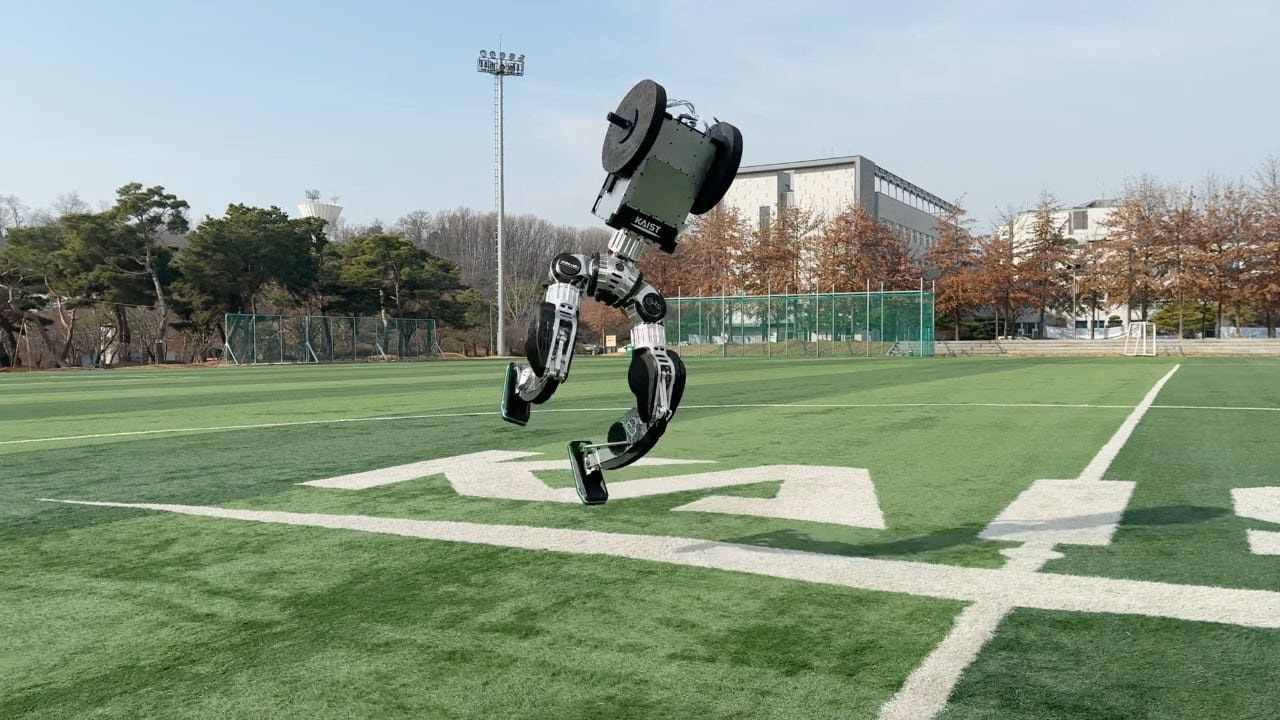
Engineers at Korea Advanced Institute of Science and Technology, also known as KAIST, built a humanoid that runs, jumps and even moonwalks with smooth control. In a recent field test, the robot sprinted across a soccer field, kicked a ball toward the goal and changed direction without hesitation.
That is the real shift. It is not about pulling off one impressive move. It is about doing it over and over without missing a beat.
US TARGETS CHINESE ROBOTS OVER SECURITY FEARS
The KAIST humanoid accelerates across a soccer field, showing its balance and high-speed control in motion. (KAIST)
Sign up for my FREE CyberGuy Report Get my best tech tips, urgent security alerts, and exclusive deals delivered straight to your inbox. For simple, real-world ways to spot scams early and stay protected, visit CyberGuy.com - trusted by millions who watch CyberGuy on TV daily. Plus, you’ll get instant access to my Ultimate Scam Survival Guide free when you join.
At about five foot five and 165 pounds, this machine was designed to move fast without losing balance. The team, led by Hae-Won Park, focused on building everything from scratch instead of relying on off-the-shelf parts.
That decision pays off. By designing their own motors, gear systems and controllers, the engineers could fine-tune how power flows through the robot's body. The result is better torque and faster response when it needs to react in real time.
One standout feature is its Quasi-Direct Drive system. It pairs strong motors with low gear ratios, which helps the robot respond quickly while staying stable. A compact gearbox design also keeps the system lighter and more efficient.
All of that adds up to performance you can see. The robot can run up to about 7.3 miles per hour and climb steps taller than a foot. That is already impressive, and the team is working toward even higher.
Speed alone does not make a robot feel realistic. Movement quality matters just as much. This is where Physical AI comes in. Instead of simply following pre-programmed steps, the robot learns how to move in ways that match real human motion.
Researchers trained it using deep reinforcement learning combined with human movement data. That training happened in simulation first, then carried over to the real world. The payoff is clear. Movements look fluid instead of robotic. Transitions between actions feel smoother. Even complex motions like dancing or kicking a ball appear controlled rather than forced.
Another interesting detail is how the robot navigates. It can move across uneven terrain using internal sensing, also called proprioception, without relying on cameras. That opens the door for use in environments where visibility is poor.
The human robot tracks and kicks a soccer ball with precise foot placement and smooth coordination. (KAIST)
It is easy to watch a robot moonwalk and think this is just a cool demo. The reality is more practical. The research team is working toward a full humanoid system that can operate in real workplaces. That includes climbing ladders, handling tools and adapting to unpredictable environments. They are also developing a system called DynaFlow. The goal is to let robots learn directly from human demonstrations. In simple terms, a worker could show a task once, and the robot could learn to repeat it. That kind of learning could reshape how automation works across industries.
AI ROBOT NOW HELPS TRAVELERS AT SAN JOSÉ AIRPORT
You may not be buying a humanoid robot anytime soon, but this shift is closer to your daily life than it sounds. Robots are getting much better at moving in the real world. That means they can start taking on work that used to be too complex for machines. Think of jobs that require balance, quick reactions or constant adjustment.
As a result, industries like construction, manufacturing and logistics could start using humanoid robots more often. These are environments where flexibility matters, and that is exactly what this new generation is built for. At the same time, more everyday tasks are becoming possible to automate. Not just repetitive work, but physical work that once required human coordination and judgment.
All of this points to a bigger change. The line between human work and machine assistance is starting to blur, and that will shape how many jobs look in the years ahead.
Think your devices and data are truly protected? Take this quick quiz to see where your digital habits stand. From passwords to Wi-Fi settings, you’ll get a personalized breakdown of what you’re doing right and what needs improvement. Take my Quiz here: Cyberguy.com
The KAIST humanoid is not just about speed or flashy moves. It reflects a bigger change in how robots are built and trained. By combining custom hardware with smarter AI, researchers are pushing machines closer to human-like capability. That does not mean robots are replacing people tomorrow, but it does mean the pace of change is picking up. When a robot can run, adapt and move naturally, it becomes useful in ways older machines never could.
Mid-stride, the humanoid maintains stability and control as it moves across the field in real-world conditions. (KAIST)
CLICK HERE TO DOWNLOAD THE FOX NEWS APP
If robots can soon learn tasks just by watching us, how comfortable are you with sharing your work with a machine that might one day do it better? Let us know by writing to us at Cyberguy.com
Sign up for my FREE CyberGuy Report Get my best tech tips, urgent security alerts, and exclusive deals delivered straight to your inbox. For simple, real-world ways to spot scams early and stay protected, visit CyberGuy.com - trusted by millions who watch CyberGuy on TV daily. Plus, you’ll get instant access to my Ultimate Scam Survival Guide free when you join.
Adriana James-Rodil is a Production Assistant for Fox News Digital.
Get a daily look at what’s developing in science and technology throughout the world.
You've successfully subscribed to this newsletter!