Jan Jekielek’s new book “Killed to Order: China’s Organ Harvesting Industry & The True Nature of America’s Biggest Adversary” (Skyhorse) starts with a ghoulish hypothetical: An American woman is in kidney failure. She begins the onerous process of getting on a transplant list, which can stretch on for years, as her health begins to deteriorate. She’ll likely be on painful dialysis or dead before a match comes through.
One day someone suggests the “China option” — i.e., bypassing the American healthcare system and getting one straight from the Middle Kingdom.
For $30,000 she can book an appointment (seemingly at her convenience), fly to Shanghai, check into the hospital, and come home two weeks later with a healthy, perfectly compatible kidney. No waiting lists, no health screenings, no questions asked.
It’s a seemingly happy, even miraculous, story — until one uncomfortable query is raised. Where did the kidney come from?
Jekielek’s answer in this scenario: It would likely come from a Falun Gong prisoner. This prisoner would have no right to object. He or she would not even know it was occurring until they were on the operating table. And they would also not survive the procedure.
Could this really be happening? And could it be so widespread that any random foreigner with $30,000 — or as much as $180,000 — could procure their own kidney, or liver, or cornea, without anyone in China breaking much of a sweat? (Except, perhaps, the victim.)
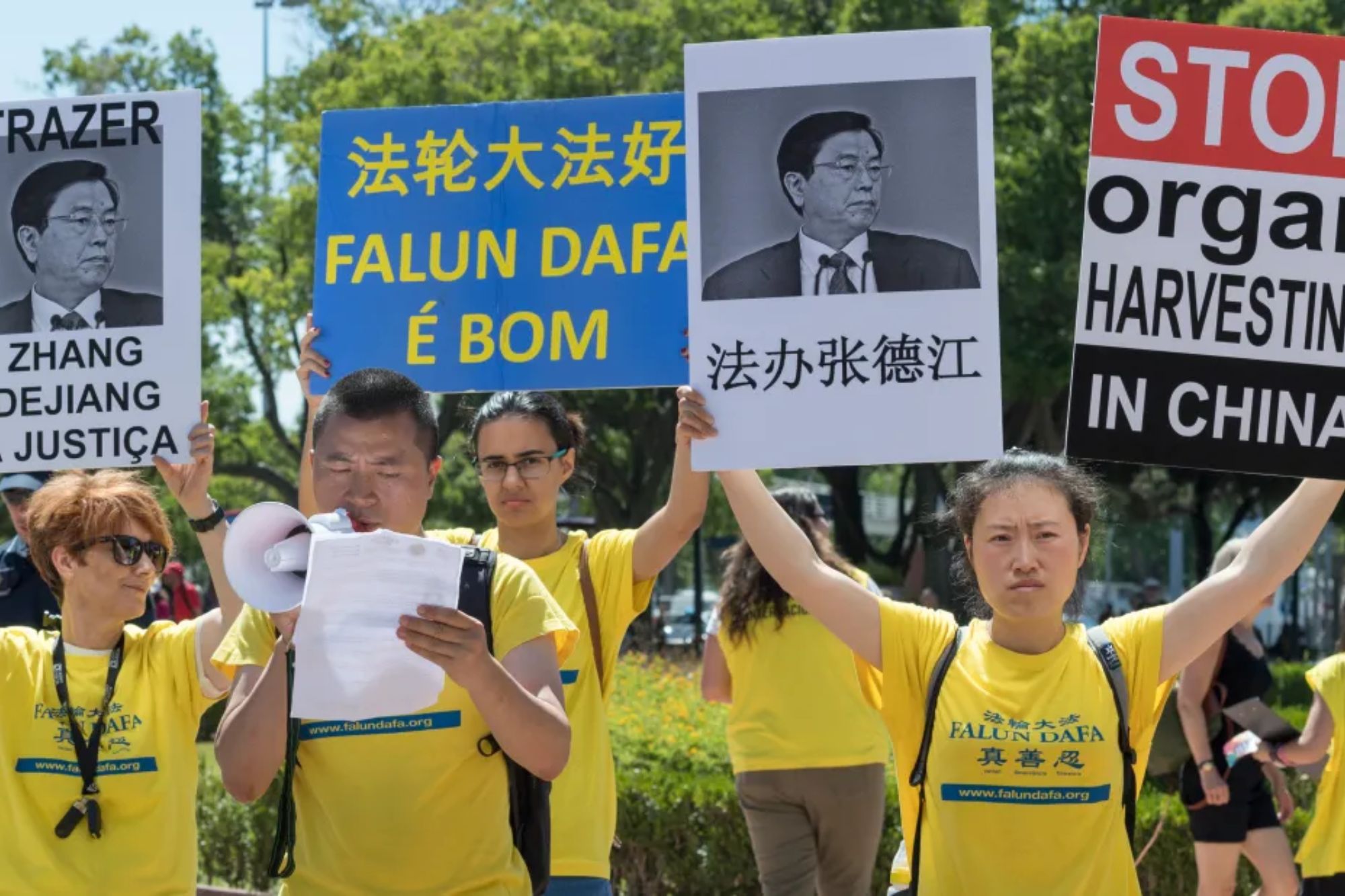
Falun Gong, the Chinese spiritual movement best known in the US for its Shen Yun performing arts group, has long been at war with the Chinese Communist Party. Organ harvesting is the most serious accusation in the war between the two, and Jekielek, a senior editor at the Falun Gong media organization, The Epoch Times, is a stalwart warrior in the battle.
Organ extraction from condemned prisoners has been a documented phenomenon coming out of China for a while. Though the details remain disputed, Human Rights Watch was issuing reports about state organ procurement as early as the 1990s.
Such practice is said to have spiked in the early 1980s thanks to the introduction of the immunosuppressant Cyclosporine A, which made transplants much safer, according to HRW. Reporters like Ethan Gutmann in his 2014 book “The Slaughter” have attempted to illuminate the practices.
In 2014, China promised to stop using the organs of executed prisoners without their previous consent and the consent of their next of kin. Whether China actually followed through with this, however, is very much an unsettled question.
Jekielek has no doubts that the practice is as alive and destructive as ever.
“The industry grows geometrically,” Jekielek told The Post. “They dehumanize the Falun Gong — it’s frankly straight out of Germany in the 1930s.”
Even more shocking and gratuitous is that, after the organ is extracted, the victim is allegedly disposed of. In an account given to The Epoch Times, which Jekielek reproduced in his book, a hospital worker reported that “her ex-husband removed corneas from detained Falun Gong practitioners and that the remains went straight to the incinerator for cremation.”
Still, an accusation of this magnitude depends on facts and data, and how many such prisoners are trapped in this nightmare remains unknown.
“The key part of it … is that it’s very large scale,” Jekielek said. “It’s not 100, or 1,000, but tens of thousands per year — unambiguously.”
Many agree with Jekielek. A 2019 international conference set up by human rights lawyers called the China Tribunal concluded the practice still goes on. And last year Congress passed the Falun Gong Protection Act, which accused the People’s Republic of China of forced organ harvesting. (It has not yet cleared the Senate.)
But the lack of data might explain why such a sickening phenomenon is virtually invisible in the mainstream media.
“Part of the reason is, it’s unbelievable,” Jekielek admitted. “It’s like sci-fi. Did you ever see that movie ‘The Island’? It’s sort of like that.”
In 2005’s “The Island,” starring Scarlett Johansson and Ewan McGregor, the main characters discover that they’ve been cloned as spare parts for a richer, more established version of themselves. Reading “Killed to Order,” the film is definitely called to mind.
But the discriminating reader will also note that much of the evidence in the book has flaws, or at least can’t be fully corroborated. And it must be pieced together to reveal the picture that Jekielek is sketching.
Among the most critical testimonies is that of Cheng Pei Ming, a Falun Gong practitioner who was detained and sentenced to eight years in prison for “using a heretical religion to undermine law enforcement,” according to China Daily.
Ming tells the story of being anesthetized against his will at a prison in Heilongjiang Province before waking up coughing and in pain. Two years later, he was transferred to a hospital and prepped for another surgery to remove a blade he supposedly ingested. He managed to escape before the procedure when his guards fell asleep without cuffing him to his bed, and eventually made his way to Thailand in 2015 and, five years later, America — where subsequent tests reveal that part of his liver and a portion of his lung were gone.
In the book, Ming is described by Jekielek as “the first known survivor of China’s organ harvesting program.”
Not that a big, well-organized state wouldn’t do everything within its power to squelch an account like that. But if the program is as widespread as Jekielek claims, an account coming this infrequently is a big red flag.
When Sovietologists were attempting to demonstrate the cruelty and prevalence of the Gulags, there was a ubiquitous amount of testimony — from Varlam Shalamov to Yevgenia Ginzburg to, of course, Aleksandr Solzhenitsyn. Likewise, the Polish underground fighter Jan Karski was famously trying to alert the Roosevelt administration about the Holocaust, and accounts of atrocities made it into the pages of The New York Times (mostly towards the back, but still.)
The timing is also off. Ming was sentenced to prison in 2002 and he escaped in 2006 — which would make it well before China’s pledge to stop using prisoners without their consent. (He was in hiding until escaping to Thailand.)
Jekielek anticipates objections and tries to quell them.
“Transplant volumes didn’t drop” after 2015, Jekielek writes. “They stayed high or rose.”
It makes a certain amount of sense that, if China cut off one form of donation, the numbers of transplants would dip. The fact that the number of donors would nevertheless level off or rise at that moment is, indeed, suspicious. But not hard proof.
Likewise, Jekielek writes, numbers are “not exaggerated; if anything, the estimates are conservative. Investigators used China’s own official data — hospital beds, approved transplant centers, surgeon reports, massive hospital expansions.”
And while Ming is the one survivor that Jekielek quotes, there is other corroborating evidence.
“Killed to Order” recounts the story of the Israeli cardiothoracic surgeon, Dr. Jacob Lavee, who had a patient in need of a heart transplant. After fruitlessly waiting for a donor, Lavee’s patient told him: “Look, I’m tired of waiting. I’m going to China to get the heart I need in two weeks. They’ve already scheduled it.”
The fact that a surgery for a matching heart can be scheduled is extraordinary. A heart donor is typically either brain dead or deceased within hours. When Lavee pieced together the explanation, he was agog.
Of course, there have been grotesque, inhumane and unbelievable things that have come out of Beijing ever since the establishment of the People’s Republic, from the cultural revolution and the great Chinese famine. And while it’s difficult to grant the Chinese government the benefit of the doubt about something this diabolical, sourcing, details, testimony and evidence also matter.
That something like this is conceivable is certainly true. It has happened. But at this scale? The answer to that remains a mystery.