They had to get out, but no one wanted to touch them.
It was July 2014, and two Americans were dying of Ebola in Liberia, the epicenter of the deadliest outbreak of the virus in human history. Dr. Kent Brantly and medical volunteer Nancy Writebol had contracted the disease while treating patients at ELWA Hospital in Monrovia.
The US government wanted to bring them home, but “no one else on Earth (literally, they’d tried) would or even could get them home,” writes journalist and former paramedic Kevin Hazzard in his new book “No One’s Coming: The Rogue Heroes Our Government Turns to When There’s Nowhere Else to Turn” (Grand Central Publishing, out now).
No one was up for what seemed like an impossible, and impossibly dangerous, mission: Evacuating two Ebola patients from West Africa without infecting the crew with the terrible virus.
“It’s deadly and contagious and absolutely horrifying,” writes Hazzard. “You liquify from the inside and then watch as the life drips out of you.”
William Walters, a State Department official running an obscure organization called Operational Medicine, made a call to Dent Thompson, co-owner of Phoenix Air, a small aviation company in Cartersville, Georgia.
The company is known for saying yes when everyone else says no. In the run-up to Operation Desert Storm, they flew 83 Patriot missile warheads out of Dover Air Force Base to Saudi Arabia. In 2004, when the Department of Energy needed someone to fly Muammar Gaddafi’s nuclear material out of Libya, they called Phoenix. And, in 2007, the CDC summoned Dent to Atlanta and asked Phoenix to build something that had never existed: an airtight, negative-pressure isolation tent capable of fitting inside a Gulfstream III and evacuating an infected doctor from anywhere on earth.
They called it the Aeromedical Biological Containment System — the ABCS — and the CDC certified that it could contain just about every known virus. Except Ebola.
Thompson told Walters they would only do the mission if the country’s top doctors could ascertain if the ABCS would work in this instance. Day later, a dozen government scientists arrived at Phoenix Air’s hangar. They inspected the apparatus. Then Walters looked at the medical team — Dr. Mike Flueckiger, nurses Vance Ferebee and Jonathan Jackson — and asked the only question that mattered.
“Guys, you’ll be the ones in the cylindrical death tube,” he said. “Can you do it or not?”
What happened next was the most dangerous medical evacuation ever attempted.
Jackson and Ferebee went to Home Depot and bought Tyvek suits, plastic goggles, masks and heavy-gauge plastic sheeting. Back at the hangar, the team suited up in 115-degree heat and practiced a 30-step process for removing contaminated protective gear inside the ABCS’s antechamber, a space not much bigger than a car trunk, without touching any surface or tearing their gloves.
Ferebee stood outside with a clipboard, calling out each step. Inside, Jackson crouched in the tiny space, legs trembling, carefully peeling off layers.
He bumped his head on the roof. “You’re dead,” Ferebee said. “Start over.”
He stepped into the antechamber with his outer gloves still on. “You’re dead. Start over.”
Meanwhile, in Monrovia, Liberia, Brantly was on the brink of death. His temperature had spiked to 105. He was hemorrhaging internally.
A doctor administered ZMapp, an experimental drug never before given to a human. Brantly began convulsing, but with an hour, his fever dropped from 105 to 100.
When the Phoenix crew arrived at Roberts International Airport outside Monrovia, the place was deserted. “It was the apocalypse,” writes Hazzard.
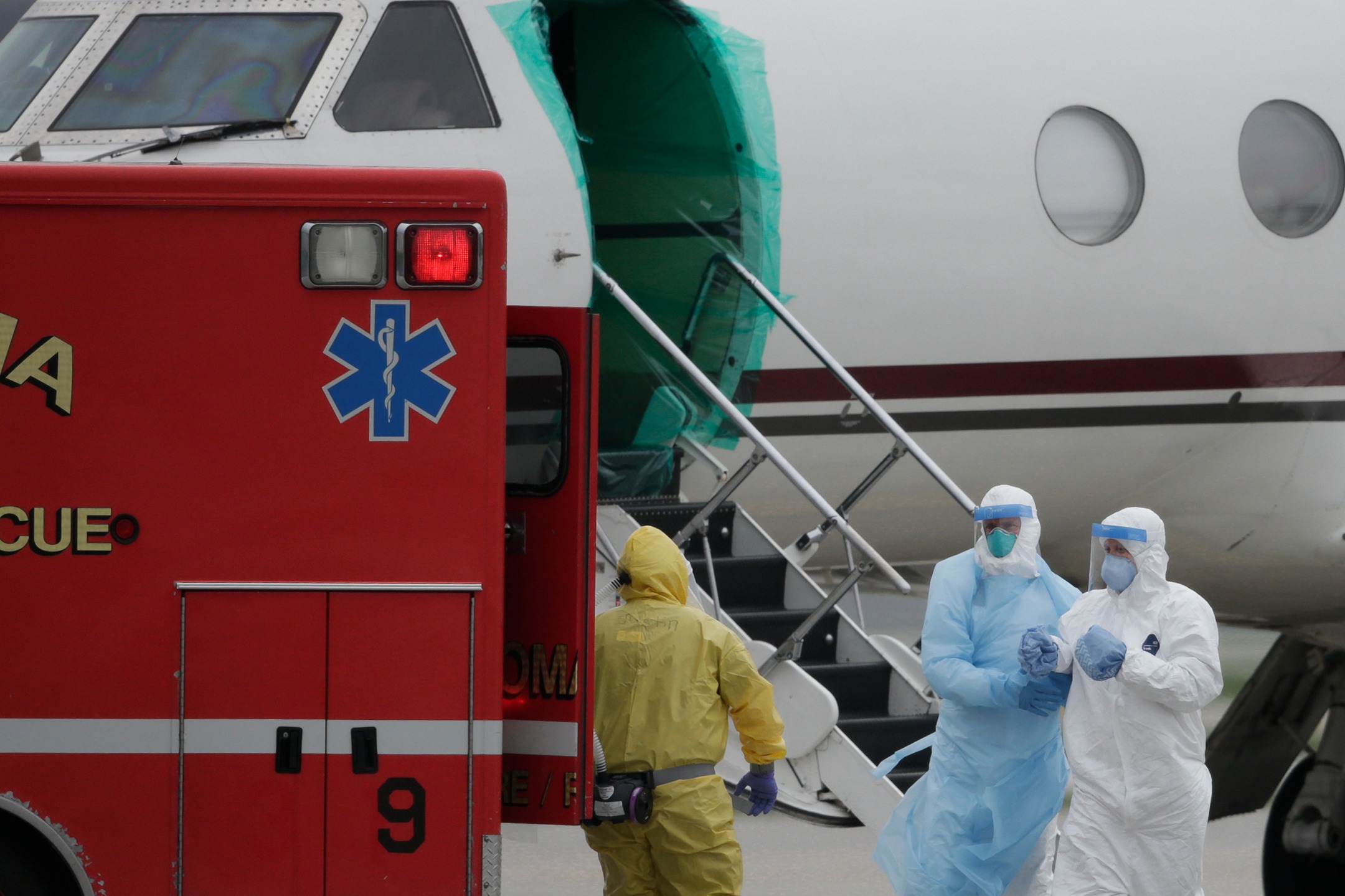
They carefully loaded Brantly and Writebol into the ABCS. Any mistake could mean infection.
Hours later, they touched down at Dobbins Air Reserve Base outside Atlanta. Ambulances met them on the tarmac. News trucks lined the highway. Helicopters buzzed overhead. It was the OJ chase for the Ebola era.
As Brantly was wheeled into Emory University Hospital’s isolation unit, medic John Arevalo leaned over and looked him in the eye: “Welcome home.”
Not everyone was so encouraging as fear about the disease spread. Protesters lined up outside Emory Hospital. Restaurants banned hospital employees. Delivery drivers refused to enter the building. Online death threats poured in against the Phoenix crew.
Still the company wasn’t deterred. Over the next year, Phoenix flew more than 40 Ebola missions, bringing doctors and volunteers from various nationalities to definitive care facilities around the world. It became the official Ebola airline of the US Department of State. One of the doctors who had accompanied Brantly — Doug Olson — flew on 11 of the flights.
Brantly spent almost a month in the Serious Communicable Diseases Unit at Emory University Hospital, eventually making a full recovery, as did Writebol.
Years later, Olson attended a book event where Brantly was speaking. At the end, he walked up to the signing table, unsure if Brantly would even recognize him.
“I don’t know if you know who I am … ” Olson began.
Brantly jumped up at the sound of his voice and threw his arms around him. He hadn’t forgotten the man who’d saved him, who’d said yes when the rest of the world said no.