The New York City Housing Authority is widely considered one of the Big Apple’s worst landlords, yet its top execs are living large in mansions on huge taxpayer-funded salaries – even as residents sometimes wait years for basic repairs.
The cash-strapped, city-owned agency saw all 104 of its upper-management honchos pocket $22 million combined last year – all made at least $140,000 annually, and 74 pulled down $200,000 or more, a Post examination of NYCHA records shows.
That’s more than double NYCHA’s nearly $11 million spending on exec salaries in 2015, when its upper-management team was 34% smaller, totaling just 79 execs.
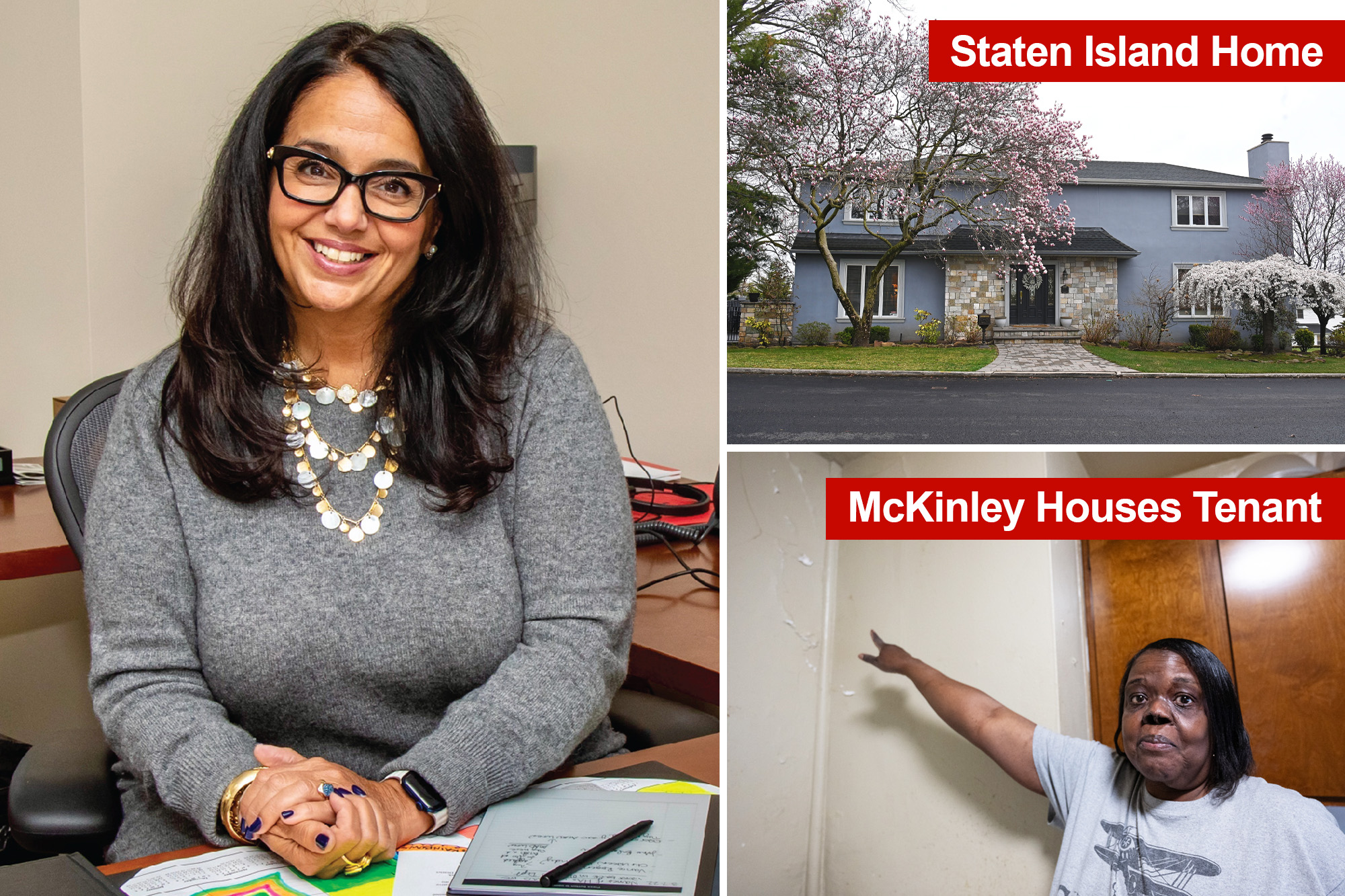
Leading the way is CEO Lisa Bova-Hiatt, whose base salary is an eye-watering $399,999.
She owns a $1.4 million home on Staten Island’s tony Todt Hill, about a mile from NYCHA’s Todt Hill Houses.
David Rohde, NYCHA’s executive VP for legal affairs, pulls down $301,198 and lives in a $2.8 million waterfront estate on the North Fork of Long Island.
Despite execs living high on the hog, the embattled authority — which saw 70 past and present staffers arrested in 2024 and later convicted following the largest single-day bribery takedown in the U.S. Department of Justice’s history — currently has 610,000 open work orders.
NYCHA also estimates it needs $78 billion to repair its aging infrastructure, which houses more than 511,000 residents across 335 public housing projects.
“NYCHA executives are cashing out off of the suffering of residents, and living large on the taxpayers’ dime,” ripped Rev. Kevin McCall, a civil-rights activist and longtime NYCHA critic.
“They turned public housing into a new hustle, with residents an afterthought, rather than saying ‘let me not take a raise’ so the money can go back into fixing the infrastructire, so that the living conditions have basic dignity.”
NYCHA’s own internal data shows it takes 449 days on average – or roughly 15 months– to resolve tenants’ non-emergency repair requests like clogged tubs and broken refrigerators, compared to 370 days just two years earlier.
Some repair requests — for routine fixes like faulty pipes — remain unresolved more than five years later, according to residents.
As of last month, paint jobs took an average of 616 days to complete, electrical work 237 days, plumbing 233 days, and elevator repair 101 days.
For many tenants living with mold, rats and other vermin is the norm.
Leila Green, 63, of the McKinley Houses in The Bronx, said NYCHA officials shouldn’t be living the high life when her home of 30 years is a wreck and routinely infested with roaches and rodents.
NYCHA management has yet to address requests she put in five years ago to fix plumbing leaks, cracked walls and floor damage, Green added.
“We should be able to live in a decent, clean place without roaches and rats and be able to live like normal people,” she said. “They do a poor job because they don’t repair anything — and don’t even answer the phone when you call.”
NYCHA reps, however, insisted Friday there’s no open work orders to make repairs in Green’s apartment.
They insisted her bathroom is freshly painted and that workers would soon paint the rest of her apartment, replace her floor tiles and make other improvements.
Although Mayor Zohran Mamdani inherited many of NYCHA’s problems when he took office in January, the silver-spoon socialist quickly came under fire from public-housing residents for briefly banning them from testifying at “rental ripoff” hearings his office began hosting citywide.
The landlord-bashing sessions target private property owners, conveniently ignoring that the Housing Authority routinely tops a yearly list complied by the city Public Advocate of NYC’s “worst” landlords.
“The mayor is responsible for NYCHA and will have to deal the city being the worst landlord,” said McCall, who began hosting independent hearings citywide to address issues NYCHA residents face after they were shut out of Mamdani’s “Rental Ripoff Hearings.”
“This isn’t just about neglect. This is exploitation at the highest level.”
NYCHA’s upper-management team under Mamdani has grown by two staffers, to 106, including former Deputy Comptroller Erin Villari, who was hired as the authority’s $276,710-a-year chief administrative officer in February.
Six other six-figure jobs are currently vacant and need to be filled, according to NYCHA’s latest staff organizational chart dated March 9.
Frances Garcia, tenant president of the McKinley Houses, said residents at the decaying five-building complex recently went through a hellish winter where they were routinely without heat, gas and hot water – even during an historic cold stretch in which NYC temperatures were sometimes lower than parts of Antarctica.
“I had to walk around with two bathrobes on,” she said. “When it’s really hot like it was a few days ago, we get heat, so why aren’t we getting heat when it’s cold?”
Despite NYCHA officials’ sky-high base salaries, some blue-collar staffers pocketed even more cash last year by racking up huge amounts of overtime. Senior officials typically don’t get overtime.
Jakub Markowski, a Housing Authority supervisor plumber, was the city’s biggest OT hog for the fiscal year that ended June 30.
He scored a staggering $331,814 in extra pay off 2,558 OT hours worked — rocketing his yearly earnings to $465,034.
Start your day with all you need to know Morning Report delivers the latest news, videos, photos and more.
NYCHA then attributed the obscene OT to “extensive plumbing and heating demands that are mandated and monitored by law.”
NYCHA spokesperson Barbara Brancaccio defended upper management’s salaries, saying “their compensation is commensurate with their civil service titles and reflective of the size of the agency, the scope of their responsibilities, and their level of experience.”
She also said that while NYCHA has a backlog in work orders, plenty of repairs are still getting done.
Last year, NYCHA was slammed with 2.5 million new repair-work orders, but resolved 2.49 million, said Brancaccio.
“NYCHA’s senior management team is comprised of dedicated public servants with decades of proven public policy and government expertise,” she said.
“These remarkable professionals have joined the Authority during a pivotal period of massive and historic organizational reform to ensure the agency’s compliance with federal and local laws and regulations, including the mandates outlined in” a landmark 2019 settlement agreement with the U.S. Department of Housing and Urban Development requiring NYCHA to address long-standing, systemic health and safety issues at its public housing sites, said Brancaccio.
Matthew Rauschenbach, a spokesperson for the mayor, insisted NYCHA tenants were never prohibited from participating in the Rental Ripoff Hearings, adding “investments in NYCHA will be central to our forthcoming housing plan.”
“We have already begun our engagement with NYCHA tenant leaders and look forward to rolling out robust, borough-by-borough engagement soon so that we can bring the voices of NYCHA tenants back to City Hall to inform our work,” Rauschenbach said.