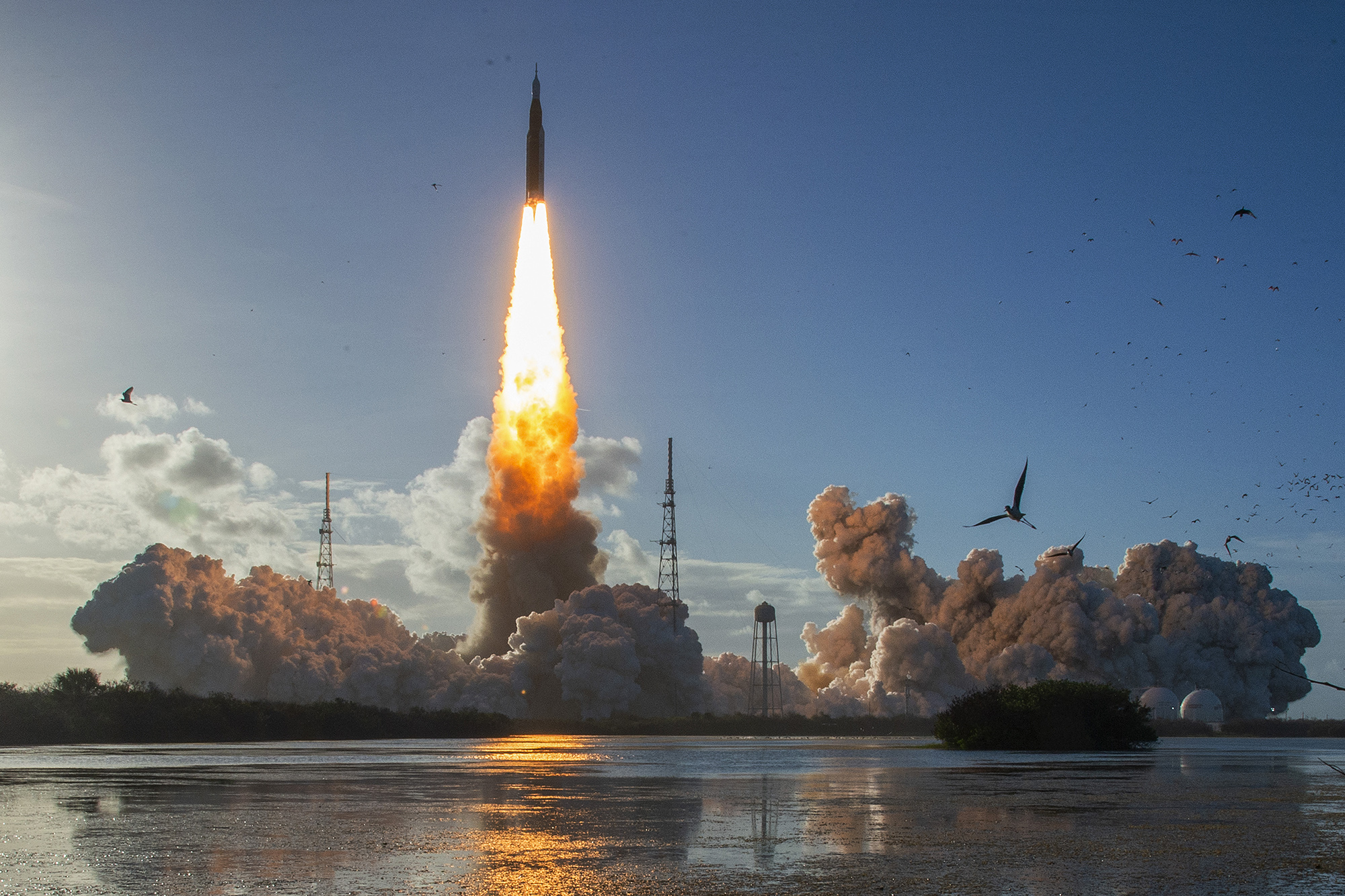
The Artemis II crewed lunar mission lifts off from Pad 39B at Kennedy Space Center in Cape Canaveral, Florida, on April 1, 2026. AFP via Getty Images So much for journalistic objectivity.
The BBC science editor covering the launch of Artemis II couldn’t contain her enthusiasm when the first plumes of smoke spread out from the launch pad.
“Oh, my goodness! Oh, my goodness!” she exclaimed, clapping like a schoolgirl.
As the rocket lifted off, she got visibly emotional: “It’s not just what you see and you hear as the rocket lifts off. You can feel the force of it through your body. This is the most powerful rocket that NASA has ever built!”
Rebecca Morelle can be forgiven for falling in love with the subject of her story.
A rocket launch is an awe-inspiring event — a controlled explosion hurling a gigantic projectile into the ether.
There’s the sheer power, the unavoidable risk, the questing spirit.
A rocket feels and looks like the future, and there’s something very human about gazing into the sky in wonder.
NASA hasn’t been glamorous in decades. Once upon a time, kids were putting up glossy photos of Apollo rockets and astronauts on their bedroom walls.
But the Apollo program was killed long ago — civil-rights activists were among those mobilizing against it, oddly enough — and nothing has captured the imagination the same way since.
The Space Shuttle made space flight routine and boring, and there was nothing particularly ambitious about the International Space Station.
Rovers and telescopes were worthy endeavors, but not thrilling.
The Artemis project is not exactly boldly going where no man has gone before, since it seeks to return to the moon after we were there half-a-century ago. But sending astronauts 250,000 miles from Earth as part of a project eventually to set up a base on the moon is the most enterprising NASA project since Apollo.
This is all to the good, but Artemis has been plagued by delays and cost overruns.
NASA hasn’t been able to replicate the urgent, mission-driven approach that characterized the Apollo program.
It took eight years to get to the moon the first time, while Artemis has been going for nine years and we still aren’t back.
NASA projects tend to get caught in a cycle: One president proposes a big new initiative only for it to get canceled by his successor, who proposes his own initiative that is canceled in turn.
The worst-case scenario is that a Democratic president elected in 2028 nixes Artemis because President Trump favored it.
That said, the space expert Robert Zubrin notes that space is particularly appealing to Americans as a people defined, in part, by the frontier.
JFK talked of “the New Frontier,” and the famous opening of Star Trek called space “the final frontier.”
Certainly, the American space program is a marked contrast with that of the European Space Agency.
NASA’s budget is several times larger. We’ve sent men to the moon whereas they haven’t.
And we’ve sent multiple successful landers and rovers to Mars (the first lander in 1976, the first rover in 1997), whereas the ESA has only managed two unsuccessful landers.
Getting back to the moon is nice, but a manned mission to Mars should be our ultimate objective.
It would truly be another giant leap for mankind, opening a vista of homo sapiens as a multi-planetary species.
The technological challenge would be significant, requiring Apollo-like exertions, while there’s much of scientific importance to be learned on the Red Planet.
Right now, the most popular movie in America is “Project Hail Mary,” a sci-thriller about a desperate mission into space.
The film plays to our inherent interest in journeys into the unknown, and to our admiration for those who have the courage to explore new worlds, from Francis Drake to Neil Armstrong.
Artemis II tapped into the same thing, which is why that BBC reporter — and so many of the rest of us — were so moved.