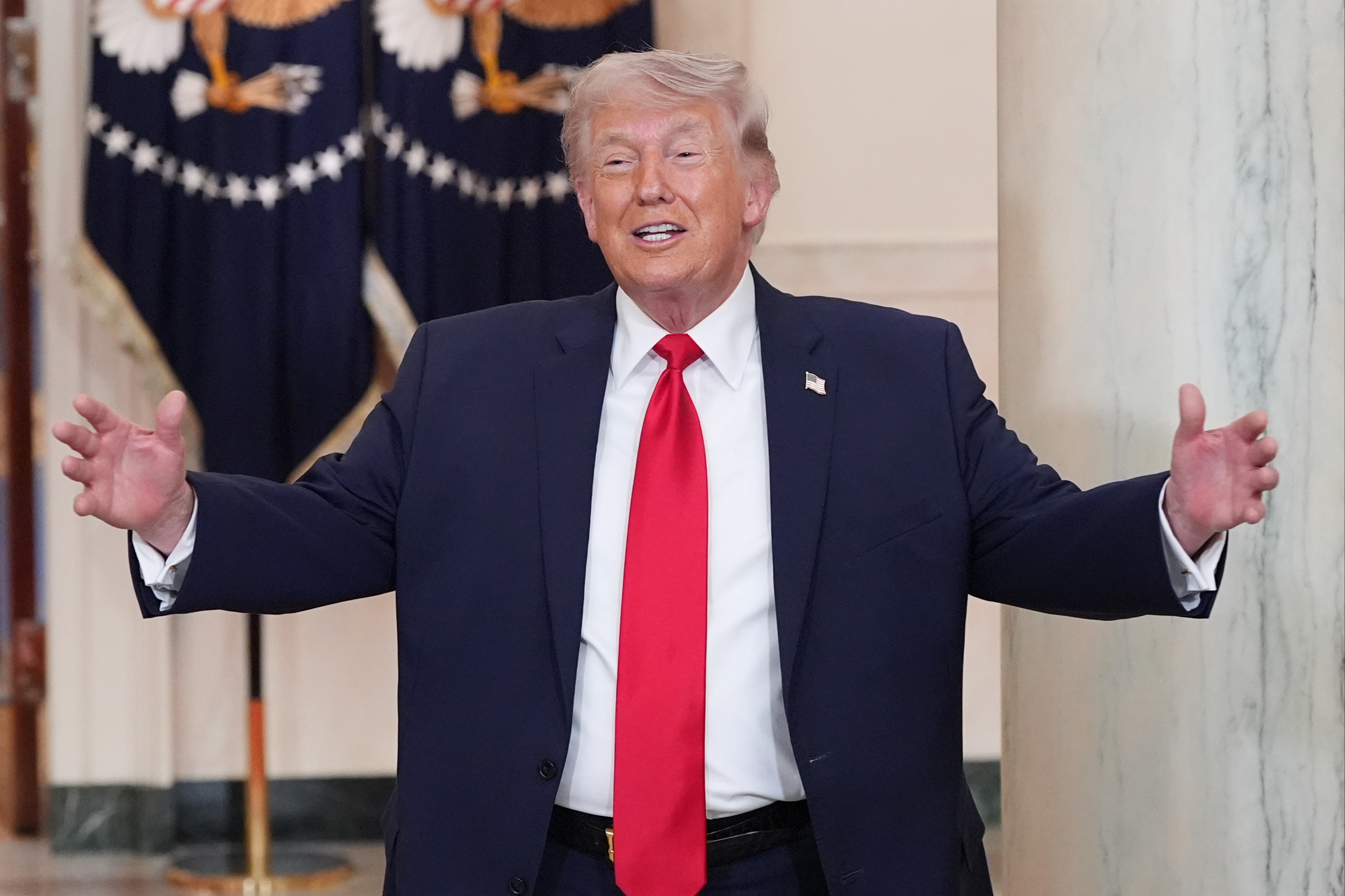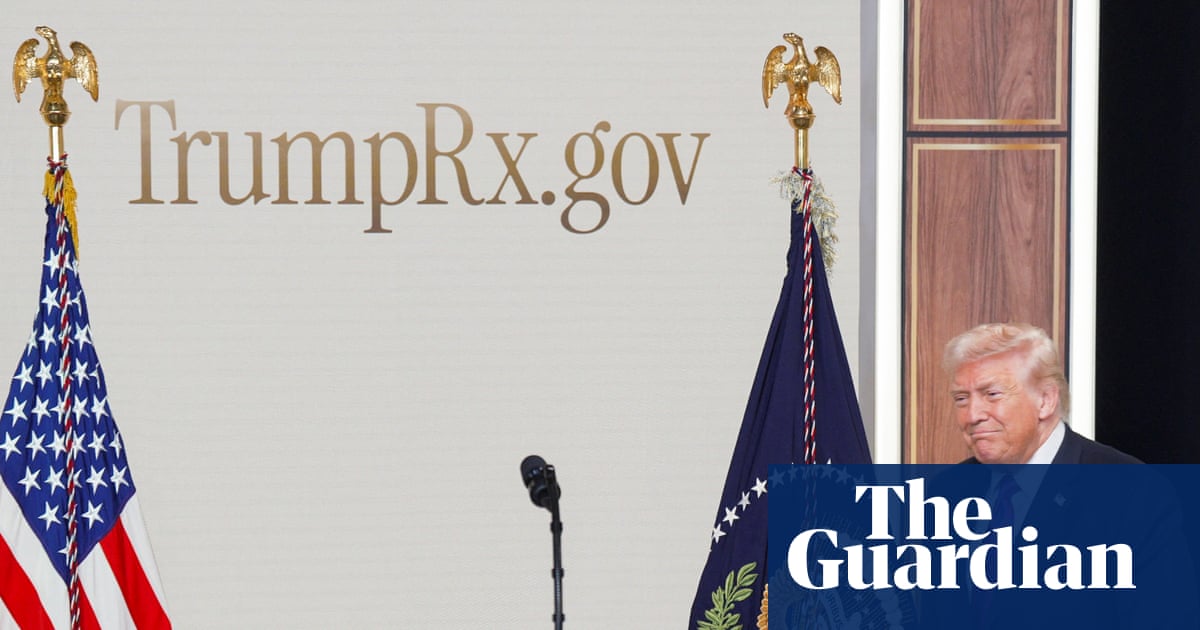
Donald Trump unveils the TrumpRx drug discount site at the White House on 5 February 2026. Photograph: Al Drago/ReutersView image in fullscreenDonald Trump unveils the TrumpRx drug discount site at the White House on 5 February 2026. Photograph: Al Drago/ReutersAnalysis‘Unconstrained’ Trump seems to be on a quest to name the most after himselfAdam GabbattPresident has affixed his name to institutions and edifices, and his visage now glowers from several federal buildings
The US has a history of naming things after its presidents.
Washington DC has the Ronald Reagan airport, while John F Kennedy international airport is New York’s main air transport thoroughfare. The Hoover Dam straddles Nevada and Arizona; Theodore Roosevelt is one of several former presidents to have a Washington DC building named after them; Franklin Delano Roosevelt has an island; Abraham Lincoln has the Lincoln Memorial; and George Washington has the nation’s capital and an entire state.
Donald Trump, however, is threatening to outdo them all – seemingly on a quest to become the US president with the most things named after him.
Less than 18 months into his second term, Trump has seen his name, face, signature daubed across government buildings, institutions and currency at an unprecedented rate, an unapologetic branding expansion that is showing no signs of slowing.
Just last month, Trump launched TrumpRx, a prescription drug website where Americans can buy prescription drugs. (As of February, the site only listed 43 medications, more than half of which were available in generic form at significantly cheaper prices elsewhere.)
That came shortly after the White House and the US navy announced the creation of a new “Trump class” of battleships – the “largest we’ve ever built”, Trump said at the time. In a sign that the ships could be a vanity project rather than an absolute need, a Pentagon press release noted that the last time the navy used battleships in combat was 35 years ago.
View image in fullscreenThe recently renamed Donald J Trump and John F Kennedy Memorial Center for the Performing Arts in Washington DC on 29 December 2025. Photograph: Tyrone Siu/ReutersOther brandings have seen the Trump name daubed on federal bodies. In December of last year, the administration renamed the US Institute of Peace, in Washington DC, the “Donald J Trump United States Institute of Peace”. A White House spokesperson told the New York Times the building had been renamed “as a powerful reminder of what strong leadership can accomplish for global stability”; weeks later, Trump launched a war on Iran.
In February 2025, Trump handpicked a new board at the John F Kennedy Center for the Performing Arts, and installed himself as chair. Under his chairmanship, the board voted in December to rename the center after Trump: the very next day the words “The Donald J Trump and” were added to the signage, in a font that didn’t quite match the pre-existing language. The change is subject to a legal challenge.
Read moreThe Republican party has largely been happy for Trump to continue on his naming odyssey. Some have even encouraged him: one week after his inauguration a Republican member of Congress introduced legislation to have Trump’s face carved into Mount Rushmore, while another has proposed naming an airport after him.
“There are lots of narcissists in politics. Most of them are constrained by politicians in their party, or by advisers or cabinet members who say: ‘This isn’t really done, this isn’t such a good idea, this is not going to benefit us.’ But Trump is unconstrained by his cabinet, by his advisers, by his party,” said Steven Levitsky, a political scientist at Harvard university and co-author of How Democracies Die.
“Republican politicians learned that the way you get ahead today in 2026 in the Republican party is to please Donald Trump. And it became clear during the second term that one of the things that pleases the boss is to have his name and his face on things.”
Trump’s face has indeed made it on to things. Giant banners depicting the president have been hung, Soviet-style, from government buildings in Washington DC, including the headquarters of the justice department and the Department of Labor.
“It is rare for public places to be plastered with pictures and names of a sitting president,” said Kim L Scheppele, a professor of sociology at Princeton University who spent years researching autocracies including Hungary and Russia. “Especially when that president [is the one who] has himself ordered his image and name to be displayed everywhere.”
“Democratic leaders wait to be honored after they leave office; dictators want their image everywhere while they are still in power, in order to demonstrate that power,” Scheppele said.
Decorum has typically seen presidents wait until after they leave office – or, indeed, until after they have died – for things to be named after them, and it is an honor usually bestowed by their successors. Not so Trump, who has shown himself to little embarrassment about the endeavor.
View image in fullscreenJared Kushner, Donald Trump, Marco Rubio and Steve Witkoff at the Donald J Trump Institute of Peace on 19 February 2026 in Washington DC. Photograph: Chip Somodevilla/Getty ImagesTake the situation in January, when Trump offered to fund an infrastructure project in New York, but only if Chuck Schumer, the Senate minority leader who is from New York, agreed to rename Penn Station and Washington’s Dulles international airport after the president.
Or how about the 24-karat commemorative gold coin, which has an engraved image of Trump standing over a desk, which Trump’s handpicked arts commission approved earlier this month. Or the separate $1 coin that was being developed by the US Mint last year, drafts of which featured an air-brushed Trump side profile?
There’s also the not insignificant matter of Trump’s signature appearing on US paper currency beginning later this year, something which the treasury secretary, Scott Bessent, said was a “powerful way to recognize the historic achievements of our great country”.
To Americans, and certainly to non-Americans, it might seem like a lot. But within the Trump administration, people seem happy to pretend this is all very normal.
“President Trump is focused on saving our country – not garnering recognition. However, given his vast accomplishments, including signing the largest tax cut in history, securing the border, restoring peace through strength and more, it is natural that local officials and other great patriots want to recognize the president’s incredible work on behalf of the American people,” Davis Ingle, a White House spokesperson, said.
There are signs, however, that the American people do not share Trump’s love for his own face.
The national parks pass, which grants access to lands across the US, typically features scenes of landscape or wildlife, but there was outrage last year when the National Park Service announced its 2026 edition would instead feature Trump glowering out at the pass holder, with a spectral George Washington hovering behind him.
The announcement prompted a cottage industry to spring up around producing stickers to cover up Trump’s face, an embarrassing development which forced the government to update its policies regarding the pass in January. Its website now states: “Stickers on physical passes are considered an alteration and may void the pass.”