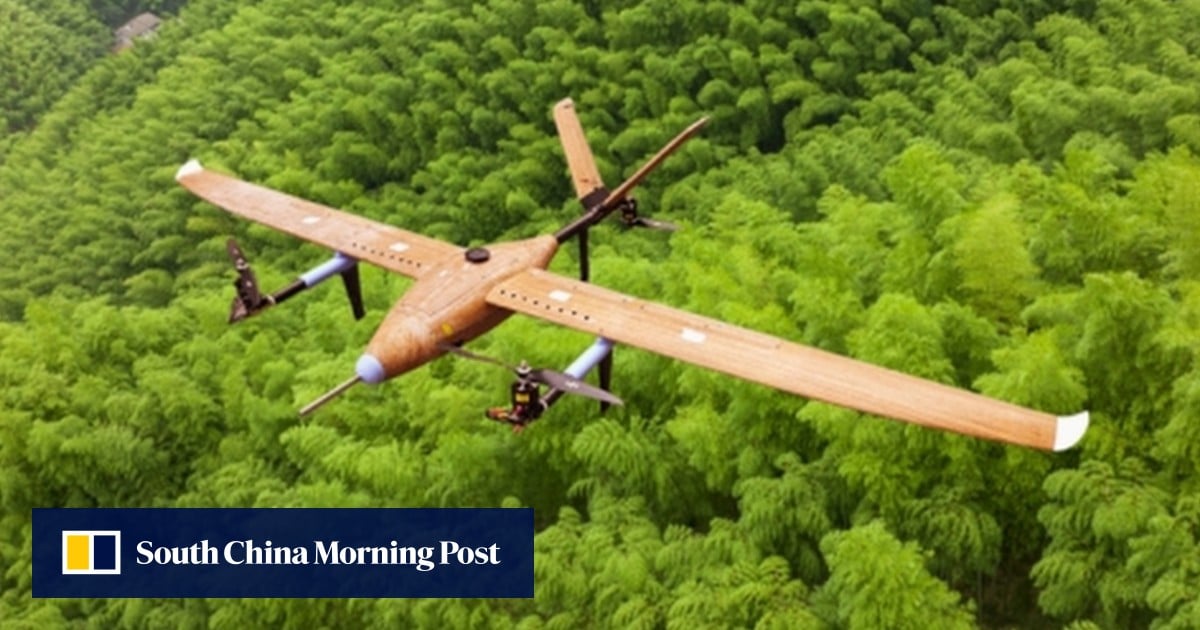
Breakthrough in low-cost, eco-friendly UAVs as researchers unveil open-source software to enhance development
2-MIN READ2-MIN ListenChao Kongin BeijingPublished: 2:00pm, 4 Apr 2026Updated: 2:01pm, 4 Apr 2026A team of researchers in China has unveiled what they describe as the world’s first open-source flight control system designed specifically for bamboo-frame drones, offering a potential breakthrough in the push for low-cost, eco-friendly unmanned aerial vehicles (UAVs).The system, developed by researchers at Northwestern Polytechnical University’s school of civil aviation, aims to solve a long-standing bottleneck in sustainable drone design: integrating non-traditional materials such as bamboo with high-performance autonomous control.Unlike conventional airframes made of composite materials, bamboo structures introduce low-frequency vibrations – typically in the 8–20 hertz range – that standard flight controllers struggle to handle.
According to the team’s paper, published on February 28 in Heilongjiang Science, existing commercial flight controllers are either closed-source and inflexible, or open-source but poorly adapted to local development needs, limiting the industrialisation of bamboo-based UAVs.
More significantly, they redesigned the control algorithms to match bamboo’s structural properties.
By tuning an extended Kalman filter and leveraging bamboo’s natural vibration-damping characteristics, the system reduces control latency from 15 to 20 milliseconds to as low as 8 to 10 milliseconds – improving responsiveness while maintaining stability.