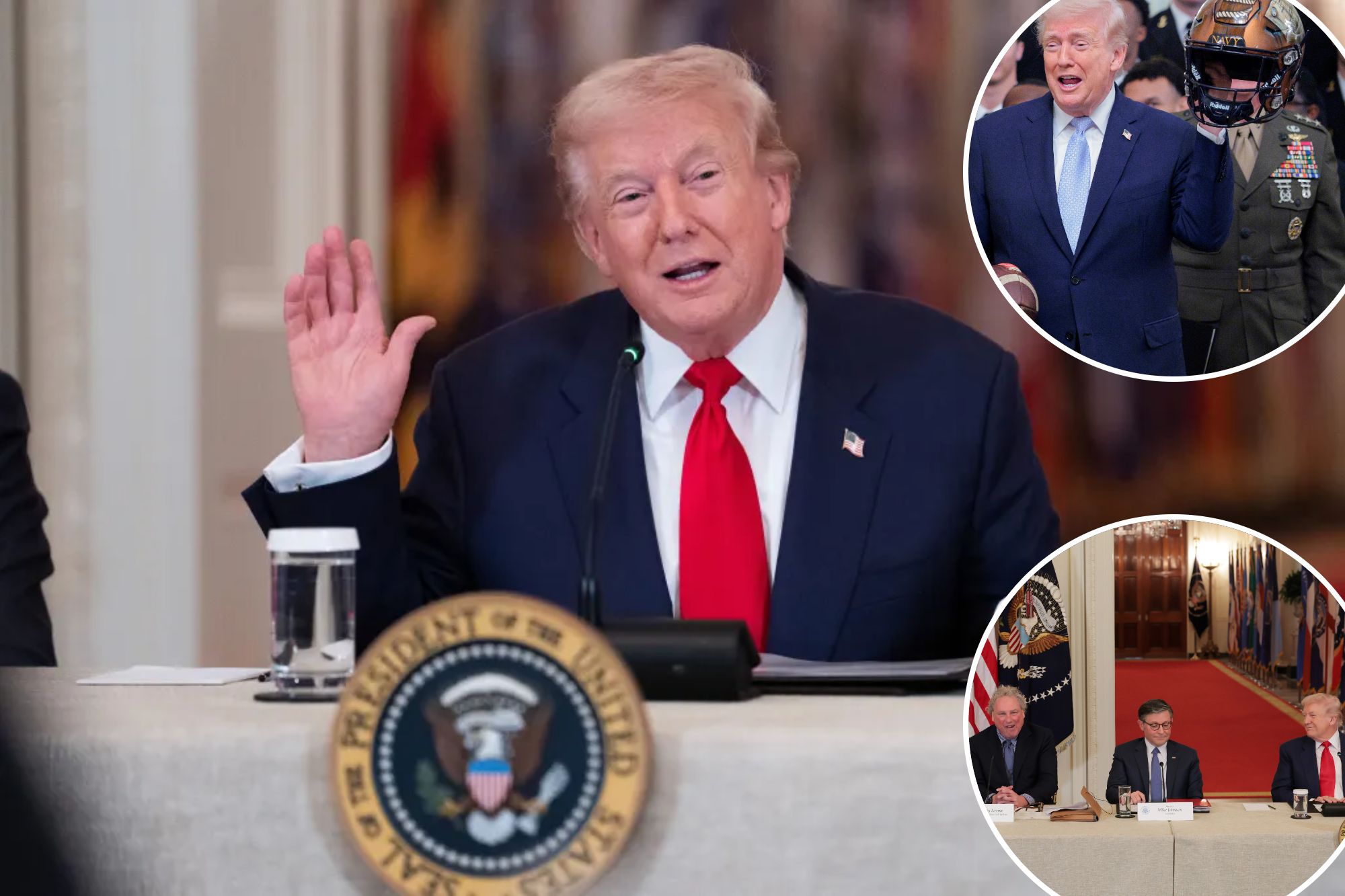
President Donald Trump issued an executive order Friday in his attempt to “solve all of the problems” affecting college sports, particularly the polarizing Name, Image and Likeness (NIL) legislation.
The executive order — which will likely need to clear several legal challenges to be considered enforceable — includes sections on eligibility, transfer rules, specifications on pro athletes aiming to return to college, revenue sharing and medical care, among other topics.
The order calls on Congress to “quickly pass legislation” and directs the the Federal Trade Commission and the Attorney General to take “appropriate enforcement actions.”:
Trump’s executive order calls for athletes to only have eligibility for a five-year period, although there are some exceptions like military service, and ban professional athletes from returning.
The latter has become a recent problem with ex-G Leaguer Charles Bediako returning to Alabama after previously entering the NBA draft, only for a judge to eventually end his season.
The order also calls for “setting structured transfer rules for academic and athletic continuity” — which would reportedly limit transfers to one time in a five-year window with immediate eligibility, but an extra transfer can be allowed should the individual earn a four-year degree.
The plan motions for the transfer window, which coaches have criticized for when it falls during the calendar, to be pushed to a time where it doesn’t affect seasons or academics.
There is also a section stating that collectives and the like which employ essentially pay-for-play transactions should be banned.
This proposal additionally ensures forth medical care for athletes during their collegiate time and for a period after their exit, plus revenue sharing with the goal to help women’s and Olympic sports, which generate little to no money, compared to the moneymakers in football and basketball.
This executive order comes one month after Trump hosted a “Saving College Sports Roundtable” featuring roughly 50 people, with Yankees president Randy Levine being tabbed as the vice chair.
NCAA president Charlie Baker, Florida Gov. Ron DeSantis, several college commissioners and former Alabama football coach Nick Saban attended the discussion.
That meeting set the table for this executive order to be put forward via a collaborative effort between The White House and the Justice Department.
“I will have an executive order within one week, and it will be very all-encompassing,” Trump said then, per ESPN. “And we’re going to put it forward, and we’re going to get sued, and we’re going to see how it plays, OK, but I’ll have an executive order, which will solve every problem in this room, every conceivable problem, within one week, and we’ll put it forward. We will get sued. That’s the only thing I know for sure.”
The NIL era established in 2021 has pioneered college athletics into a new realm where the collegiate ranks resemble the pros, with teams able to buy players and establishing haves and have-nots.
Schools previously cheated by paying players under the table, but they can now do it in public for staggering figures.
BYU men’s basketball star AJ Dybantsa signed an NIL deal reportedly worth $7 million, while Kentucky allegedly spent $22 million on a team that won one NCAA Tournament game this season.
Texas quarterback Arch Manning, Eli’s nephew, has a $5.4 million NIL projection, per on3.com.
“That’s cheating,” former Ohio State and Florida coach Urban Meyer said while decrying the collectives that pay the athletes, per ESPN. “Donors put money in a pot. It’s distributed to the players through coaches and managers. That’s not allowed. Not supposed to do that. That’s pay-for-play.”
The advent of the transfer portal has also led to chaos at times, with players changing schools seemingly every year — and sometimes just for a money grab.
Baker previously asked for legal help in handling this new frontier.
He aimed for help in preventing athletes from becoming employees of their school, replacing state laws with a federal statute and shield the NCAA from lawsuits.
“When I took this job, the message I heard from Congress was clear — fix what you control first,” Baker said in January, per the Associated Press. “Since then, we have modernized college sports to meet the needs of today’s student-athletes. But we can’t solve every threat we face alone.”
This is the second executive order Trump has issued regarding college sports in short time, calling for an exclusive window for the Army-Navy game.