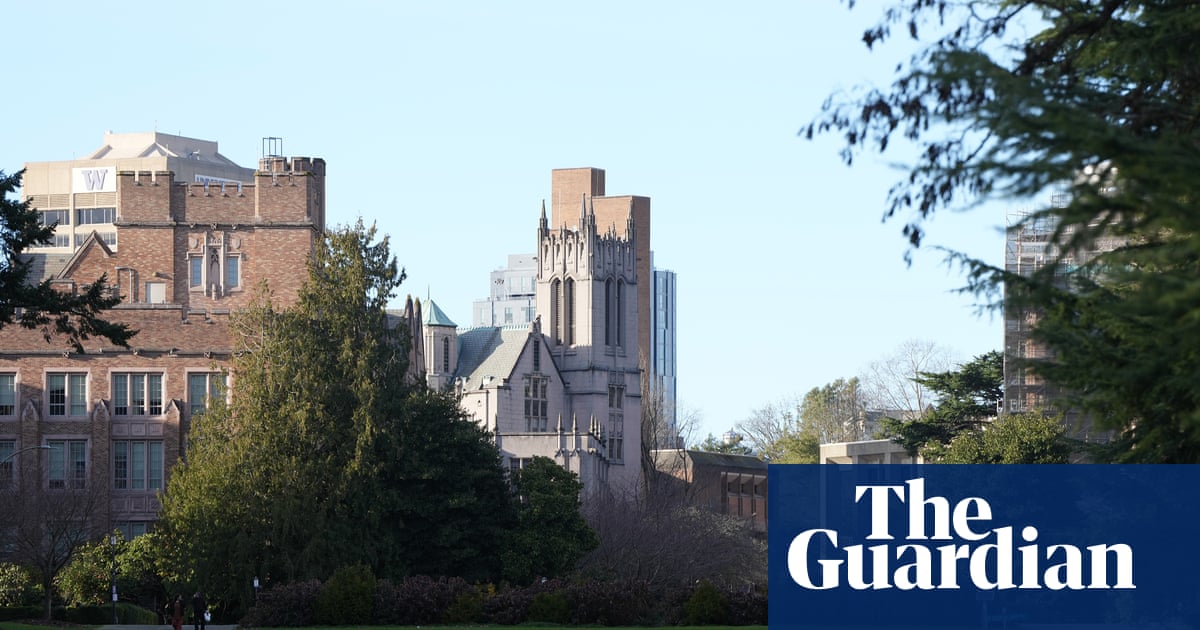
Fani is still employed as a professor at the University of Washington (pictured) but is on medical leave for the quarter, according to reports. Photograph: Mitchell Layton/Getty ImagesView image in fullscreenFani is still employed as a professor at the University of Washington (pictured) but is on medical leave for the quarter, according to reports. Photograph: Mitchell Layton/Getty ImagesUniversity of Washington professor fired from director job after sending email criticizing Iran warAria Fani of University of Washington’s Middle East Center is latest critic of Israel to lose position at US university
A University of Washington professor was removed as head of the school’s Middle East Center after reportedly using newsletters from the center to criticize the US and Israel’s war on Iran and describe Zionism as “cancerous”.
His case is one of at least three incidents in the past month in which higher education faculty members have faced suspension or dismissal after voicing opposition to US-Israeli actions in the Middle East.
Aria Fani, associate professor in the University of Washington’s Jackson School of International Studies, said its director, Daniel Hoffman, informed him last week that he was being dismissed from his leadership post. Fani is still employed as a professor, but is currently on medical leave for the quarter, according to the Seattle Times.
Read moreAccording to reports, on 18 March Fani wrote in a newsletter sent via the center’s listserv that “Israeli actions tell us that they seek the destruction of the state, not just its ruling class”. The email reportedly added that it “was always BS” that the Islamic Republic was pursuing nuclear weapons.
In July, Fani told the student newspaper that “if you tell the dozens of children that were killed in Israeli bombardment, that were killed in Iran, or the families of the nuclear scientists who were just wiped out – I hardly imagine they would say that the world is a more peaceful place”.
Fani had signed a three-year agreement in 2025 to serve as director of the Middle East Center, where his duties included overseeing programming, engaging with the community and fundraising, the Times reported.
In a statement, the University of Washington confirmed that Fani was no longer director of its Middle East Center, and that Hoffman would cover its administrative responsibilities over the coming months.
“Fani remains an associate professor at the university,” it said. “Out of respect for employee privacy and confidentiality, the university chooses not to discuss the circumstances surrounding individual employment outcomes. Employment decisions are based on the requirements of the position and university expectations.”
In a separate case, philosophy professor Idris Robinson filed a lawsuit against officials at Texas State University, claiming the institution violated his constitutional rights by terminating his contract. The action followed an off-campus talk he gave in another state about the Israeli-Palestinian conflict, during which a fight occurred.
Because Robinson did not initially identify himself as affiliated with Texas State at the event, it reportedly took about a year for several pro-Israel social media accounts to connect him to the university. Those accounts then launched a campaign urging his dismissal, directing criticism at university leadership and accusing him of being a terrorist and encouraging violence.
Earlier in the week, Shirin Saeidi, former head of the Center for Middle East Studies at the University of Arkansas at Fayetteville, was formally dismissed after allegedly expressing support for the Iranian regime and making anti-Israel statements.
Saeidi had reportedly received a warning letter in July from the Fulbright College dean, Brian Raines, after she allegedly used university letterhead to advocate for the release of Hamid Nouri, who was convicted in a Swedish court in 2022 for ordering the execution of thousands of political prisoners in 1988.
She was later suspended in December following social media posts supporting Palestine and Ayatollah Ali Khamenei. Her termination proceeded despite a faculty committee’s unanimous recommendation that she be retained, according to the Arkansas Times.
Following Saeidi’s suspension last year, the Middle East Studies Association (Mesa) published a letter denouncing her removal and calling on the university to reinstate her and “publicly denounce the campaign of defamation that has been waged against her and to refrain from any action that may chill or censor her speech”.
The dismissals comes amid a sharp rise in censorship allegations. Universities across the country have cracked down on pro-Palestinian speech since 7 October 2023, a trend that has accelerated since Donald Trump returned to power and launched an unprecedented campaign to bend them to his ideological will.
Arab and Muslim faculty and students have been particularly affected. As of April, affiliates of Harvard University say they have filed more than 500 discrimination complaints, sparking renewed scrutiny over the institution’s response to allegations of anti-Arab, anti-Muslim and anti-Palestinian bias.
The complaints, which have been accumulating over the past year and escalating in recent weeks, detail what advocates describe as a systemic pattern of marginalization. These allegations include the cancellation of academic programming and persistent administrative inaction across several of the university’s schools.
Chloe Truong-Jones, an attorney at Palestine Legal, told the Guardian in March that her organization has seen a marked increase since 7 October 2023 in US faculty members seeking legal help after being disciplined for speech on Palestine – rising from 37 such requests in 2022 to 150 last year, a 305% increase.