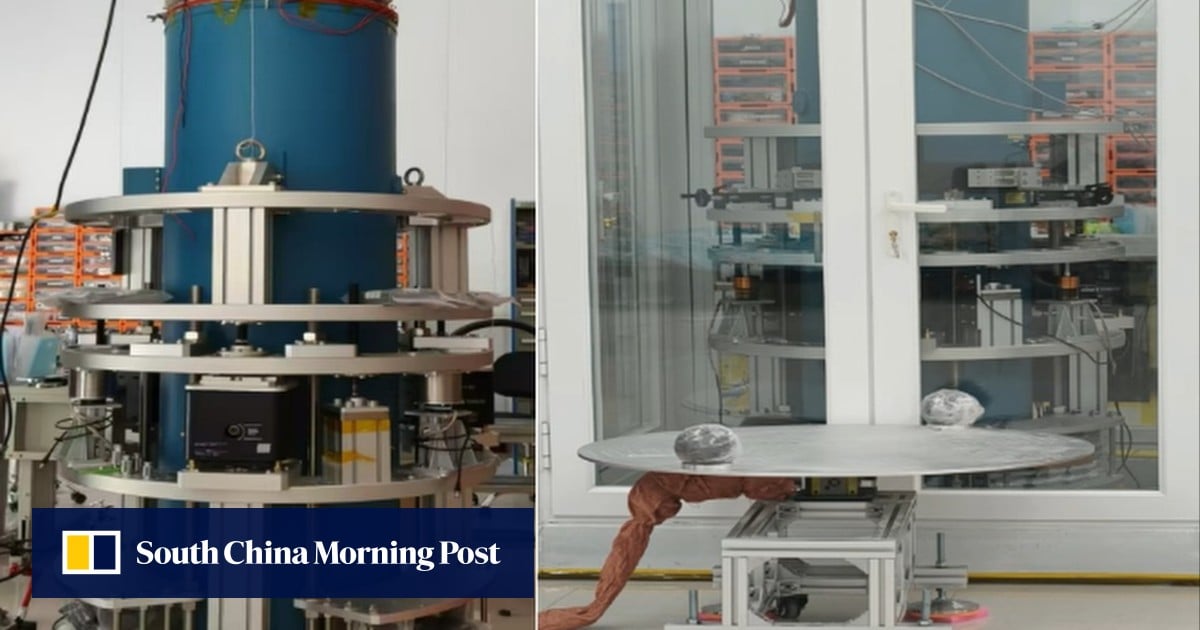
Device can spot objects by measuring tiny shifts in gravity, and its compact design means it can be used outside a lab
3-MIN READ3-MIN2 ListenZhang Tongin BeijingPublished: 10:00pm, 3 Apr 2026Chinese researchers unveiled a gravity detector with world-leading precision last month, potentially expanding the military applications of the technology.
It uses a superconducting quantum interference device (SQUID) to detect objects by measuring tiny changes in gravity.
The team that developed the instrument says it can be used for scientific research and finding underground resources. It also brings the country one step closer to being able to spot patrolling nuclear submarines.
According to a report on the Chinese Academy of Sciences (CAS) website, the instrument reduces gravity gradient measurement noise – outside effects that can disrupt a gravity detector’s accuracy, such as vibrations from seismic activity – to a level that is second only to gravitational wave detectors built on the kilometre scale.
One such detector is the Laser Interferometer Gravitational-Wave Observatory in the United States which uses mirrors spaced 4km (2.5 miles) apart to study the cosmos. Meanwhile, the instrument built by the CAS team is about the size of an office cubicle.
Existing submarine detection methods – sonar, magnetic anomaly detection, and radar – can be evaded. However, gravity cannot be masked.