To play this video you need to enable JavaScript in your browser.This video can not be played
Watch: BBC joins police on front line against car theft
It is 01:00 on a Thursday and we are in the back of an unmarked police car on the hunt for vehicle thieves in east London.
A call comes in over the radio about a stolen Ford Transit van. Within 25 minutes officers have found it, chased it down and arrested a suspect.
Officers tell us the night has been successful, with further arrests made, yet across the UK a car is stolen every four minutes.
Despite a recent drop, vehicle thefts are up almost 50% in England and Wales compared with a decade ago, according to Home Office data. Last year, just 3% of vehicle theft offences resulted in a charge or summons.
As well as spending time on the front line in London and Sussex, we have privately spoken to 20 police officers from six forces.
They told us while they have the skills and experience to tackle vehicle crime, they are overstretched, under-resourced and struggling to keep pace with increasingly sophisticated criminal networks.
Thieves are becoming more confident. A man who claims he receives stolen vehicles and breaks them into parts at a so-called "chop shop" told the BBC he does not fear the authorities, because they "couldn't catch a cold".
Once the preserve of joyriders and opportunists, vehicle theft is now a lucrative global criminal business. Cars are stolen to order, and moved across the country or dismantled within hours, say police, making them difficult to recover and suspects hard to track. Many vehicles are sent overseas to places like the United Arab Emirates, The Democratic Republic of Congo and Jamaica.
Victims of car theft have told us they feel frustrated and helpless. One woman said it took car thieves just 35 seconds to steal her BMW, yet police only began investigating a day later. Another man said he feared for his life when masked thieves broke into his home demanding his car keys.
The success criminals are having is also hitting motorists more widely, with insurance quotes having risen by 82% since 2021, according to security think tank the Royal United Services Institute (Rusi).
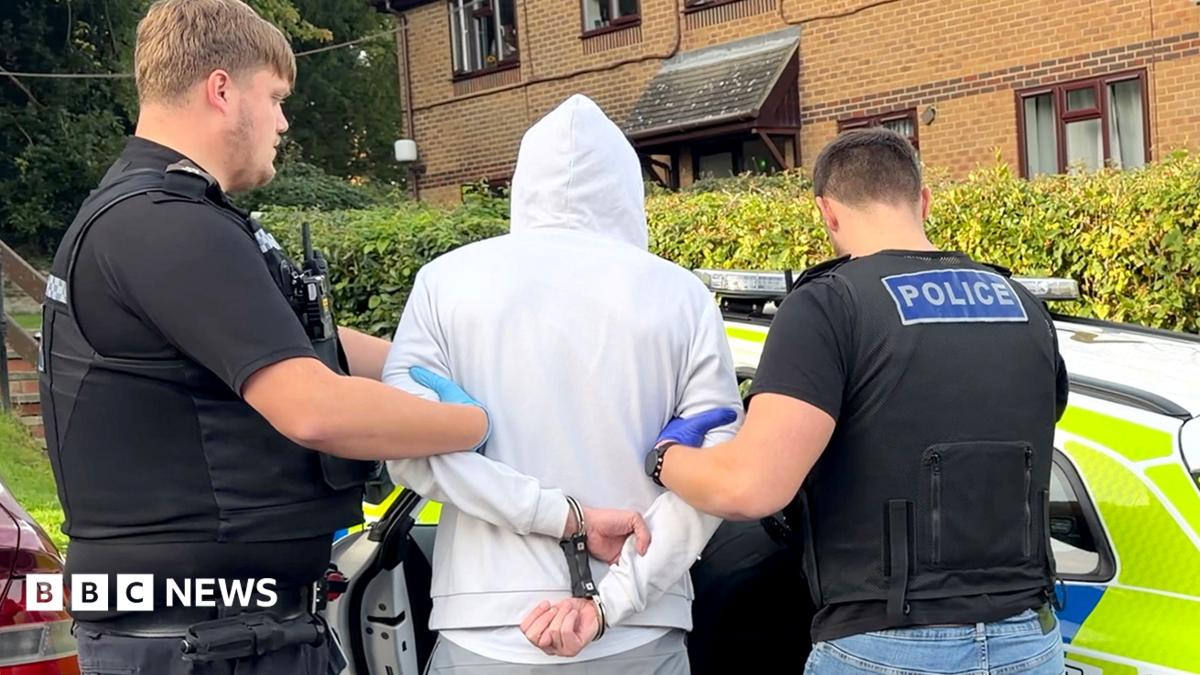
Image caption, Police arrested three suspects in the targeted Sussex operation the BBC attended
Our night-time ride in the unmarked police car takes place during an eight-hour Metropolitan Police operation targeting vehicle crime.
"Havering has been affected quite badly," PC Yoosef Outaleb tells us - partly because thieves use the back roads as a cut-through to neighbouring Essex.
Police say the county has particularly high numbers of illegal "chop shops", which dismantle vehicles for parts so they can be sold and exported.
"They [the criminals] don't have borders, whereas we do," he says. When criminal activity straddles police force boundaries, investigations can often slow down - which gangs look to exploit.
Two stolen vehicles are recovered, yet Met officers also uncover other crimes.
They pursue armed robbers on e-bikes, apprehend a drunk driver and arrest three men in a car full of Class A drugs, cash and phones.
It is all important work, but police admit that responding to these crimes diverts them away from targeting known vehicle thieves.
The thieves, known as "grafters" within criminal networks, are out every night stealing cars, the man claiming to work at a chop shop told us.
Many vehicles are then broken into parts. Such is the demand, he says, that deals to re-sell the parts are often done before he has even finished dismantling a vehicle.
Some stolen vehicles are left intact, given new number plates and sold in the UK or abroad, while others are used to facilitate drug dealing and human trafficking, or as getaway vehicles for robberies and break-ins.
Stolen: Chasing Britain's Car Thieves
Join police on the hunt for high-tech thieves behind a wave of UK car crime. See the latest weapons gangs are using in action, including electronic skeleton keys and military grade signal-jammers.
Watch on iPlayerWhile the long-term trend presents difficult reading for police, reported vehicle thefts fell 5% in England and Wales last year, to 119,000. In Scotland and Northern Ireland, vehicle thefts remained largely flat, at about 5,000 and 1,200 a year respectively.
Fifteen of the 32 police forces in England and Wales that responded to a BBC Freedom of Information request said they do not employ any full-time, specially-trained stolen vehicle examiners, who can carry out detailed examinations of cars and bolster investigations.
But Assistant Chief Constable Sarah Grahame, the national police lead on tackling vehicle crime, tells us officers' efforts - like the night-time operation in east London - are having an impact.
UK forces are also collaborating with Interpol, shipping companies and vehicle manufacturers to address an issue "that spans globally", she says.
She admits current theft levels are unacceptable, but says there is no funding to routinely carry out large-scale operations within current police budgets, set by the Home Office.
Instead, forces organise "intensification weeks" aimed at disrupting criminal networks.
One involving 32 forces last month, called Operation Alliances, led to at least 286 arrests and 319 vehicles seized.
Image caption, Three keyless Toyota RAV4s were stolen in Sussex, but all were recovered
In East Sussex in September, where we witnessed a smaller, targeted operation, we were told that 17 cars had been stolen in the Hastings and Rother areas in the previous two months.
Many of the vehicles were keyless Toyota RAV4s - taken by thieves using technology that bypasses vehicle security systems. Three of the vehicles had been taken the previous night.
Within hours, officers recovered all three vehicles and arrested three suspects, including one they believe had been in charge of the other two.
Two suspects have now been charged, including one arrested after a stolen Toyota was found near his home.
Sussex vehicle crime lead Ch Insp Oliver Fisher, says police resources are now being focused on "the top of that criminal network... that's where you'll seize the most assets and cause the most disruption".
Without catching criminal bosses, experts agree, others lower down will continue carrying out thefts to order - often using tech such as cloned keys to access vehicles.
Manufacturers need "a constant focus on security", says Thatcham Research - a body that works with carmakers, police and government to improve vehicle security.
"Within months" of a car being launched, thieves can develop targeted tools to steal it, it says.
At Thatcham Research's headquarters, we are shown a device hidden within a wireless speaker that can start a car by tapping into its internal communication system. We also see a military-grade signal jammer, left behind by criminals after a theft, that can block out all electronic signals for miles around.
While manufacturers are meeting security guidelines, the government should update regulations to ensure "sophisticated [theft] countermeasures are on a vehicle as standard", says Thatcham Research's principal engineer for automotive security, Steve Launchbury.
Tech that puts a key to sleep while motionless is one option, he says, so thieves cannot hack into it. In future, it may be possible for manufacturers to remotely lock down a car reported by the owner as stolen, he adds.
The Society of Motor Manufacturers and Traders told us car makers go "above and beyond regulatory requirements", while Toyota said it "continuously enhances vehicle security".
Mike Bull, 33, believed he had done everything he could to prevent his BMW M3 from being taken. He had CCTV, a house alarm and a protective container for his keys.
Image source, Mike BullImage caption, Masked men broke into Mike's home in the middle of the night
But just two months after he bought the car, two masked men broke into his home in the middle of the night and demanded the keys.
"I was kind of scared for my life," he says. Avon and Somerset Police says it is "following up all lines of enquiry", but his car has not been recovered.
Rose-Marie Clarke has been a victim of car theft twice in three years. Most recently, in March, her BMW was stolen from outside her home using an antenna to amplify the signal from the key fob inside her house. It took thieves just 35 seconds.
Image caption, Mike has now bought a cheaper car, so he doesn't have "a target" on his back
Clarke, like many victims we have spoken to, is critical of the police.
She says officers told her they knew the likely suspect, who had recently been released from prison, but they had been unable to prove it was him. "It's disheartening… you feel powerless because the police are powerless," she says.
Warwickshire Police said despite "extensive enquiries… an offender could not be identified". BMW UK said it worked "continuously" to improve security.
Many victims we spoke to told us they had also been hit hard by a rise in their car insurance premiums.
Image caption, Rose-Marie says her insurance premiums have sharply increased
Across the UK, car insurance quotes have risen by 82% since 2021 and Eli Glantz, an expert in organised crime and policing at security think tank Rusi, says vehicle crime "is certainly a factor".
"As more vehicles are stolen, insurers are forced to pay out more often. Premiums are going to rise," he adds.
Vehicle crime costs the UK economy £1.7bn a year, Rusi estimates.
Since April, it has been an offence to possess electronic devices used in vehicle thefts, but Glantz believes legislation is still failing to keep pace with the criminals.
It is welcome, he says, that the government is now giving vehicle thefts more attention, but he stresses that current police resources will not meaningfully reduce the number of crimes.
Several of the police officers we spoke to privately felt similarly. They said they had confidence in their ability to take down serious, organised vehicle crime networks, provided they had the necessary level of funding and support from decision-makers.
The Home Office says it "will continue to support police" in tackling organised vehicle theft and provides £300,000 a year to help strengthen its response, mainly to the National Vehicle Crime Reduction Partnership.
If you would like to contact BBC Journalist NJ Convery about this story you can email him directly at NJ.Convery@bbc.co.uk, external
Your Voice: What story do you want BBC News to cover?