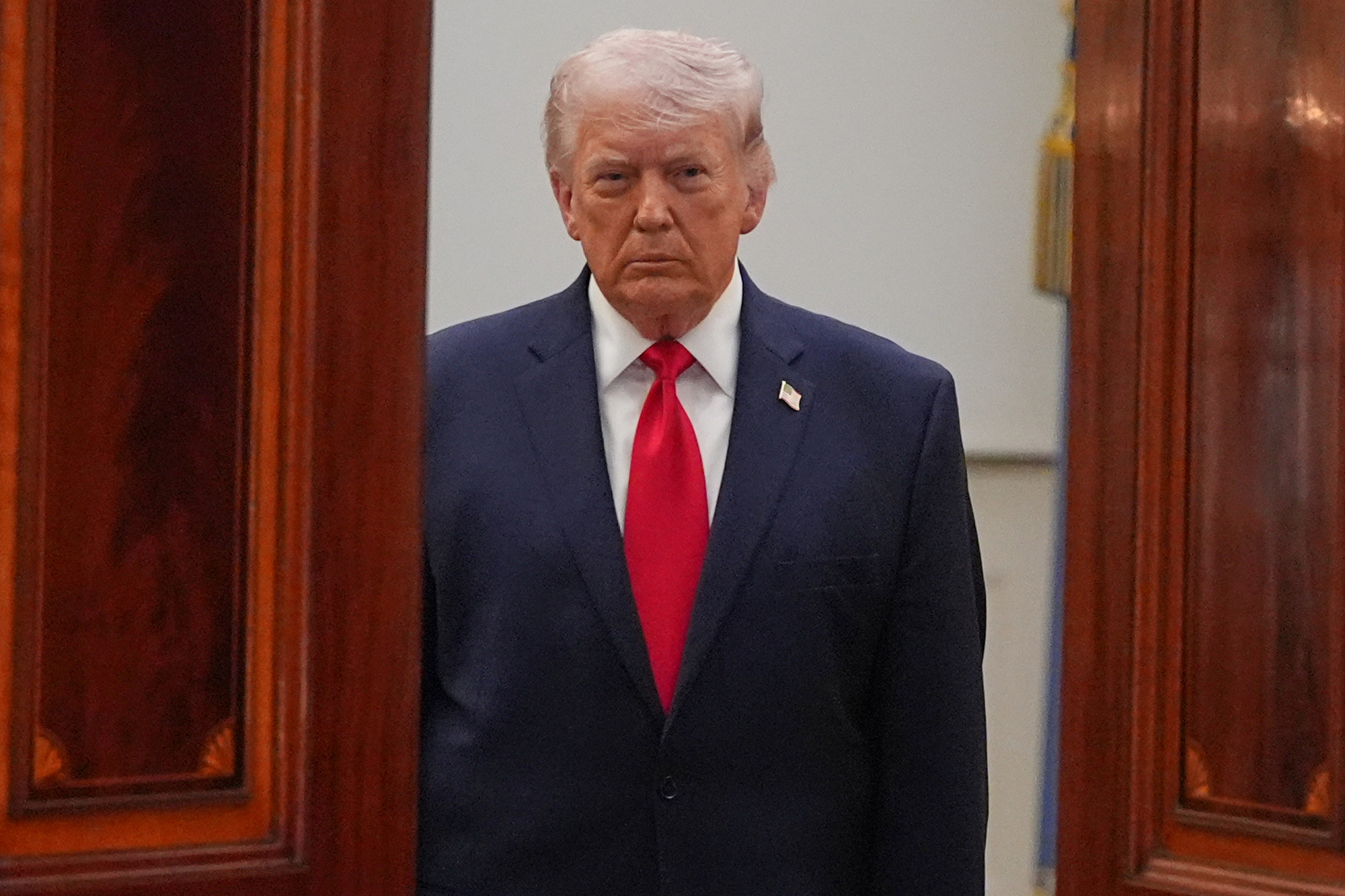
President Donald Trump arrives to speak about the Iran war from the Cross Hall of the White House on Wednesday, April 1, 2026, in Washington. AP NATO members are not legally required to join another member’s military operation that isn’t formally sanctioned by the alliance or aimed at protecting the membership’s homelands.
Some NATO members joined the United States in Afghanistan and Iraq, on the theory that the Taliban and Saddam Hussein were dangers to all Western security in the post-9/11 environment.
They followed the precedent set by America’s 1999 intervention in the distant Balkans, when it led a three-month NATO campaign to dismantle Slobodan Milosevic’s often bloody ambition to establish a Greater Serbia.
The US also joined the 2011 UN-approved, French- and British-inspired “coalition of the willing” bombing campaign in Libya.
That effort proved a seven-month misadventure — especially since the targeted Libyan strongman Moammar Khadafy had given up his nuclear weapons program and was desperately trying to cut a deal with the West.
When NATO members in the past have operated unilaterally to defend their own national interests, they have often called on the United States, as NATO’s strongest member, for overt help.
For nearly 40 years, the US offered logistical, intelligence, reconnaissance, refueling and diplomatic support to the French in their postcolonial efforts to protect Chad from Libya and, later, Islamists.
During the 1982 Falklands War, a solitary Britain faced enormous logistical challenges in steaming halfway around the world to eject Argentina from its windswept and sparse islands.
American aid was critical to the effort: The United States stepped up to help with intelligence, reconnaissance, the supply of some 2 million gallons of much-needed gasoline and crucial restocking of Britain’s depleted Tomahawk missiles.
The assistance prompted anger from most Latin American nations of the shared Western hemisphere, as well as from many Hispanic American citizens at home.
No matter — President Ronald Reagan rightly saw the importance of solidarity with a NATO member and a longtime US ally.
So he gave Britain a veritable blank check for Washington’s aid.
Currently, President Donald Trump has not asked NATO members to help bomb Iran — even though Europe, not the US, was in range of Iran’s ballistic missiles, and soon perhaps nuclear-tipped ones as well.
Europeans are far more vulnerable to Iranian-inspired Islamic terrorism.
They are more reliant on oil from the Middle East, some of it passing through the Strait of Hormuz.
All the US had initially requested was basing support in disarming a common Western enemy that, for nearly half a century, has slaughtered American diplomats and soldiers and tried to kill an American president and secretary of state.
But most NATO members could not even offer tacit help.
Some damned the US effort as either illegal or unnecessary.
The American public watched the British waffle for days over permitting the US to use their Diego Garcia airbase.
The Spanish banned American use of their NATO bases and airspace.
The Italians refused a request from American bombers to land and refuel at a Sicilian NATO base.
Many NATO heads of state rebuked the United States to their domestic audiences while, in typical two-faced fashion, publicly offering empty verbal support for the US campaign.
The NATO response to an Iranian missile aimed at fellow NATO member Turkey was anemic.
Even worse was the pathetic British reaction to another Iranian missile launched at a British base at Akrotiri, Cyprus.
Yet neutering a theocratic Iran is clearly of benefit to Europe.
So is preventing the international waters of the Strait of Hormuz from becoming a tollbooth run by the Iranian regime.
Such passivity stood in sharp contrast to the five-year-long Ukraine War on Europe’ border.
Nonetheless, Europeans made urgent requests for the US to honor the spirit of NATO solidarity and help protect Europe’s territorial integrity.
The combined population of the European Union and European NATO members is around 450 million — more than 100 million greater than that of the United States.
These same European nations enjoy an aggregate annual GDP of more than $22 trillion, 10 times the size of the Russian economy.
European diffidence comes on top of Trump’s perennial effort to harangue NATO members into honoring their commitments to spend 2% of GDP on defense — especially in the case of deadbeat Spain and Canada, which for years have welched on their pledges.
Trump’s rhetoric is not what has undermined NATO.
Instead, he ripped off a happy-face scab and exposed a festering wound of increasingly anti-American hypocrisy beneath.
If you wanted to wreck the alliance, there would be no better way than to follow the duplicitous example of Western Europe’s NATO members.
Victor Davis Hanson is a distinguished fellow of the Center for American Greatness.