After a large convoy of Iraqis crossed into Iran this week, observers worried they would join Iran's war effort against the US and Israel. But, experts say, Iraq's situation is way more complicated than that.
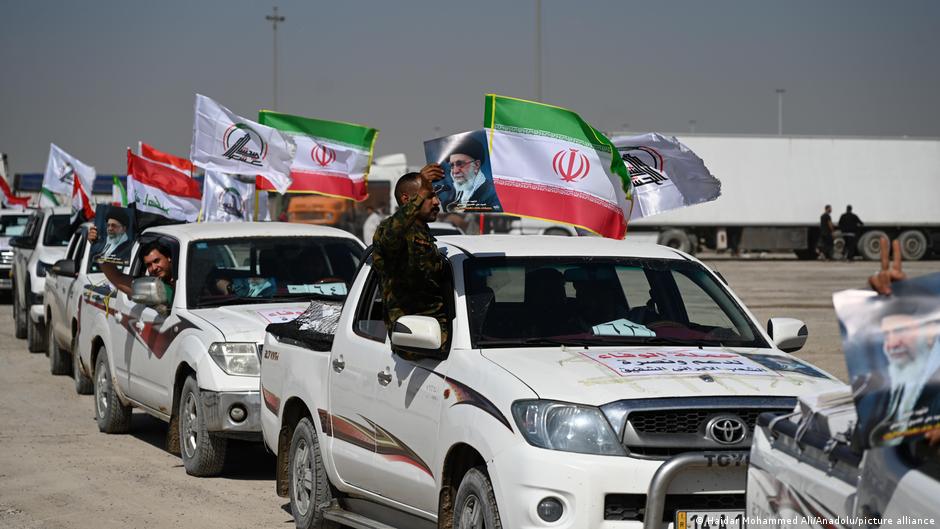
https://p.dw.com/p/5BaXYA convoy entered Iran last weekend in what was billed as a 'humanitarian mission' by members of Iran-allied militiasImage: Haidar Mohammed Ali/Anadolu/picture allianceAdvertisementA few days ago, a large convoy of trucks carrying Iraqis was filmed crossing the southern border into Iran. The convoy was supposedly carrying out "a humanitarian mission." But there were suspicions that the procession, which carried members of one of the Iraqi paramilitaries allied with Iran, was going to assist Iranian security forces.
Were those Iraqis about to drag their country into the Iran war?
"Even if the convoy includes fighters, that's unlikely to make any serious difference in a war shaped by airstrikes, missiles and wider regional military calculations," Hayder al-Shakeri, a research fellow at the British think tank, Chatham House, said.
Omar al-Nidawi, director of programs and research at the US-based organization, the Enabling Peace in Iraq, or EPIC, agreed.
Iran doesn't need foot soldiers from neighboring Iraq, he said.
"In fact, I think this [convoy] is more about perceptions," he told DW. "One of the things that has been working for Iran in terms of leverage, is this threat of expanding the war and increasing the pain and chaos for the US and its allies. And the image of this convoy is a show of force along these lines. The idea being that, if we can mobilize across the border to help Iran then perhaps we can also mobilize to strike into Kuwait or Syria, as some pro-Iran militia commanders have hinted at this week."
In fact, it is what happens inside Iraq that is likely to be more problematic, observers say.
The paramilitaries involved in the convoy are part of what are known as the Popular Mobilization Forces, or PMF. This group of fighters, numbering around 238,000 personnel, first formed in 2014 to combat the extremist group known as the "Islamic State." Since then the PMF have been formally integrated into Iraq's armed forces, with members paid by the government. It also has significant political representation and power in the Iraqi parliament.
Within the PMF are factions who are seen as more aligned with the Iranian government than their own. These factions are considered part of the so-called "axis of resistance," a group of militias in the Middle East, who act as Iranian proxies. Other members are Hezbollah in Lebanon, Hamas in Gaza and the Houthi rebel group in Yemen.
After the US and Israel attacked Iran in late February, the "axis of resistance" militias in Iraq responded by attacking what they say are targets associated with the US or Israel.
This includes US and European diplomatic and military facilities as well as civilian infrastructure, including oil fields and hotels. They have also fired rockets over Iraq's borders.
As al-Shakeri points out, "even a relatively small number of factions could have an outsize impact if they launch attacks from Iraqi territory, target foreign interests, or act in ways that invite retaliation. That's how they can expose the whole country to the consequences of a conflict that most Iraqis do not want."
As a result of the various attacks on targets associated with Americans, the US has responded by bombing PMF strongholds, something it has previously tried to avoid.
Last week, the Iraqi government held an emergency session. During this, it ordered that anybody who was attacking Iraqi security institutions, civilian sites or diplomatic missions be arrested.
But, in an example of the structural dilemma Iraq faces, during that same emergency session, it also gave all military units, including the PMF, broader powers to respond to any attacks against them "in self-defense."
The decision was seen as controversial because it "effectively makes Iraq a belligerent in the current regional war, rendering it responsible for actions carried out by the PMF factions under claims of self-defense," Mohammed Salih, a senior fellow at the US-based think tank, the Foreign Policy Research Institute, explained in an analysis last week.
Another example of Iraq's security dilemma is this week's kidnapping of an American journalist in Baghdad.
Shelley Kittleson, a regular correspondent for the US-based media outlet, Al Monitor, was seized in central Baghdad on Tuesday.
After the kidnappers' car was involved in an accident, its driver was arrested. Kittleson was transferred to another vehicle and is still missing.
Media reports say it was likely the kidnappers were members of a PMF faction, Kataib Hezbollah. The group apparently had Kittleson's name on a list of targets and anonymous sources told the New York Times that it has offered to negotiate for Kittleson's release.
If it turns out Kataib Hezbollah is involved, then both parties — the forces seeking Kittleson and the group that took her — are actually part of Iraq's official security apparatus.
Tensions between those two groups have increased during the current war.
Iran-allied militias have also attacked their own country's state security organizations, including the Iraqi National Intelligence Service in Baghdad and the Iraqi Counter-Terrorism Service.
The attackers say the two organizations have ties to the US. For instance, its well known that Iraqi counter-terrorism officers trained with American officers.
"The fact that militias affiliated with or linked to the PMF have begun directly targeting official institutions … indicates that a long-standing, largely covert rivalry has now reached a far more dangerous threshold," Sercan Caliskan, an expert on Iraq at Turkish think tank, the Center for Middle Eastern Studies, argued in a briefing this week.
"This underscores the structural problem created by the PMF's ambiguous position within the Iraqi state. On one hand, it is formally a security entity. On the other, some of its components are capable of targeting other official state institutions," he explained. "The country now faces a scenario where different elements of its security apparatus are effectively pitted against each other."
The Iran war is worsening a problem that should have been resolved years ago, al-Shakeri said.
"There is a serious concern about fragmentation inside Iraq's own security and political system," he explained. "Armed groups have become more emboldened because they operate in an environment where accountability is weak … that creates space for kidnappings, coercion and attacks that harm civilians, intimidate institutions and undermine the authority of the state. The danger is that this kind of behavior becomes more frequent as pressure on these groups grows."
"There are no easy ways out [of this dilemma]," al-Nidawi conceded. "This hijacking of the state is like a train wreck that's been in the making for 20 years, and now we're watching the debris being thrown every which way."
Reversing the damage requires that Iran has less ability to exert influence on Iraq, he noted. But that seems unlikely to happen. Another possibility is that more pragmatic PMF factions, who prefer stability and enjoy growing economic and political power, put pressure on the more militant factions, he says.
Al-Shakeri has a similar suggestion but says that's difficult right now because Iraq still hasn't formed a new government after last November's elections.
"For now, the [Iraqi state's] immediate priority is damage control, containing escalation and pushing for a government to be formed," he concluded. "Only after that will there be any real opening to move towards proper reform, and even then it will depend on support from actors within the system who still want a stronger state."
How the Iran war compares to the US's 2003 invasion of IraqTo view this video please enable JavaScript, and consider upgrading to a web browser that supports HTML5 video