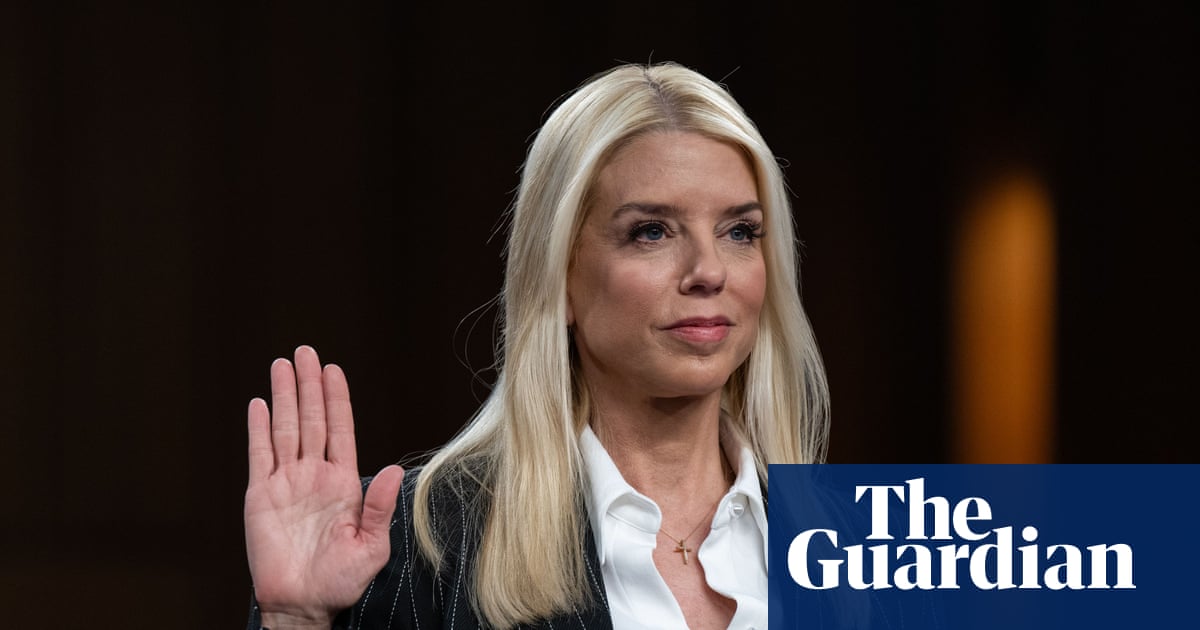
Pam Bondi testifies at her Senate confirmation hearing in January last year. Photograph: Rex/ShutterstockView image in fullscreenPam Bondi testifies at her Senate confirmation hearing in January last year. Photograph: Rex/ShutterstockEpstein accusations and pressure from the boss: Bondi’s time as Trump’s chief enforcerFrom attempts to prosecute president’s foes to claims of a cover-up, attorney general endured tumultuous tenure
Analysis: Bondi firing a reminder that even ultra-loyalists get dumped by Trump
Donald Trump fired Attorney General Pam Bondi on Thursday, removing the nation’s chief law enforcement officer after months of mounting frustration over her handling of the Epstein files and her faltering attempts to prosecute the president’s political enemies.
“We love Pam, and she will be transitioning to a much needed and important new job in the private sector, to be announced at a date in the near future,” Trump wrote in a social media post on Thursday. He said she would be replaced by her deputy, Todd Blanche, on an interim basis.
Here’s a look at her tenure as attorney general.
Days before Trump was inaugurated for a second term, Bondi appeared before the Senate judiciary committee for her confirmation hearing. There was little doubt that Bondi, a Trump loyalist and former attorney general of Florida, would be confirmed. She was Trump’s second choice for the job after his first, far more controversial pick, the former Florida congressman Matt Gaetz, stepped aside.
View image in fullscreenBondi in Washington for her confirmation hearing. Photograph: Bloomberg/Getty ImagesPressed by Democrats, Bondi pledged then that she would not politicize the justice department or to pursue prosecutions “just for political purposes” as Trump campaigned on doing.
The US Senate confirmed Bondi in a 54-46 vote, largely along party lines. All Republicans voted to confirm and all but one Democratic senator, John Fetterman, voted against.
View image in fullscreenBondi is sworn by Clarence Thomas alongside her partner John Wakefield and mother Patsy Bondi. Photograph: Andrew Harnik/Getty ImagesThe following day, she was sworn in as the 87th attorney general of the United States. In an Oval Office ceremony, Trump praised Bondi as an “unbelievably fair and unbelievably good” legal mind. The conservative supreme court justice Clarence Thomas administered her oath of office. In brief remarks, Bondi pledged to “make America safe again”.
In a Fox News interview that would come to haunt her tenure, Bondi said that a “client list” related to the late sex offender Jeffrey Epstein was “sitting on my desk right now to review”. The comment raised expectations of conservative influencers and conspiracy theorists who had speculated wildly about a list containing the names of clients to whom Epstein had trafficked underaged girls.
Days later, she presented a group of rightwing influencers and media personalities visiting the White House with binders, meant to signal her commitment to transparency regarding the investigation. But the move was widely criticized by both the left and right as a political stunt, with the binders mostly containing information that was already available publicly.
Beginning last spring, the justice department launched a sprawling effort to obtain unredacted citizen voter data, demanding states turn over sensitive and private data such as driver’s license and partial social security numbers for the purpose of enduring compliance with election laws. According to a tally by the Brennan Center for Justice, the DoJ has sought this information from at least 44 states and the District of Columbia. Most have refused to comply with the request, sparking a volley of legal action between states and the federal government.
View image in fullscreenThe Department of Justice building in Washington. Photograph: Kevin Carter/Getty ImagesSeveral federal courts have rejected the department’s lawsuits, with a federal judge in California warning that its bid to obtain the records “threatens the right to vote”.
In a memo, the justice department formally ruled out the existence of an Epstein “client list”, despite Bondi’s previous comment that the document of the late financier’s wealthy and powerful conspirators was being prepared for release. The admission sparked angry backlash among rightwing influencers, leading to calls for Bondi to be fired.
In a weekend Truth Social post, Trump implored Bondi to prosecute several of his long-time political foes, including the former FBI director James Comey and California senator Adam Schiff. In the public post, addressed to “Pam” and signed “President DJT”, Trump lamented the lack of progress in the investigations targeting Comey, Schiff and the New York attorney general Letitia James.
View image in fullscreenBondi testifies before the Senate judiciary committee in October last year. Photograph: Win McNamee/Getty Images“We can’t delay any longer, it’s killing our reputation and credibility,” Trump wrote. “They impeached me twice, and indicted me (5 times!), OVER NOTHING. JUSTICE MUST BE SERVED, NOW!!!”
Though the Wall Street Journal later reported that Trump intended to send the message privately to Bondi, it revealed the extraordinary pressure he was placing on his attorney general and raised serious questions about the department’s independence.
A federal judge dismisses criminal prosecutions of former FBI director James Comey (charged with false statements and obstruction) and NY attorney general Letitia James (charged with bank fraud). The judge rules that the interim US attorney who obtained the indictments had been invalidly appointed – a major embarrassment for Bondi.
A federal judge dismissed the criminal cases against Comey and James, ruling that the interim US attorney who obtained the indictments at Trump’s urging was illegally appointed by the justice department. Bondi vowed the decision was not the final word on the matter.
After federal immigration agents shot and killed an American citizen in Minneapolis for the second time in January, the attorney general sent a letter to Tim Walz, the Democratic governor of Minnesota, outlining what she described as a series of “simple steps” to “bring back law and order”. Among them was a seemingly unrelated request to turn over access to the state’s voter rolls – a move one attorney representing the state described in a court hearing as a “ransom note”.
Walz dismissed the letter as unserious, and a coalition of 21 Democratic state attorney generals condemned the move as an unprecedented threat to states’ rights.
After missing the 19 December deadline set by Congress in the Epstein Files Transparency Act, the DoJ released more than 3 million documents in late January. Bondi delegated much of the public-facing handling to her deputy, Todd Blanche, who insisted in a testy news conference that the White House “had nothing to do” with vetting the released documents.
In a combative public hearing, Bondi attacked and berated Democrats, raised her voice at lawmakers and, when asked to apologize to the Epstein survivors in the room, accused the questioner of “doing theatrics”. “You’re a washed-up loser lawyer. You’re not even a lawyer,” she told Congressman Jamie Raskin of Maryland, the top Democrat on the committee. She largely avoided addressing the questions about the way the department has handled the files.
View image in fullscreenBondi speaks to Thomas Massie, the Kentucky Republican who has led the bipartisan push for a full release of the Epstein files. Photograph: Roberto Schmidt/AFP/Getty ImagesLawmakers say release of Epstein files insufficient14 February 2026In a letter to Congress signed by Bondi, the justice department said all records and materials required by the Epstein Files Transparency Act have been released. Lawmakers maintain that the release is insufficient, and that there are more documents and data that should be made public.
The six-page letter included a lengthy list of government officials, celebrities, business leaders and other “politically exposed persons” whose names appear at least once in the released materials.
Five Republicans on the House oversight committee joined with Democrats in voting to subpoena Bondi and compel her to testify about the justice department’s handling of the Epstein investigation and its release of the Epstein files.
On 17 March, she was formally subpoenaed to appear before the panel. In a subpoena letter, congressman James Comer, the Republican chair of the House oversight and government reform committee, said his panel was reviewing the “possible mismanagement of the federal government’s investigation” and sought her testimony “regarding the Department of Justice’s handling of the investigation into Jeffrey Epstein and his associates and its compliance with the Epstein Files Transparency Act”.
When Bondi appears voluntarily before the House oversight committee in mid-March, Democrats walked out of a closed-door briefing in protest, leaving what California congressman Robert Garcia called “an outrageous fake hearing” after the attorney general refused to commit to honoring a subpoena to testify under oath.
View image in fullscreenBondi answers questions from the media outside the Capitol. Photograph: Matt McClain/Getty ImagesBondi and Blanche had gone to Capitol Hill in an effort to quell bipartisan frustration over the justice department’s handling of millions of files related to Epstein’s sex trafficking investigation.
Trump ousts Bondi as attorney general, citing frustration over her handling of the Epstein files and the DoJ’s failure to successfully prosecute his political opponents.
Despite her efforts to re-orient the justice department around the president’s priorities and personal grievances, Bondi nevertheless failed to appease Trump’s desire for political retribution and move past his frustration with the politically explosive release of the Jeffrey Epstein files.
View image in fullscreenBondi with Donald Trump in the White House press briefing room last year. Photograph: Jacquelyn Martin/AP“Pam Bondi is a Great American Patriot and a loyal friend, who faithfully served as my Attorney General over the past year. Pam did a tremendous job overseeing a massive crackdown in Crime across our Country, with Murders plummeting to their lowest level since 1900,” Trump wrote in a post on Truth Social.
“We love Pam, and she will be transitioning to a much-needed and important new job in the private sector, to be announced at a date in the near future.”