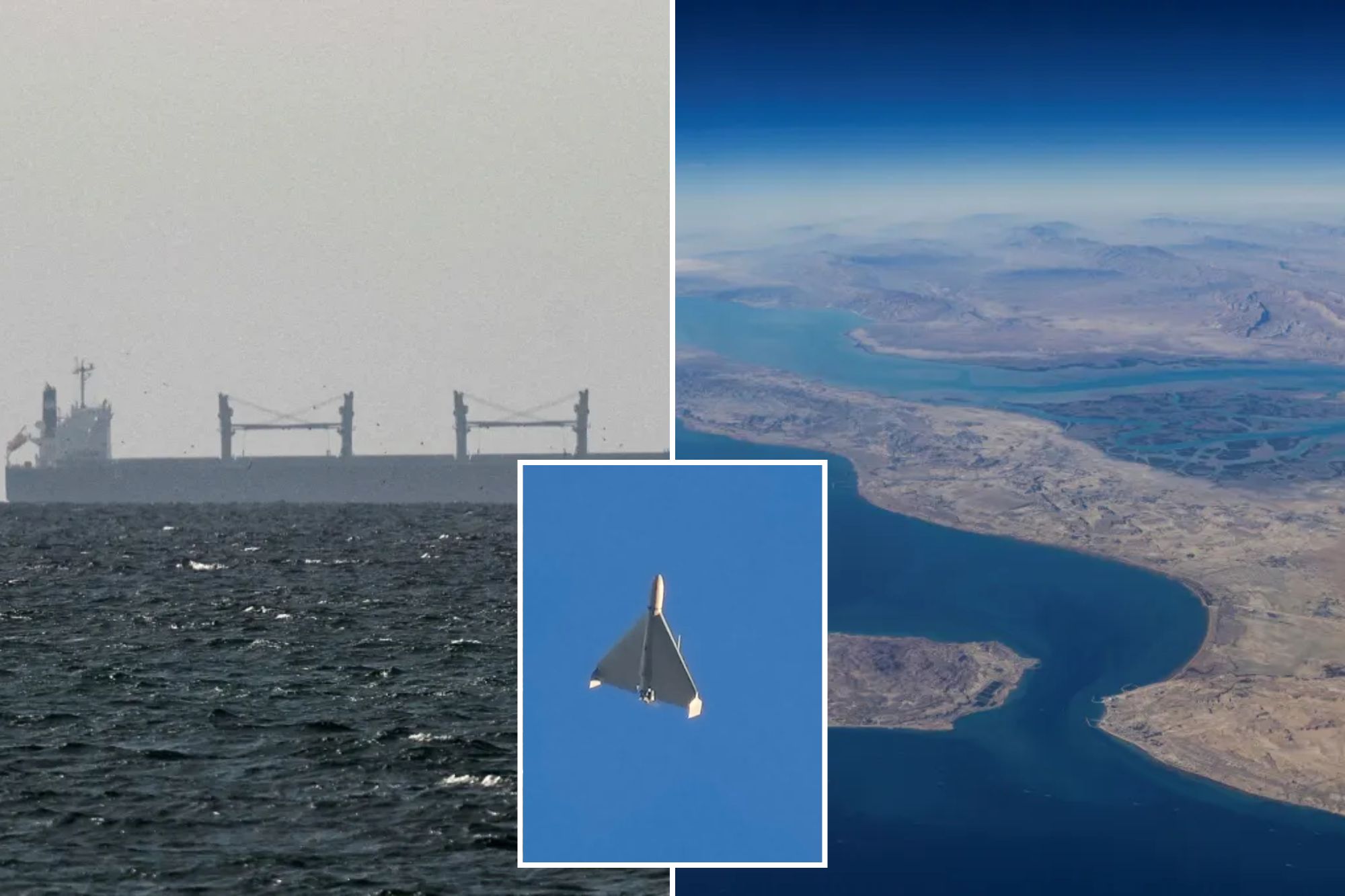
A coalition of 40 nations on Thursday huddled on how to meet President Trump’s demand to reclaim the Strait of Hormuz — and opened the door to military escorts if Iran eases off ambushing commercial ships.
“This meeting showed clearly the determination of the international community to secure freedom of navigation and re-open the Strait of Hormuz,” the British government said in a readout of the virtual international gathering. “Iran’s closure of the Strait of Hormuz is a direct threat to global prosperity.”
Trump has asked European and Gulf partners to take a more immediate role in ensuring passage through the strait — even threatening to exit the NATO alliance over their lack of help. Key allies have pushed back, arguing that deeper involvement in Iran must wait until the danger subsides.
“This is not our war. We will not be drawn into the conflict,” British Prime Minister Keir Starmer said Wednesday, stressing that the priority remains “diplomatic and political measures” to restore safe transit.
But the UK signaled a shift on Thursday, announcing it would convene military planners from various nations to hammer out ways to keep the strait secure — once the most intense fighting of the war comes to a close.
“Iran is trying to hold the global economy hostage in the Strait of Hormuz. They must not prevail,” the British government said. “To that effect, partners today called for the immediate and unconditional reopening of the Strait and respect for the fundamental principles of freedom of navigation and the law of the sea.”
The countries also discussed further sanctions on Iran to “bear down on Iran if the Strait remains closed,” as well as unspecified “joint arrangements to support greater market and operational confidence.”
“Today, we looked at diplomatic, economic, and security measures to restore safe passage, alongside working with the shipping industry,” EU High Representative for Foreign Affairs and Security Policy Kaja Kallas posted to X. “This waterway is a global public good. Iran cannot be allowed to charge countries a bounty to let ships pass.”
“International law doesn’t recognize pay-to-pass schemes,” she added, referencing Iran’s desire to charge a toll to pass through the strait.
Meanwhile, France has explored forming a coalition of nations to help sail alongside oil and gas tankers once the main fighting comes to a close, holding a teleconference last week with 35 nations to feel out how each may be willing to participate.
But beyond warships and sanctions, some defense experts say there may be a lower-risk way forward.
A newly launched US military tech company with some big-name investors told The Post that cheap, swiftly made drones could be the way forward for more risk-averse allies without putting boots — or boats — in harm’s way.
“It can’t really be done with just manned boats,” Powerus President and Chief Operating Officer Brett Velicovich told The Post. “You need this moving security layer — you can’t have a static defense.”
Velicovich said swarms of low-cost, rapidly deployable unmanned vessels could offer a safer alternative to sailing navy warships through the dangerous waters, arguing they could continuously patrol the strait, detecting threats and safeguarding commercial ships in real time.
“You have hundreds of these boats patrolling and monitoring and sensing, making sure a vessel is safe to transit,” said Velicovich, who started the company after spending years in Ukraine working with drone operations. “That’s far more flexible than big naval ships trying to cover vast distances.”
Unlike traditional warships, which can be limited by range and visibility, unmanned systems can be deployed en masse and adjusted instantly as threats evolve.
“There’s just not enough boats in the US Navy’s arsenal to do it alone,” Velicovich said. “You have to deploy these assets at scale and adjust in real time.”
He emphasized the technology is not meant to replace existing naval forces but to enhance them.
“It’s a force multiplier,” he said. “You integrate unmanned boats with drone capability into the fleet, and suddenly commanders have far more coverage and capability — without waiting years to build new ships.”
Powerus, launched last month in West Palm Beach, Fla., counts Donald Trump Jr. and Eric Trump among its backers, with former Special Envoy to Ukraine Keith Kellogg joining its board earlier this week.