The Five Largest Holdings in the RANK ETF After Its Latest Rebalance TipRanks Tue, October 13, 2026 at 3:00 PM EDT 12 min read X.TO +0.23% AMZN -0.11% AVGO +0.88% BAC -0.89% GOOG +0.40% Explore stocks on Coinbase Trading disclosure Trading disclosure The above button links to Coinbase. Yahoo Finance is not a broker-dealer or investment adviser and does not offer securities or cryptocurrencies for sale or facilitate trading. Coinbase pays us for certain activity generated through this link. Prices displayed are informational.
The Defiance KSM TipRanks Analyst ETF (RANK) has completed its latest quarterly reconstitution and rebalance, which took effect after the close on September 21, 2026 with notable changes among its largest holdings.
RANK seeks to track the performance, before fees and expenses, of the TipRanks US Momentum Analysts iNDEX. The index is calculated and administered by VettaFi LLC (a TMX Group company) or its affiliates and is constructed utilizing proprietary data provided by TipRanks Ltd.
The index starts with the 500 largest U.S.-listed companies and keeps the 100 with the most analyst Buy recommendations, based on TipRanks' data. It then looks at price momentum, meaning how each stock's recent price compares with its longer-term averages, and selects the 50 stocks with the strongest momentum. Holdings are weighted by market capitalization, subject to caps at the company and sector level, and the index is reconstituted quarterly.
Unlock powerful investing tools with TipRanks Premium to make smarter, more confident investment decisions
The approach combines two signals: how bullish Wall Street analysts are on a stock, and whether the shares are actually trending higher.
RANK has a fund inception date of June 29, 2026, and had $12.43 million in net assets as of September 29, 2026.
Compared with the fund's reported holdings as of June 30, 2026, the top of the portfolio looks different. Visa (V), Coca-Cola (KO) and Bank of America (BAC) are new to the portfolio and now rank among its ten largest holdings. Walmart (WMT), the fund's third-largest position at the end of June, is no longer in the portfolio, along with Broadcom (AVGO) and Alphabet (GOOGL). Micron (MU) remains the largest holding, and Nvidia (NVDA) has moved up to second.
Here are the fund's five largest holdings as of September 30, 2026, along with how Wall Street analysts rate each one. Analyst data is from TipRanks as of October 12, 2026. Fund holdings are subject to change.
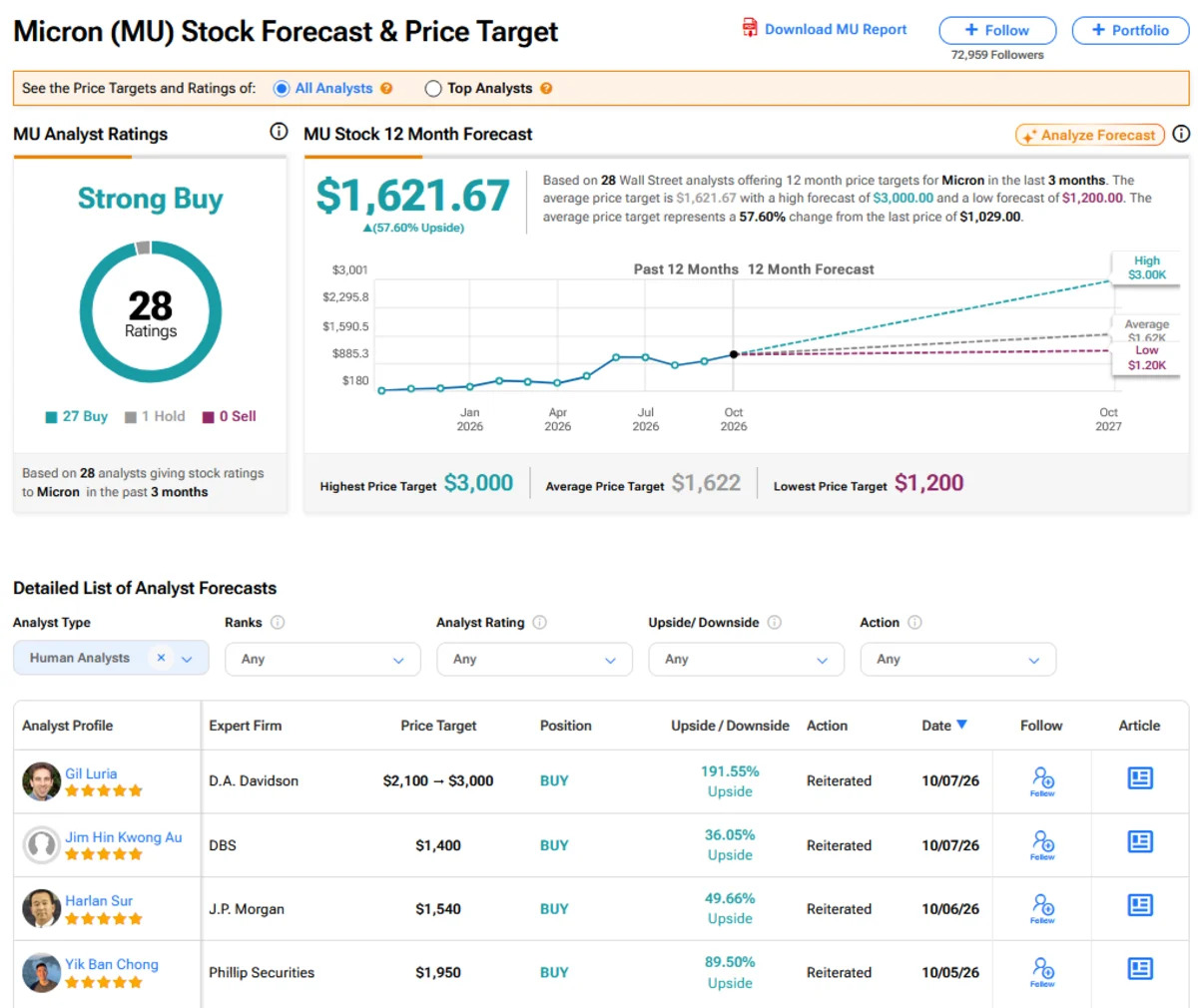
Micron Technology develops, manufactures and sells semiconductor memory and storage products. It is the largest holding in RANK at 9.21% of net assets, compared with 6.65% at June 30, 2026.
On TipRanks, the stock has a Strong Buy consensus rating. Of the 28 analysts who rated the stock over the past three months, 27 rated it a Buy. The average price target is $1,621.67.
Demand for memory chips from AI data centers has outpaced supply, which has supported memory prices and Micron's revenue.
Five-star TipRanks-rated Robert W.Baird analyst Tristan Gerra recently reiterated his Buy rating on Micron with a price target of $1,520. He highlighted Micron's expectations for materially tighter Dynamic Random-Access Memory (DRAM) supply in fiscal 2027–2028 versus 2026, alongside industry bit growth in the low‑20% range and incremental capacity ramps. This, he said, should underpin stronger pricing and justify a stock rerating over time.
He also pointed to a steady path of gross margin expansion through fiscal 2027, supported by long‑term customer supply agreements that lock in pricing bands and secure a large share of Micron's future output and revenue through 2030.
Nvidia designs graphics processors, computing platforms and networking products used in AI data centers. It is the second-largest holding in RANK at 6.73% of net assets, compared with 4.51% at June 30, 2026.
On TipRanks, the analyst consensus on Nvidia is a Strong Buy. All 33 analysts who rated the stock over the past three months rated it a Buy. The average price target is $324.20.
Goldman Sachs analyst James Schneider recently maintained a Buy rating on Nvidia with a price target of $300. He pointed to the view that AI could reach a total addressable market of $3 trillion to $4 trillion by 2030, driven by the industry's shift from traditional retrieval-based computing toward generative models that require new, specialized compute infrastructure.
Schneider also cited Nvidia's tightly integrated hardware and networking stack as a structural advantage as customers seek higher performance and efficiency from their AI spending. He highlighted generative AI use cases in coding and cybersecurity, Nvidia's growing share of AI investment, and its ability to manage supply and data center capacity constraints.
The pharmaceutical company, arguably best known for weight-loss drugs such as Zepbound, is the third-largest holding in RANK at 5.88% of net assets, compared with 4.60% at June 30, 2026.
On TipRanks, the stock has a Strong Buy consensus rating. Of the 23 analysts who rated the stock over the past three months, 20 rated it a Buy. The average price target is $1,366.05.
Lilly's revenue comes from a broad range of medicines, spanning weight-loss and diabetes treatments as well as cardiovascular and cancer drugs.
Berenberg analyst Kerry Holford recently upgraded the stock to Buy from Hold. She expects the drugmaker to exceed its 2026 guidance, driven by growth in weight-loss drug sales, and views Lilly as the market leader in obesity and diabetes medications.
Visa operates a global electronic payments network connecting consumers, merchants and financial institutions. New to the portfolio, it is the fourth-largest holding in RANK at 5.79% of net assets.
On TipRanks, the analyst consensus on Visa is a Strong Buy. Of the 28 analysts who rated the stock over the last three months, 26 rated it a Buy. The average price target is $425.54.
Visa's stock is up nearly 19% in the last six months driven by cross-border volumes and value-added services such as cybersecurity. It also received a boost from this summer's FIFA World Cup as fans enjoyed the football and wider hospitality.
Five-star TipRanks-rated Wolfe Research analyst Darrin Peller recently raised his price target on Visa to $460 from $435. He updated estimates, targets and ratings in the payments, consumer finance and IT services group following Q2 reports. He said that results across the sector demonstrated healthy U.S. consumer spending and credit trends.
The e-commerce and cloud computing company is the fifth-largest holding in RANK at 5.72% of net assets, compared with 5.15% at June 30, 2026.
On TipRanks, the stock has a Strong Buy consensus rating. Of the 43 analysts who rated the stock over the past three months, 41 rated it a Buy. The average price target is $332.35.
Amazon's business is driven by consumer e-commerce and by Amazon Web Services, its cloud platform serving cloud and AI customers. On September 24, 2026, the company announced plans to invest more than $100 million in a new manufacturing facility in Greenwood, Indiana, to support its fulfillment and robotics network.
Evercore ISI analyst Mark Mahaney recently reiterated his Buy rating on the stock. He said Amazon is maintaining its leading share of U.S. online retail, with broad recognition for price, selection and convenience. He also sees upside from newer growth drivers, including agentic AI, which he said is already driving incremental product discovery, and faster shipping.
RANK is designed to reflect two signals at once: analyst conviction and price momentum. Rather than relying on a single analyst's view, the index draws on Buy recommendations from all analysts in the TipRanks database who cover a stock, then keeps the companies whose shares are also showing the strongest price momentum.
Because the index is reconstituted every quarter, the portfolio changes as analyst views and price trends shift, and this latest update reflects that. Analyst ratings and price targets are opinions, not guarantees, and momentum can reverse quickly.
For full fund details, the prospectus, holdings, and performance current to the most recent month-end, visit defianceetfs.com/rank or call 833.333.9383.
Fund holdings and weights are as of September 30, 2026, unless otherwise noted. Fund holdings are subject to change at any time and should not be considered recommendations to buy or sell any security.
Analyst ratings, consensus ratings and price targets cited in this article are sourced from TipRanks as of October 5, 2026. They reflect the opinions of third-party analysts, are subject to change without notice, and are not guarantees of future results. They are not recommendations by Defiance ETFs LLC, Tidal Investments, LLC or Foreside Fund Services, LLC, and they do not represent the past or expected performance of the Fund. There is no assurance that any price target will be achieved.
Defiance ETFs LLC is the ETF sponsor. The Fund's investment adviser is Tidal Investments, LLC ("Tidal" or the "Adviser").
The Fund's investment objectives, risks, charges, and expenses must be considered carefully before investing. The prospectus and summary prospectus contain this and other important information about the investment company. Please read the prospectus and/or summary prospectus carefully before investing. For a prospectus or summary prospectus with this and other information, go to defianceetfs.com. Hard copies can be requested by calling 833.333.9383.
Investing involves risk. Principal loss is possible. As an ETF, the Fund may trade at a premium or discount to NAV. Shares are bought and sold at market price (not NAV) and are not individually redeemed from the Fund. A portfolio concentrated in a particular sector or industry may be subject to a higher degree of risk. There is no guarantee the Fund will achieve its investment objective, and an investor may lose some or all of its investment.
Momentum Risk. The Fund's index emphasizes securities that have had strong recent performance. Securities exhibiting marked recent outperformance may be more volatile than the broader market, and strong recent performance may be an indicator that a security's price is peaking. Momentum can turn quickly and reverse, and the Fund may experience significant losses if momentum stops, reverses, or behaves differently than expected.
Third Party Data Risk. The composition of the Index, and therefore the Fund's portfolio, depends heavily on analyst recommendations and other data calculated and published by independent third parties. If that data is incorrect or incomplete, the Index, and in turn the Fund, may include or exclude securities that would have been treated differently had the data been accurate and complete.
Equity Market Risk. Common stocks are subject to sudden, unpredictable declines in value, as well as longer periods of decline, due to factors that affect securities markets generally or particular issuers, industries, or sectors.
Sector and Industry Risk. To the extent the Fund invests more heavily in particular sectors or industries, its performance will be especially sensitive to developments that significantly affect those sectors and industries.
Information Technology Sector Risk. The Fund is generally expected to invest significantly in the information technology sector. Information technology companies face intense competition, rapid product obsolescence, and heavy dependence on intellectual property, and their stock prices may be more volatile than the broader market.
ETF Risks. As an ETF, the Fund is subject to risks that include a limited number of Authorized Participants, market makers, and liquidity providers; trading costs and bid-ask spreads; the potential for Shares to trade at a premium or discount to NAV; and the possibility that an active trading market for Shares may not develop or be maintained, or that trading may be halted.
Foreign Securities Risk. Investments in non-U.S. securities, including through American Depositary Receipts (ADRs), involve risks not typically associated with U.S. investments, including currency fluctuations, political or economic instability, and less publicly available information about issuers. ADRs may not provide a return that corresponds precisely with that of the underlying foreign shares.
Large-Capitalization Investing. The securities of large-capitalization companies may be relatively mature and subject to slower growth during times of economic expansion, and such companies may be unable to respond quickly to new competitive challenges.
Non-Diversification Risk. Because the Fund is non-diversified, it may invest a greater percentage of its assets in a single issuer or a smaller number of issuers than a diversified fund. As a result, the Fund may be more sensitive to adverse developments affecting a single issuer or a small number of issuers, which may increase the Fund's volatility.
Passive Investment Risk. The Fund is not actively managed and does not attempt to outperform the Index or take temporary defensive positions in declining markets. As a result, the Fund's performance may be adversely affected by a general decline in the market segments related to the Index.
Tracking Error Risk. As with all index funds, the performance of the Fund and the Index may differ for a variety of reasons. For example, the Fund incurs operating expenses and portfolio transaction costs not incurred by the Index, and the Fund may not be fully invested in the securities of the Index at all times.
Underlying Index Risk. There is no assurance that the Index Provider or Index Owner will compile, calculate, or maintain the Index accurately, or that the Index will be available or produced in a timely manner. Errors in Index data or construction may occur and may not be identified or corrected for a period of time, which could have an adverse impact on the Fund and its shareholders.
New Fund Risk. The Fund is a recently organized management investment company with no operating history. As a result, prospective investors do not have a track record or history on which to base their investment decisions.
Operational Risk. The Fund is subject to operational risks arising from factors such as human error, processing and communication errors, and failures of the Fund's service providers, processes, or systems.
Economic and Market Risk. The Fund's investments are subject to changes in general economic conditions and general market fluctuations, which can cause the value of investments to decline due to factors including interest rates, inflation, and geopolitical events.