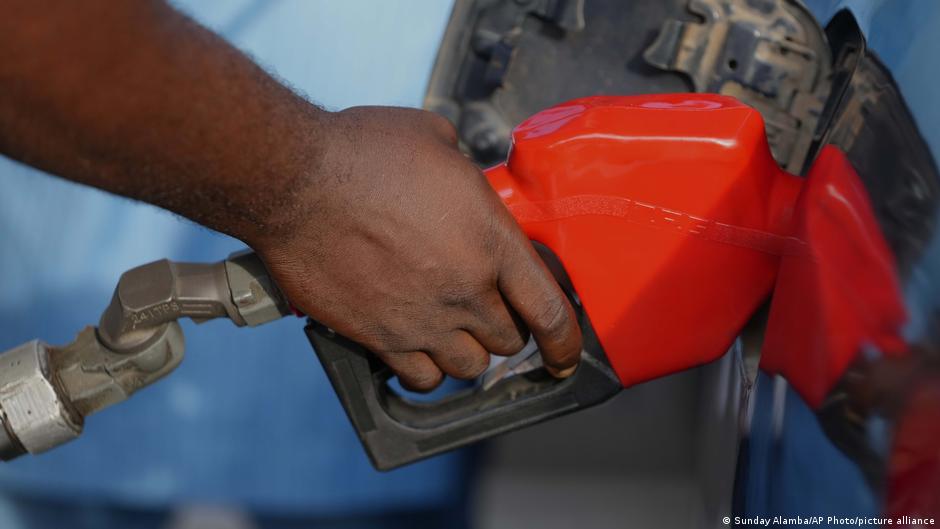
Africa is running low on fuel. The US-Israel-Iran war has sent fuel prices skyrocketing. Are African countries doing enough to calm the fuel market?
https://p.dw.com/p/5BaDQLike in other parts of the word, fuel prices have increased in AfricaImage: Sunday Alamba/AP Photo/picture allianceAdvertisementA month into the war on Iran, Africa is scrambling to keep its engines running. In Kenya, there are reports of shortages of roughly 20% hitting petrol stations; suppliers attribute most of this to panic buying. The East African nation typically maintains fuel stocks equivalent to roughly two to three weeks of national demand, highlighting its reliance on continuous imports and exposure to global supply disruptions.
People in neighboring Tanzania, meanwhile, have had to stomach price hikes of over 30% at the pump—levels last witnessed in 2022 during Russia's invasion of Ukraine. Existing supplies can keep the country running at current capacity for another month, foreshadowing another potential increase.
In Ethiopia, the government has already instructed suppliers to prioritize deliveries to government projects and major industries. In the restive Tigray region, authorities have completely stopped fuel deliveries with the prospect of another civil war looming.
How the Iran war threatens East Africa's economyTo view this video please enable JavaScript, and consider upgrading to a web browser that supports HTML5 video
South Sudan meanwhile is home to some of the continent's most promising oil reserves but has little refining capacity of its own. The little petroleum the country manages to refine is used to generate nearly all of the country's spasmodic electricity supply.
Attiya Waris, an independent expert on foreign debt and human rights for the UN, believes that the current crisis could get worse. "On average in most African countries, we still have only 40% electricity penetration," Warris told DW. "For those who are on the electricity grid, there's a real potential of a growing shortage of electricity," she said.
Africa's largest oil producer, Nigeria, is trying to increase its refining capacities, both at its dilapidated state-run facilities and at the private Dangote Petroleum Refinery in Lekki outside Lagos. While Dangote is increasing its output , Nigeria's state-run refining infrastructure has little leeway after decades of neglect. Instead, Nigeria continues toexport crude and import refined petroleum products.
Can Nigeria and Angola shield Africa from oil hikes?To view this video please enable JavaScript, and consider upgrading to a web browser that supports HTML5 video
Oil-extracting African nations like Nigeria and Angola find their hands tied in the current geopolitical climate, according to Waris.
"Many countries on the African continent have debts not only with the International Monetary Fund (IMF)but also have private debt with other countries across the world," Warris said, adding that as a result, there's also an oil-for-debt trade. "Even though you have petroleum in your country, you can't actually use it for your country. It has to go straight away to pay off the debt."
She warned that petroleum is running out in several countries across the world, which means factories are coming to a standstill.
Waris suggests that African countries should "put price controls and other measures in pretty fast" to cope with what could turn out to be a growing crisis. "Other parts of the world have already put low movement orders, work-at-home, stay-at-home orders, shutting down public spaces so that private spaces have access to oil and gas for cooking, for example. But I haven't heard of this happening yet on the African continent," she said.
Perhaps the closest comparable initiative is what has been happening in South Africa this week, where President Cyril Ramaphosa's coalition government — known for its infighting and a general lack of cohesion — appears, for once, to be rallying around solving the biggest issue of the day together, with the government eventually agreeing to mitigate the effects felt at the pump. Ramaphosa's biggest coalition partner, the Democratic Alliance (DA), has been pushing for consumers to be spared as much as possible, advising the government to lower its fuel levies.
Meanwhile, South Africa's finance minister Enoch Godongwana from the African National Congress (ANC), the biggest coalition partner, expressed some caution over the compromise, saying that agreeing on lowering fuel levies, mere days after signing off on the next fiscal budget, was a premature decision. "What are the other things that are going to require government intervention [as a result of the war in Iran]? … We don't know what [the] long-term impact will be. Is [the] war going to continue? For how long?" Godongwana stated.
James Lorimer, the DA's de facto shadow minister for mineral and petroleum resources, expressed cautious hope about the outlook for supplies, noting that South Africa imported only about 20% of its crude oil from the Middle East. This leaves the country in a somewhat flexible position to look into diversifying its imports, with less pressure than some other nations on the continent.
Among other solutions, Lorimer suggested that the government could be making a bid to secure additional supplies of refined petrol from Dangote in Nigeria, highlighting that South Africa had limited refining capacity of its own. "Because of the closure of a few of our refineries over the last few years, we don't refine all of our fuel at the moment," Lorimer explained.
Minerals minister Mantashe proposed that some of South Africa's decommissioned refineries might be restarted to keep the country oiled up, though this would entail a considerable environmental burden.