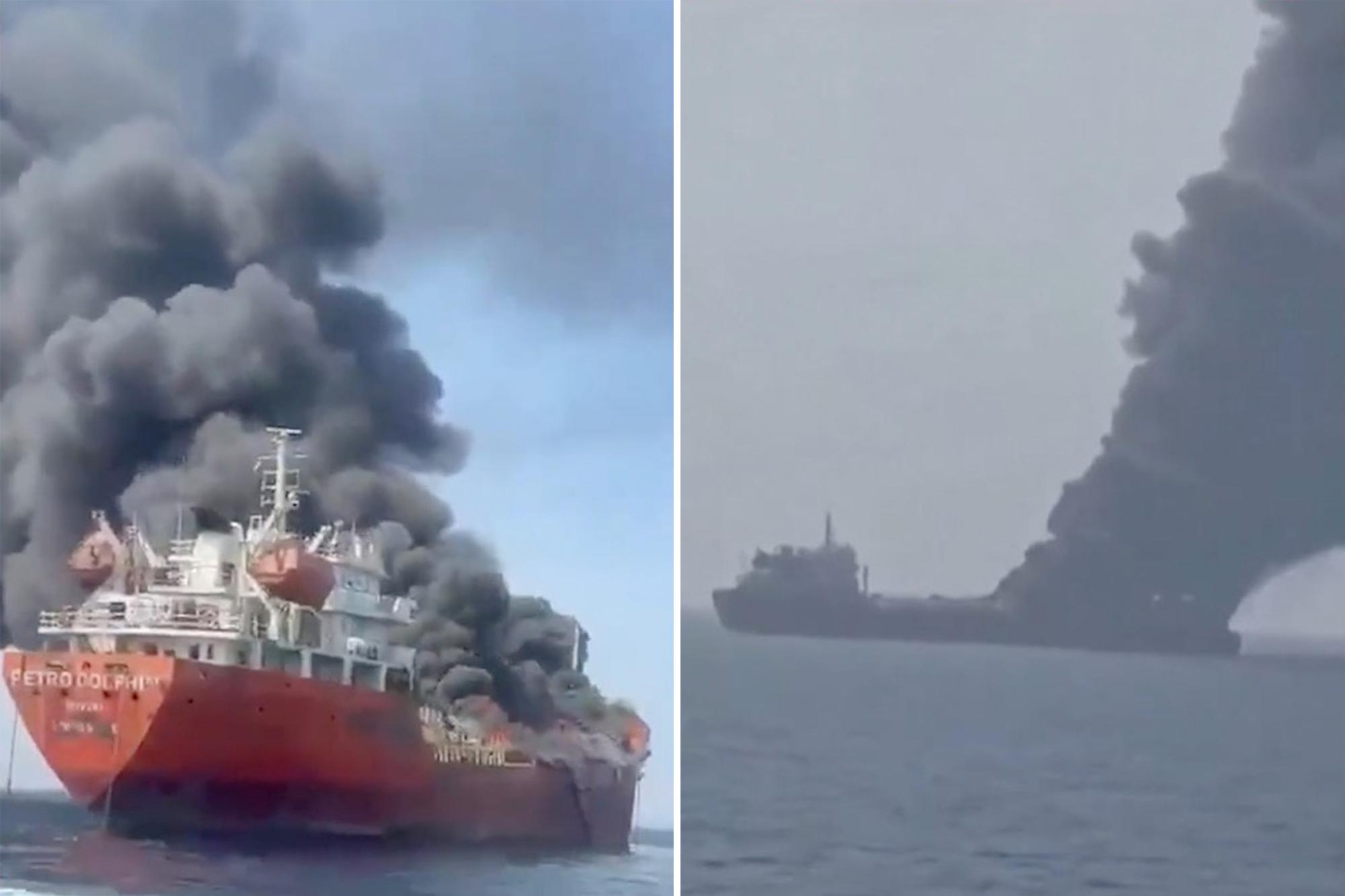
Make New York Post a Preferred Source Ships around the Strait of Hormuz are suffering their worst attacks of the war so far, with 24 ships struck in the past two weeks — causing oil exports to plummet to less than half the pre-war flow.
The updated data showed that at least six vessels were struck on Sunday alone, marking the heaviest fire on tanker and cargo ships near the vital shipping route since the war began on Feb. 28, according to the UK Maritime Trade Operations (UKMTO).
All the ships provided late reports asserting that they had been hit by an unknown projectile while attempting to exit the Strait of Hormuz, with Iranian media publishing videos of burning tankers in the water.
The frequency of the attacks come as Iran attempts to regain control over the strait after oil flow through the Persian Gulf began to hit pre-war volumes under US military escorts.
At least 18 ships were hit between Oct. 1 and Oct. 11, according to the UKMTO, with another six attacks recorded by other European security sources, the Financial Times reported.
Attacks can often be reported late as vessels are turning off their transponder data to sneak through the Strait of Hormuz undetected.
Iran’s Islamic Revolutionary Guard Corps has specifically warned that ships turning off their transponders will be targeted for supposed “illegal oil smuggling” along the strait.
The successful attacks also suggest that Iran is only getting better at targeting ships, with the strikes likely to get worse, the Washington-based Institute for the Study of War think tank warned.
“Iran may be developing its anti-ship missile capabilities to improve its ability to target vessels,” the ISW said in its latest analysis.
The strikes have caused oil flow out of the strait to drop significantly since reaching their highest level of the war last month at an average of 15.5 million barrels per day, according to maritime analyst Kpler.
Start your day with all you need to know Morning Report delivers the latest news, videos, photos and more.
September’s oil flow was nearly at pre-war levels, where between 17 to 20 million barrels of crude sailed through the strait every day.
But during Sunday’s strikes, only 2.9 million barrels of oil transited the strait, with the average seven-day average flow falling to 43% below pre-war levels, according to Kpler.
Oil prices have remained volatile under the renewed attacks, with the Brent crude benchmark hovering above $105 per barrel.
The average cost of gasoline in the US has remained above $4.31 per gallon over the past month, with diesel going for $6.27 per gallon on Tuesday, according to AAA.